French Wedding Photographer
lejolistudio

WEDDING BLOG

If Abbaye des Vaux de Cernay Were a Woman

If Abbaye des Vaux de Cernay Were a Woman

An Editorial Wedding Guide by Le Joli Studio

Planning a wedding at Abbaye des Vaux de Cernay?

This editorial guide explores one of France’s most iconic luxury wedding venues through the lens of Le Joli Studio, combining inspiration, French culture and timeless wedding photography.
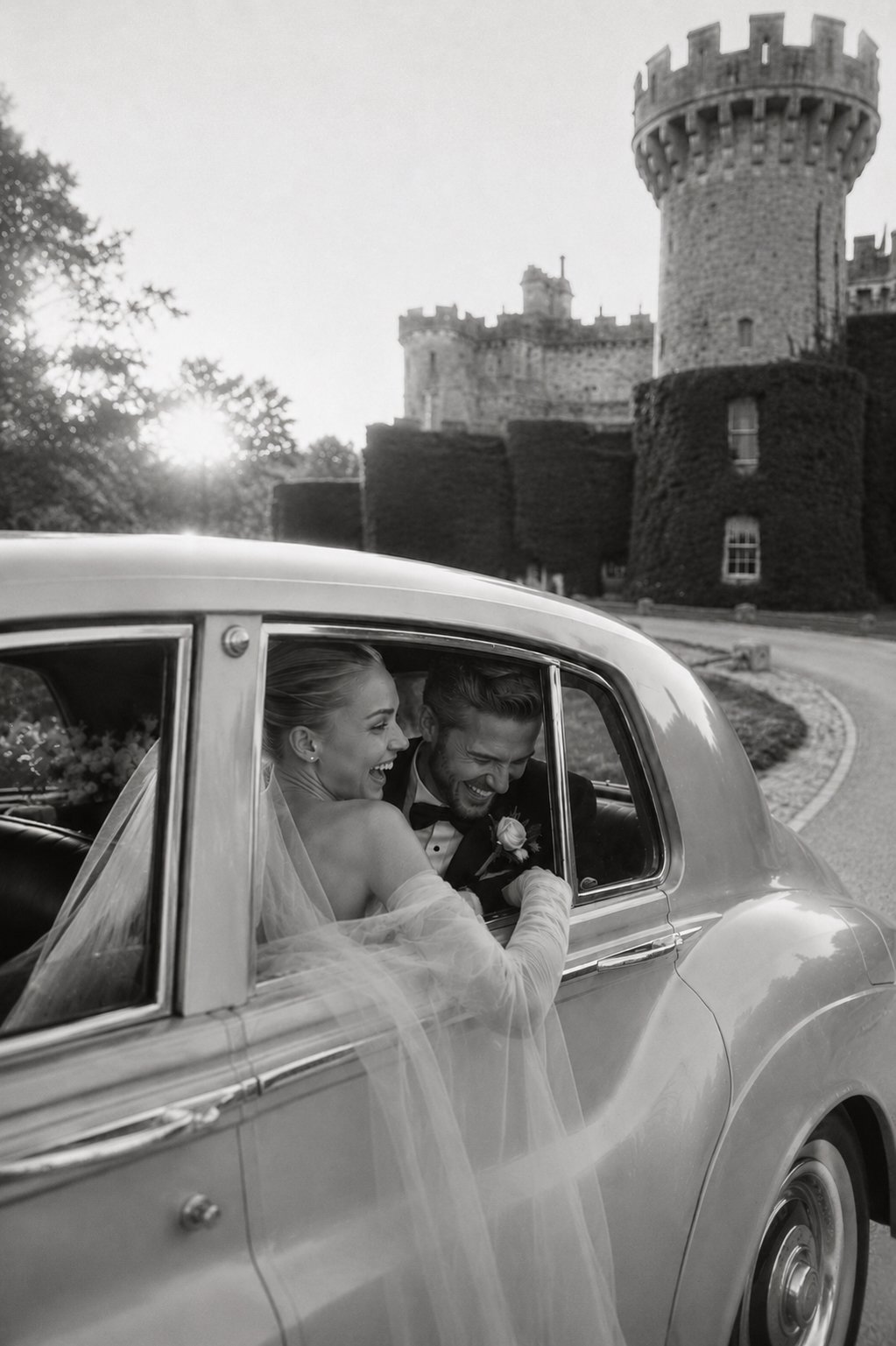
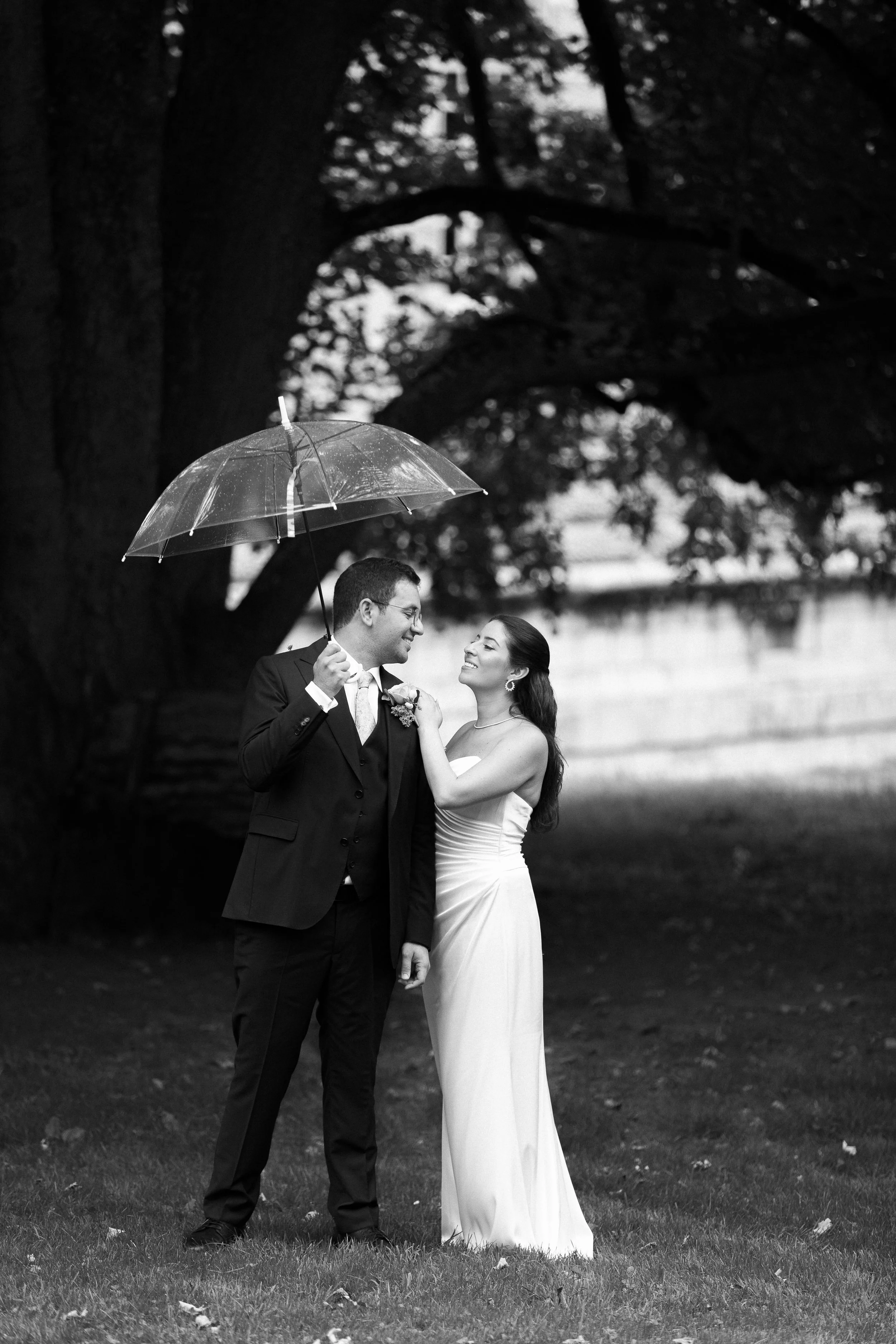
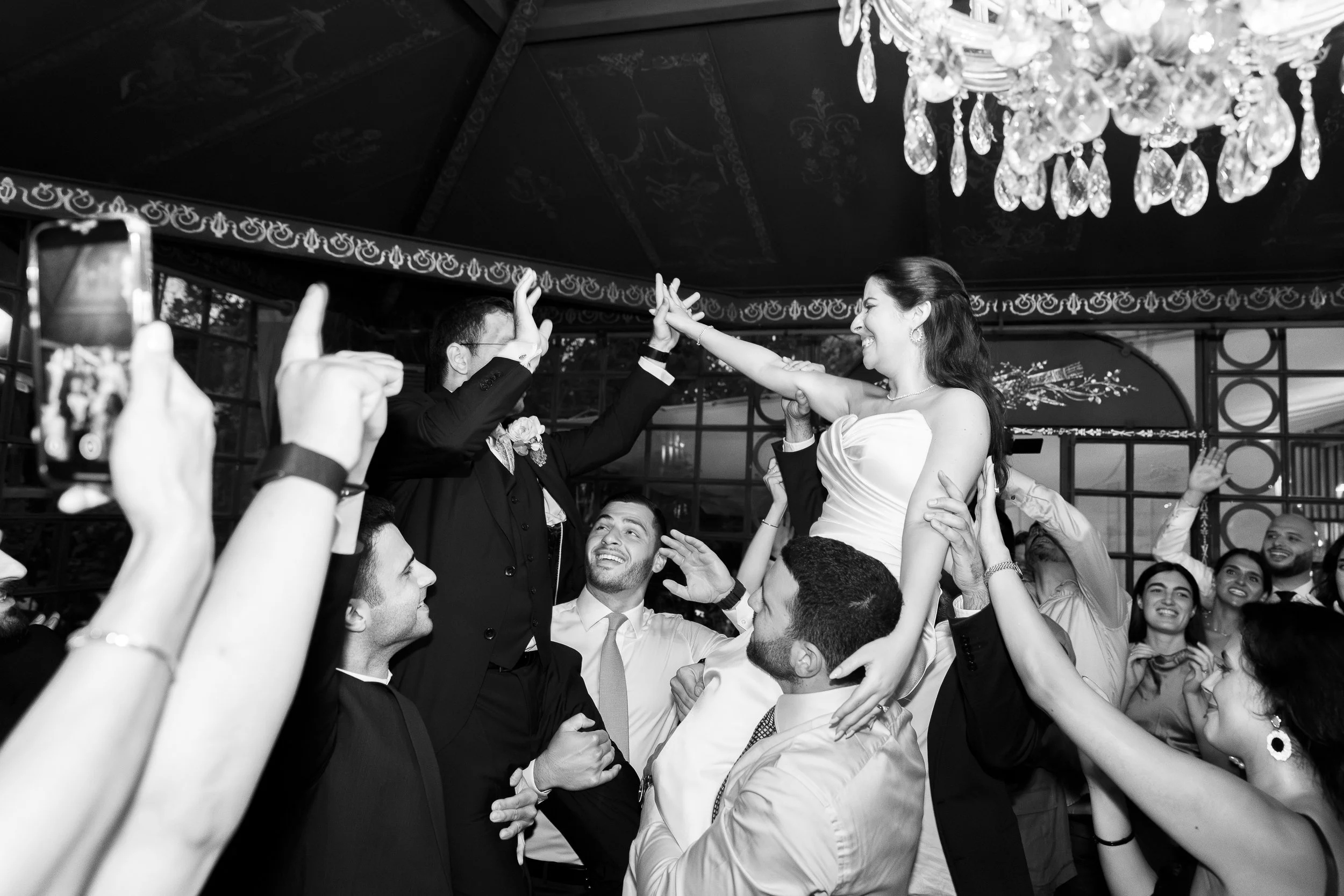
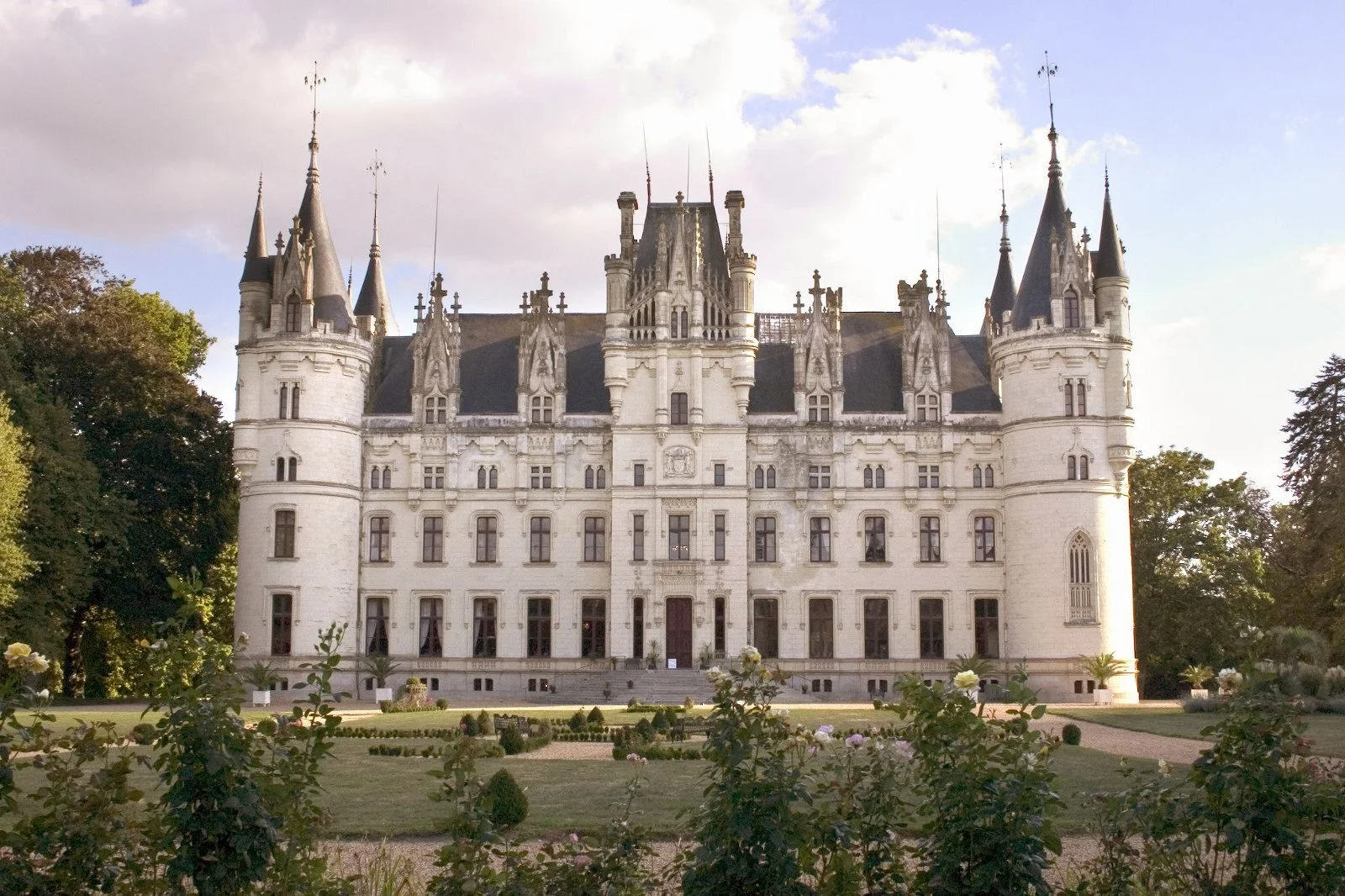
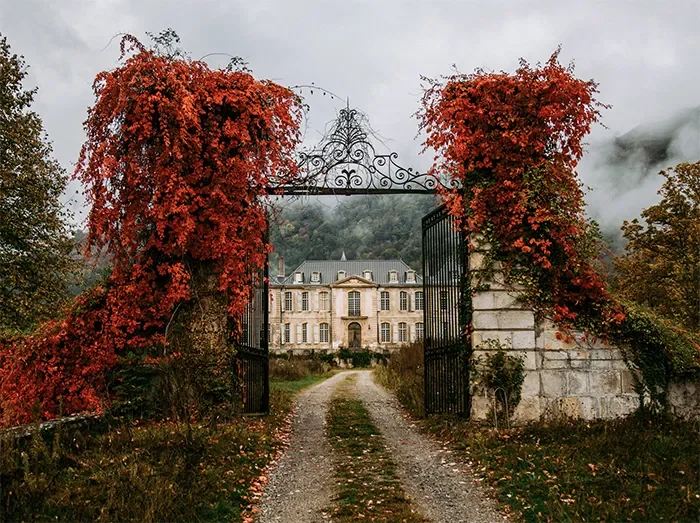
Bride and groom sharing a joyful moment inside a vintage wedding car in front of Abbaye des Vaux de Cernay, France. Elegant black and white editorial wedding photography.

If Abbaye des Vaux de Cernay were a woman, she would not be an ingénue. She would never describe herself as luxurious.

That would be terribly gauche.

She would not wear blush tulle, collect peonies or describe everything as dreamy.

She would have lived.

She would have read Colette before breakfast and Françoise Sagan too young. She would know that a ruined wall can be more seductive than a freshly gilded ballroom, and that the people who constantly announce their refinement rarely possess very much of it.

She might have the cheekbones of Tilda Swinton, the composure of Charlotte Rampling and something of Isabelle Huppert’s unnerving intelligence. Although naturally, she would be French.

Or at least French enough to consider punctuality negotiable, champagne medicinal and over-decoration a minor moral failing.

She would not attempt to charm everyone.

That is largely why everyone would want to be invited.
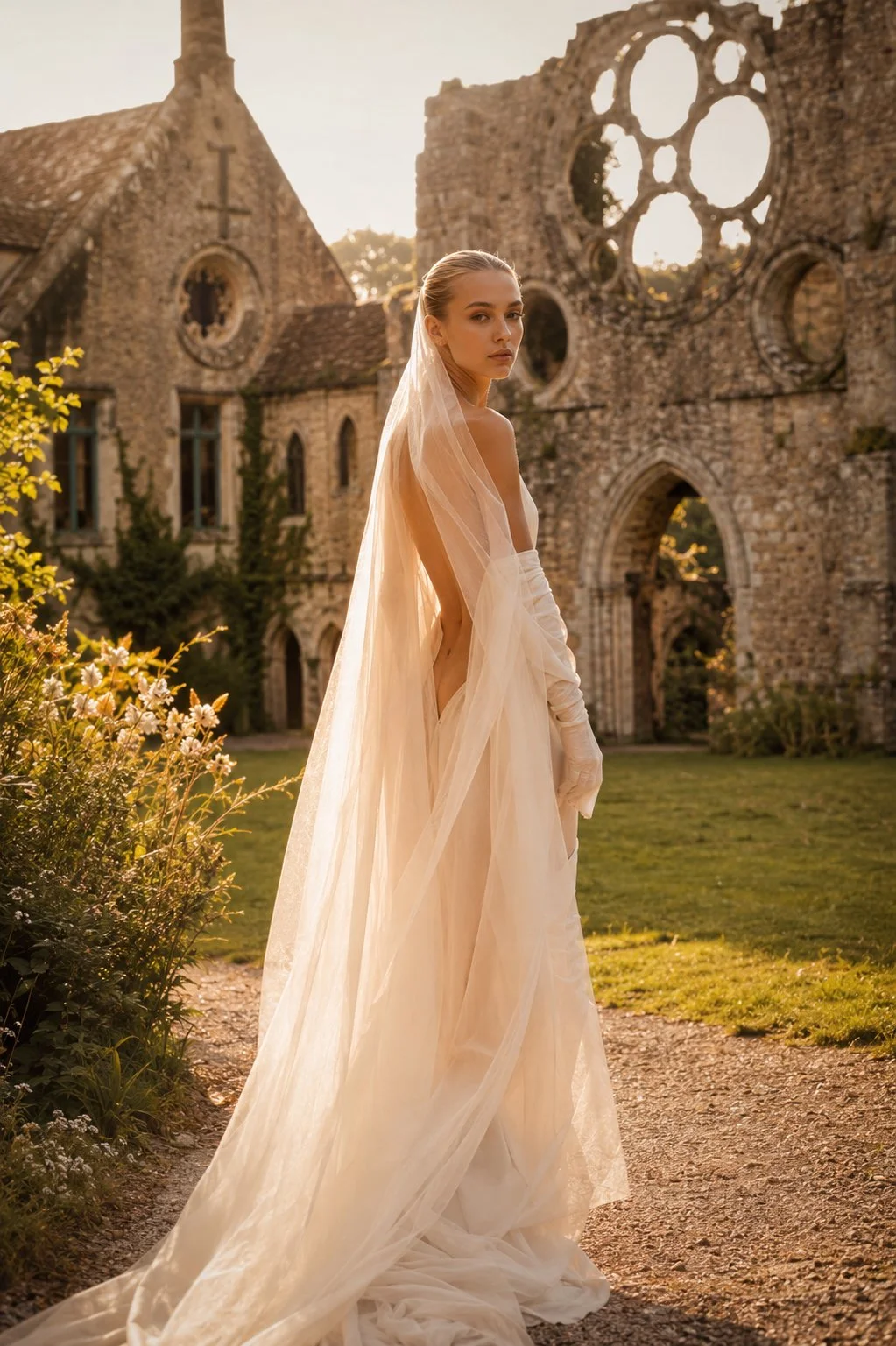
Editorial portrait of a bride wearing a minimalist couture wedding gown in the ruins of Abbaye des Vaux de Cernay during golden hour, France.

Golden hour wandering through the ruins of Abbaye des Vaux de Cernay.


She Would Have Very Little Interest in Trends

The Abbey was founded in the twelfth century, which gives it a useful perspective on seasonal colour palettes.

It has survived religious upheaval, neglect, reconstruction, changing dynasties and several centuries of questionable furniture. It is therefore unlikely to be troubled by whether butter yellow is having a moment.

This is one of its considerable advantages as a wedding venue.

Many beautiful places are dependent on decoration. Remove the flowers, candles and carefully positioned furniture, and there is surprisingly little left to discuss.

At Vaux de Cernay, decoration enters a conversation already in progress.

The Gothic ruins, the cloister, the dark timber, the lake, the forest and the weathered stone possess their own authority. A floral designer can respond to them. A couturier can flirt with them. Neither should attempt to overpower them.

The Abbey has waited eight centuries. It will not be upstaged by a centrepiece.

She Would Dress Extremely Well, but Never Explain the Outfit

There is something distinctly French about clothes that do not disclose how hard they worked.

A bias-cut silk dress.

A severe black jacket.

An old family jewel worn with an almost indecent lack of ceremony.

The Abbey operates in much the same manner.

Its grandeur is not polished into submission. Its textures remain visible. Stone, tapestry, carved wood and old brick are allowed their age. Nothing has been made so immaculate that it loses its character.

This is where the right wedding wardrobe becomes interesting.

Not a costume designed to compete with the architecture, but couture with movement and personality: an Elie Saab gown catching against an ancient doorway, a sculptural Lanvin silhouette in a room that has seen far stranger fashions, a dinner dress that might have pleased Loulou de la Falaise.

The ideal bride here does not look as though she has been arranged to match the property.

She looks as though both she and the Abbey have excellent taste and have agreed, discreetly, to spend the weekend together.
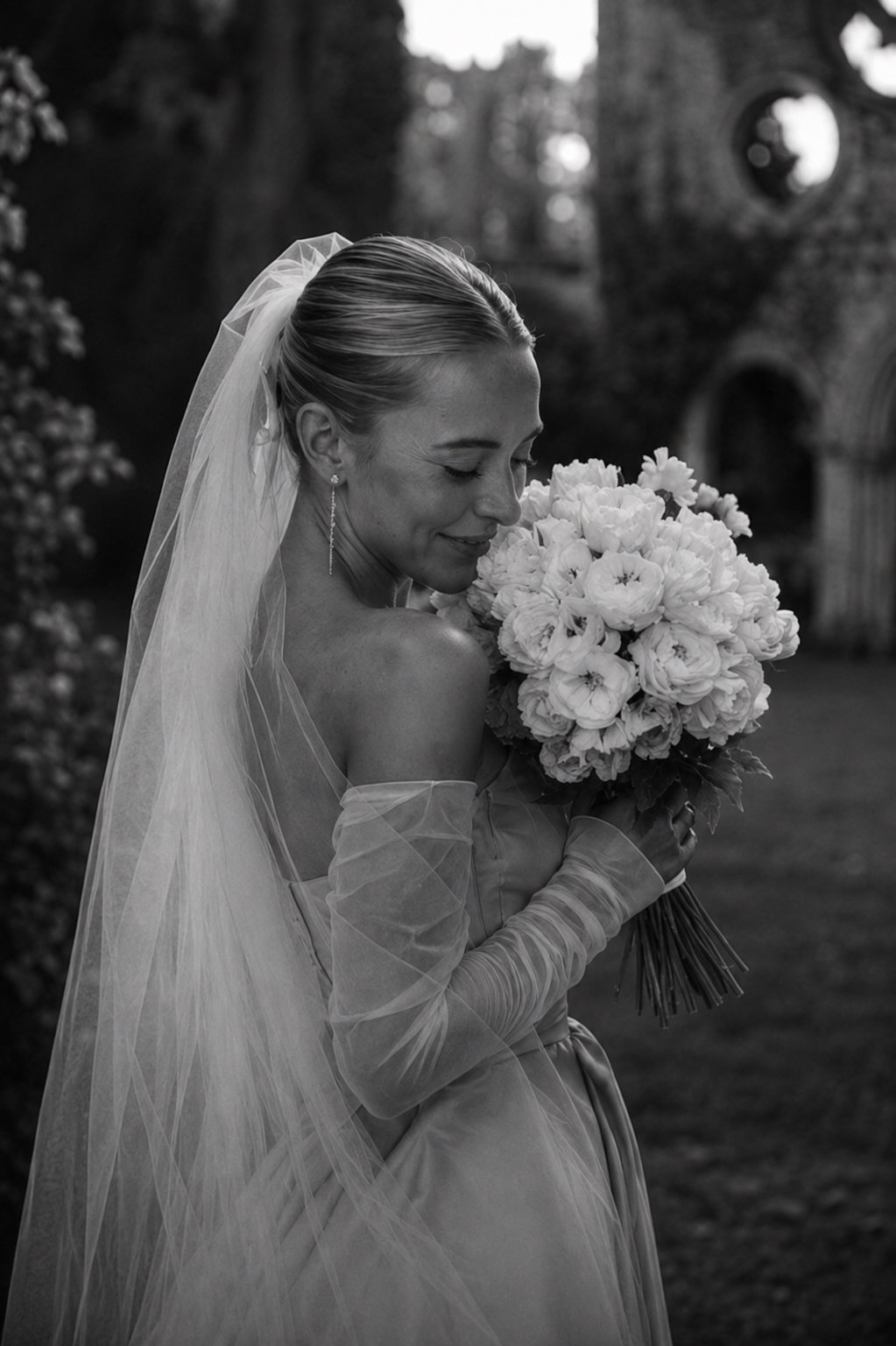
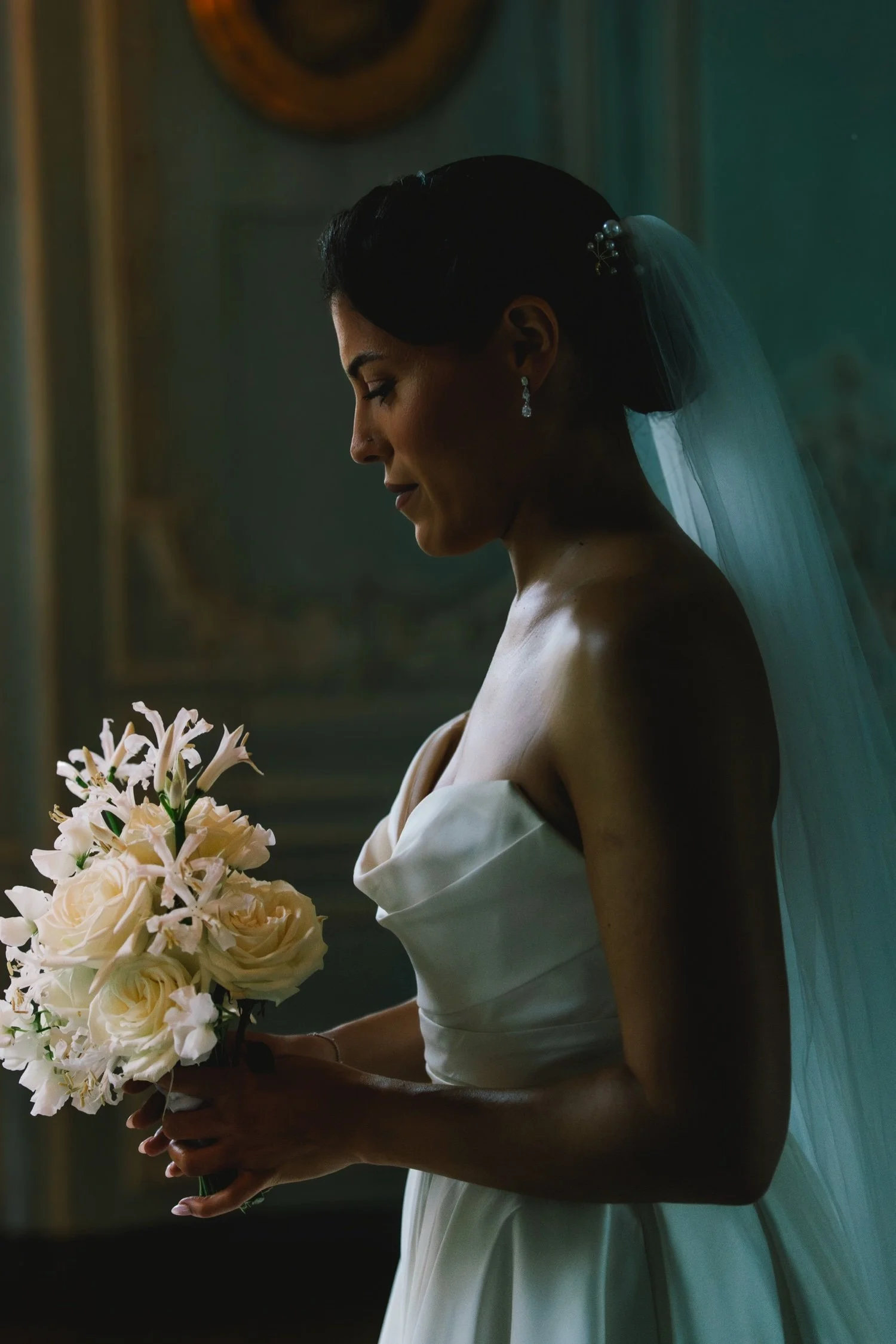
Editorial bridal portrait in black and white of a bride holding her bouquet in the ruins of Abbaye des Vaux de Cernay, France.

A quiet moment before the celebration, captured among the historic ruins of Abbaye des Vaux de Cernay.

She Would Prefer Rohmer to a Romantic Comedy

There would be no need for violins every time somebody crossed the courtyard.

The location already understands drama.

A veil moving through a cloister. A bride disappearing briefly behind a stone column. Guests walking back from dinner beneath umbrellas. A groom trying to remember his speech while everyone he loves watches him fail quite beautifully.

These are not grand gestures.

They are better.

Éric Rohmer understood that desire often exists in pauses, detours and conversations that seem to be about something else. Jacques Demy knew that colour could carry emotion without becoming decorative. Agnès Varda noticed the eccentric detail everyone else had overlooked. Alain Resnais understood that architecture can behave almost like memory itself.

A wedding at the Abbey deserves this sort of visual attention.

Not imitation cinema. Not a heavy-handed reconstruction of Last Year at Marienbad. Simply photographs that allow rooms, weather, gestures and people to have more than one meaning.

Because a cinematic image is not merely an image with grain.

It is an image that leaves something unresolved.
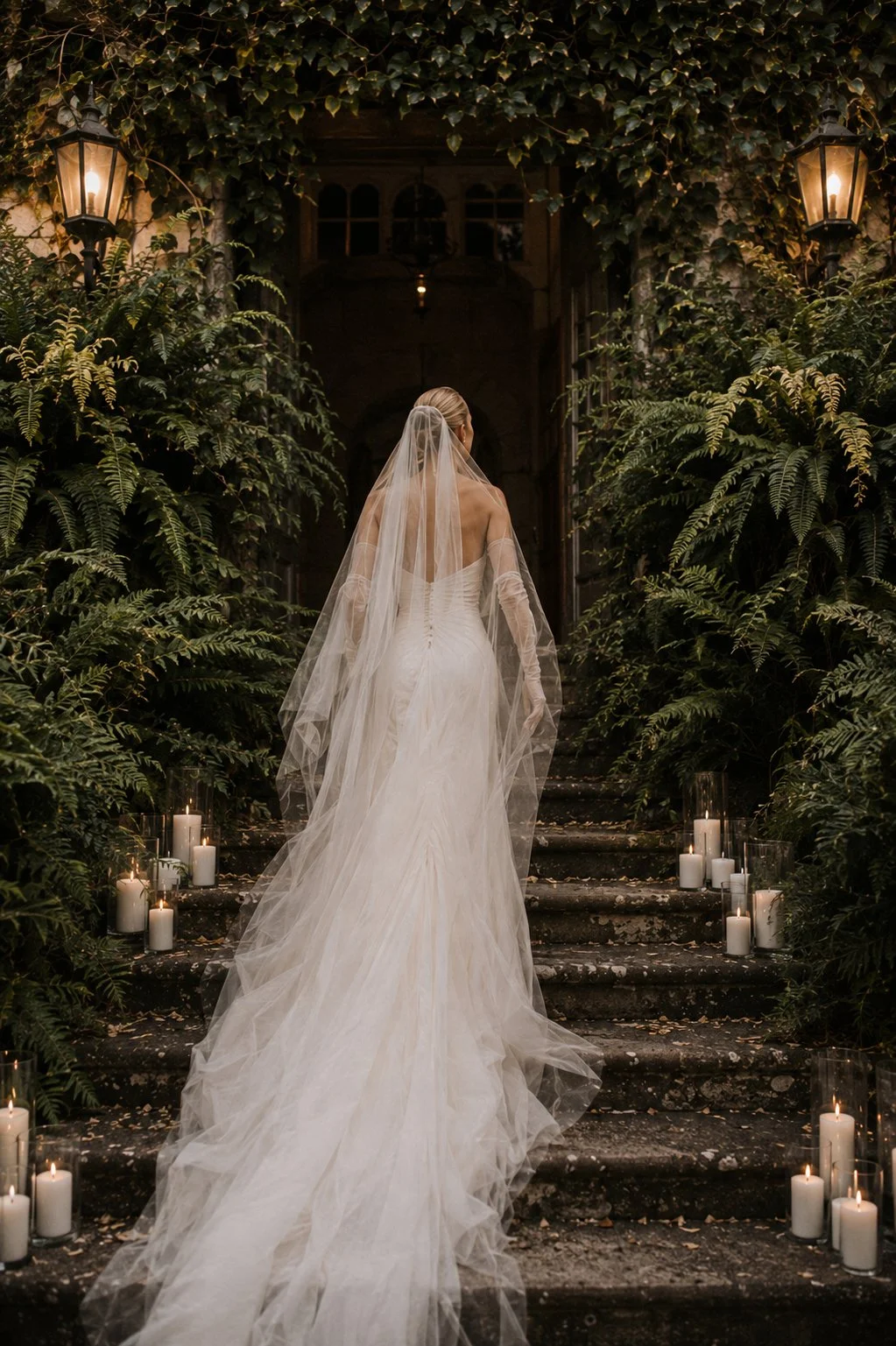
Bride walking up the candlelit entrance of Abbaye des Vaux de Cernay wearing a couture wedding gown and cathedral veil.

Her Idea of Glamour Would Not Involve Behaving Properly

French glamour has never been especially obedient.

It belongs as much to Jeanne Moreau laughing with her mouth open as it does to Catherine Deneuve remaining perfectly still. It can be a smudged eye at midnight, a heel abandoned beneath the table, or a bride eating something before the caterer has formally declared it available.

The Abbey needs this life.

Without it, the photographs become an architectural brochure with unusually expensive clothing.

A genuinely glamorous wedding is not one in which everybody remains pristine. It is one in which elegance survives human behaviour.

Champagne spills.

Silk creases.

Children invade the aisle.

A grandmother monopolises a handsome waiter.

Someone dances before dinner.

The bride’s hair looks better at 1 a.m. than it did at 1 p.m., although the hairstylist may disagree.

This is where photography becomes more than visual evidence of a beautiful production. It catches the private comedy inside the splendour.

And that comedy is often where affection lives.
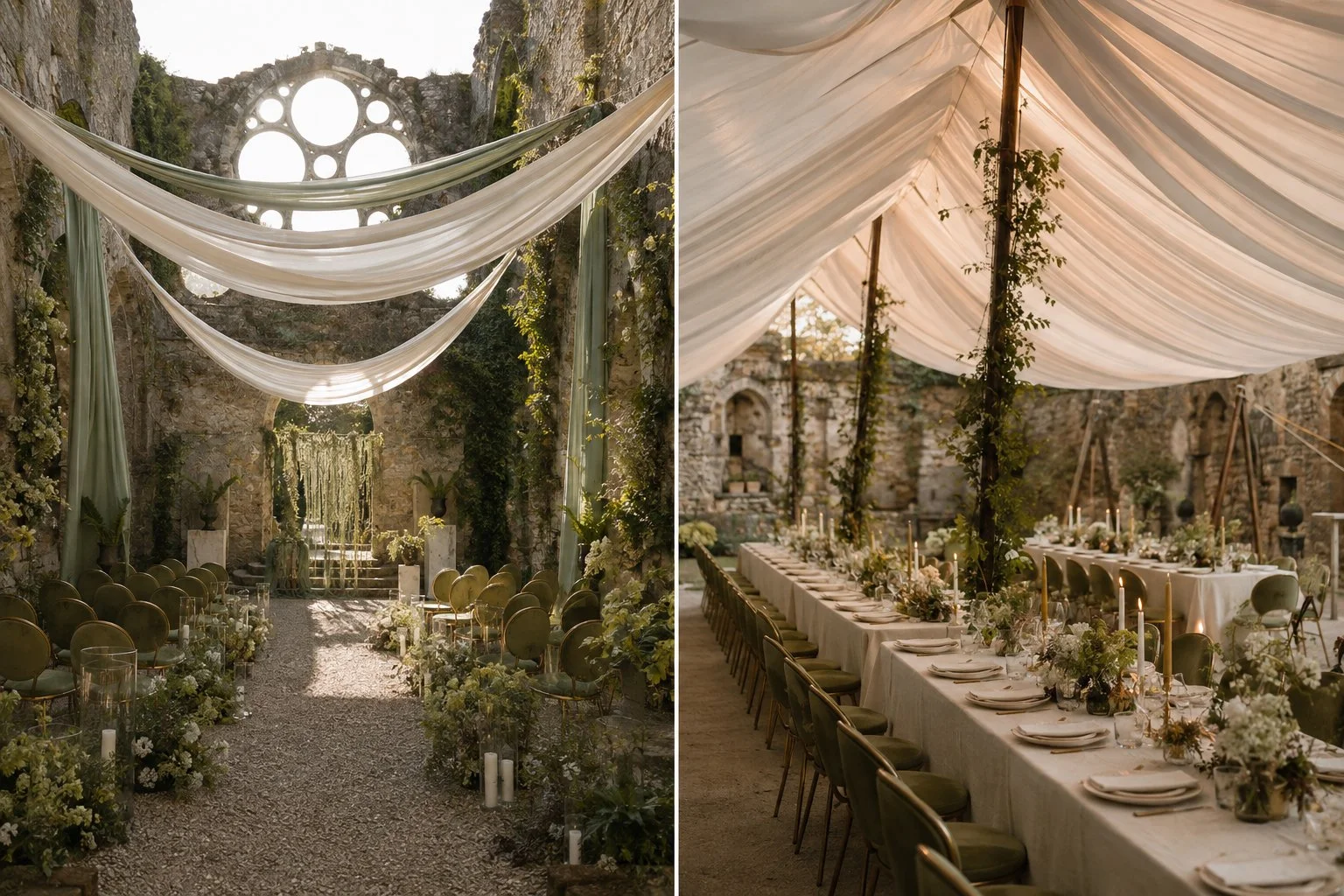
Elegant wedding ceremony and reception design at Abbaye des Vaux de Cernay featuring flowing drapery, candlelight and refined floral arrangements.

Luxury Wedding Reception at Abbaye des Vaux de Cernay

She Would Be Suspicious of Anything Described as “Instagrammable”

The word suggests a place has been created to be consumed from one approved angle.

The Abbey has too many moods for that.

In the morning, its interiors can feel almost monastic. By afternoon, the gardens become sociable and expansive. In poor weather, the stone darkens and the whole estate acquires the magnificent gloom of a nineteenth-century novel in which somebody has made a disastrous but beautifully dressed decision.

Then evening arrives. The scale changes. Rooms become intimate. Candlelight picks out faces rather than architecture. Guests stop admiring the venue and begin inhabiting it.

That progression matters enormously to a photographer.

The strongest visual story will not consist of ten variations of the same flattering view. It will move from restraint to abundance, solitude to sociability, ceremony to mild disorder.

A place this complex should never look identical from noon until midnight. Neither should a marriage.

She Would Know Paris, but Be Relieved Not to Live There

Vaux de Cernay lies within reach of Paris, yet the psychological distance is rather greater than the mileage suggests.

That is part of its seduction for international couples.

Guests can arrive through Paris, spend a few days behaving impeccably at Hôtel Costes or very badly elsewhere, and then leave the city for the forest and the Abbey. The journey creates a transition without demanding the logistical commitment of Provence or the Riviera.

The setting feels removed, but not inaccessible.

French, but not postcard French. Historic, but not ceremonial in the Versailles sense.

This is not France performing for visitors with lavender, striped shirts and a strategically parked Citroën.

It is France on better behaviour. Mostly.

She Would Be an Excellent Hostess and a Merciless Editor

The finest weddings at Vaux de Cernay will not attempt to use every possibility simply because it exists.

Every ruin does not need flowers.

Every corridor does not need candles.

Every course does not need a performance.

Restraint here is not minimalism. It is editing.

A ceremony beneath ancient stone.

An aperitif beside the water.

Dinner shaped by fabric, fruit, candlelight and confident florals rather than a forest of decorative ambition.

Music that changes the energy of the room instead of merely filling silence.

A weekend with rhythm, surprise and enough empty space for people to become themselves.

A very good wedding planner understands this. So does a very good couturier. So, ideally, does the photographer.

The question is never: What else can we add?

It is: What would be unforgivable to remove?
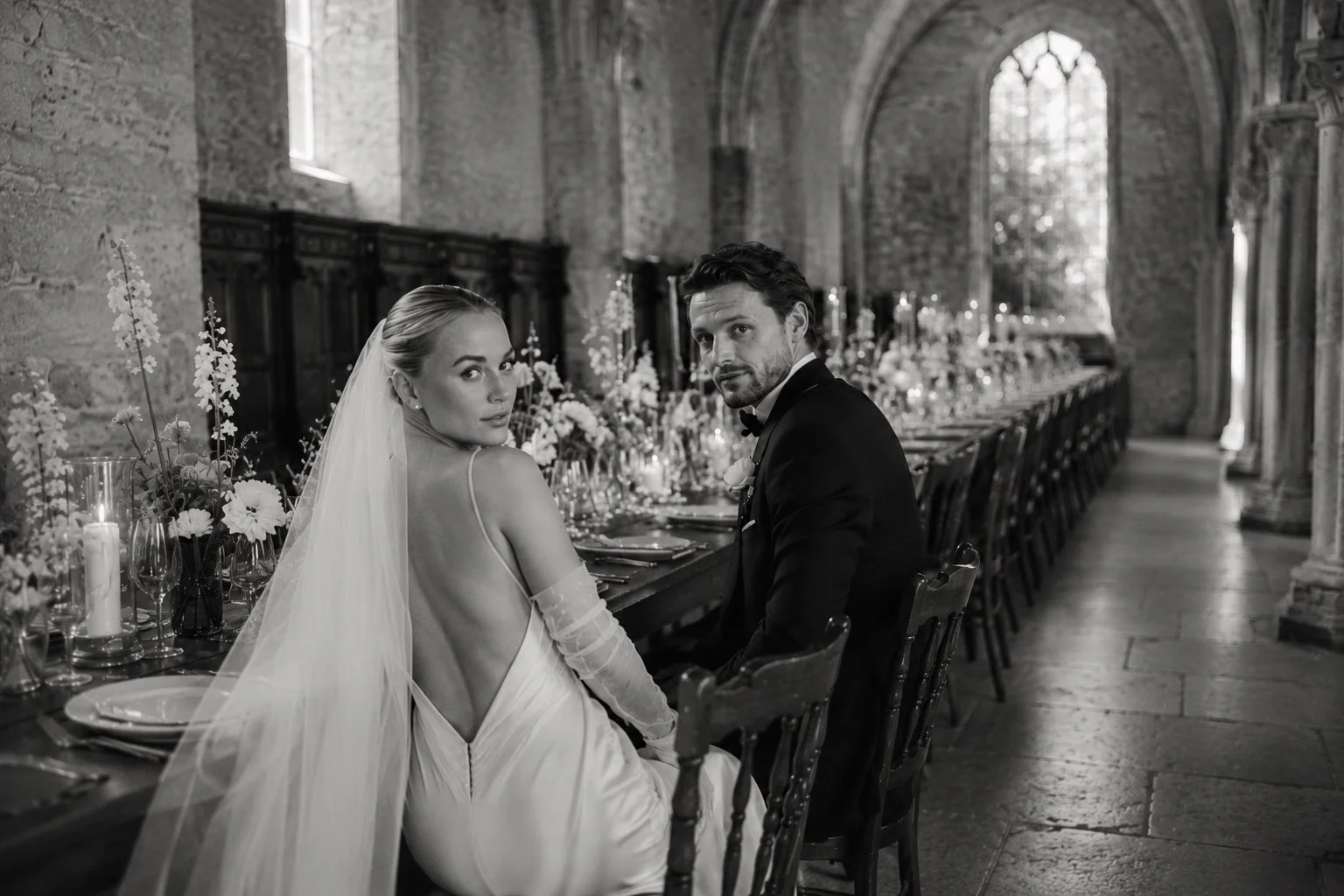
Bride and groom seated at an elegant candlelit reception table inside Abbaye des Vaux de Cernay, both looking toward the camera in a refined editorial wedding setting.

She Would Never Pose. She Would Occupy the Space.

Most brides arrive believing they need to perform happiness.

To smile at the correct moments.

To stand beautifully.

To remember their profile.

She would find all of this exhausting.

She would not pose for the Abbey.

She would inhabit it.

She would wander into a forgotten corridor simply because the light looked interesting.

She would stop halfway up a staircase because somebody had just made her laugh.

She would disappear for three minutes simply to breathe.

She would hold her husband’s hand without wondering where the photographer was standing.

She would forget the camera.

Which is precisely when the photographs become interesting.

For me, directing a wedding has never meant choreographing every gesture.

It means creating enough trust that people eventually stop performing altogether.

That is when elegance stops looking manufactured. And starts looking inevitable.

She Would Understand That Beauty Is Never Rushed

The most beautiful photographs rarely happen while everybody is looking at the camera.

They happen between places.

A dress lifted to cross wet grass.

The silence after the ceremony.

The five minutes nobody planned.

The walk back to dinner.

The moment before somebody speaks.

Luxury has time.

That is why the finest weddings never feel hurried.

Neither should the photography.

She Would Know That Couture Is Meant To Move

A couture gown was never designed to stand perfectly still.

It breathes. It twists. It catches the wind. It folds unexpectedly when somebody laughs. It brushes against centuries-old stone.

By midnight, it carries memories as well as craftsmanship.

The photographer’s task is not to preserve perfection. It is to witness transformation.

She Would Welcome Bad Weather

Imagine this. Rain arrives ten minutes before dinner.

Somebody panics. She doesn’t.

The stone becomes darker. The gardens grow quieter. Candles suddenly matter more. Guests move closer together. Conversation slows.

The photographs become impossible to repeat. Some weddings are remembered because everything unfolded exactly as planned.

Others because life interrupted the plan.The second kind usually ages better.
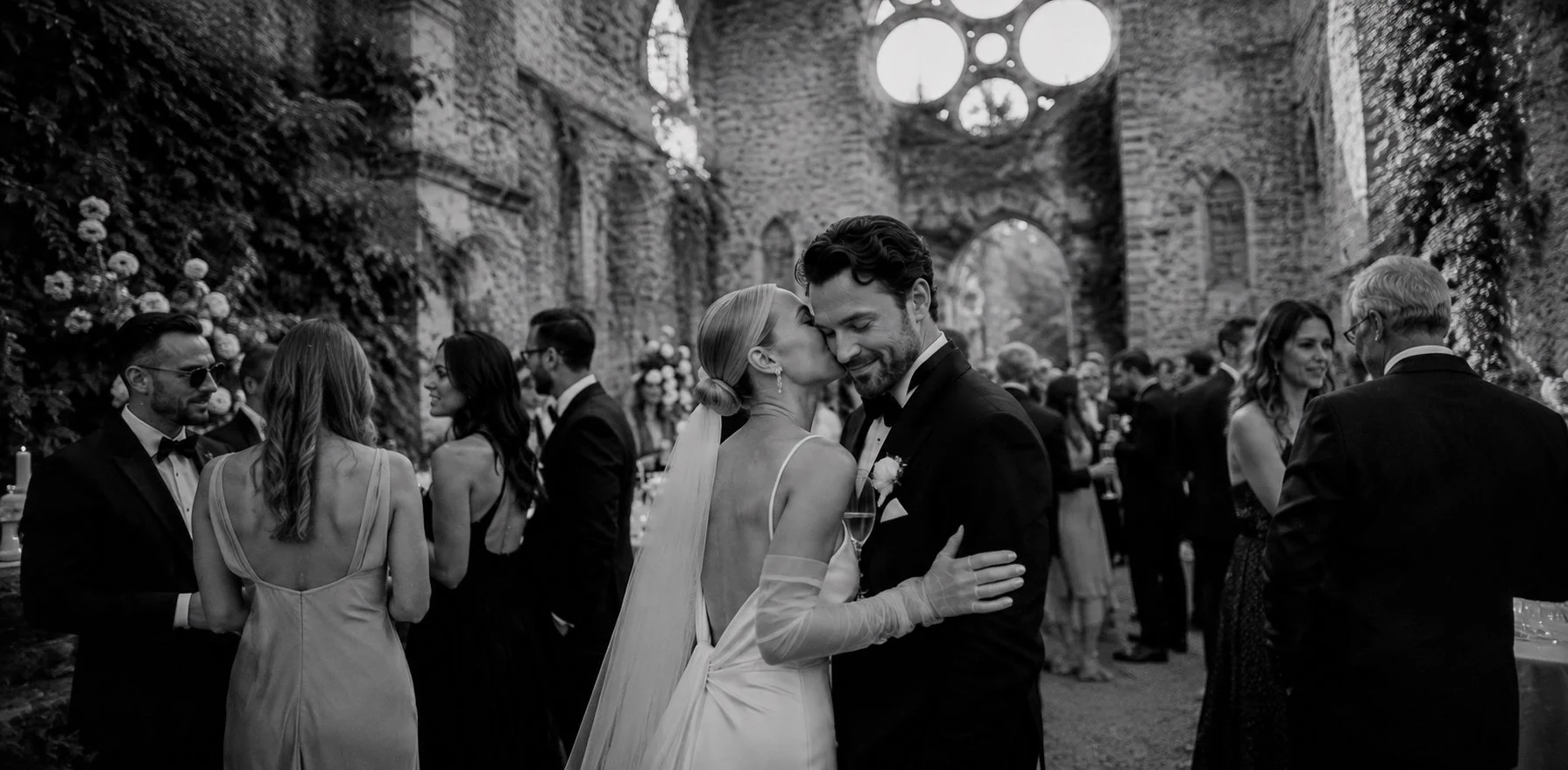
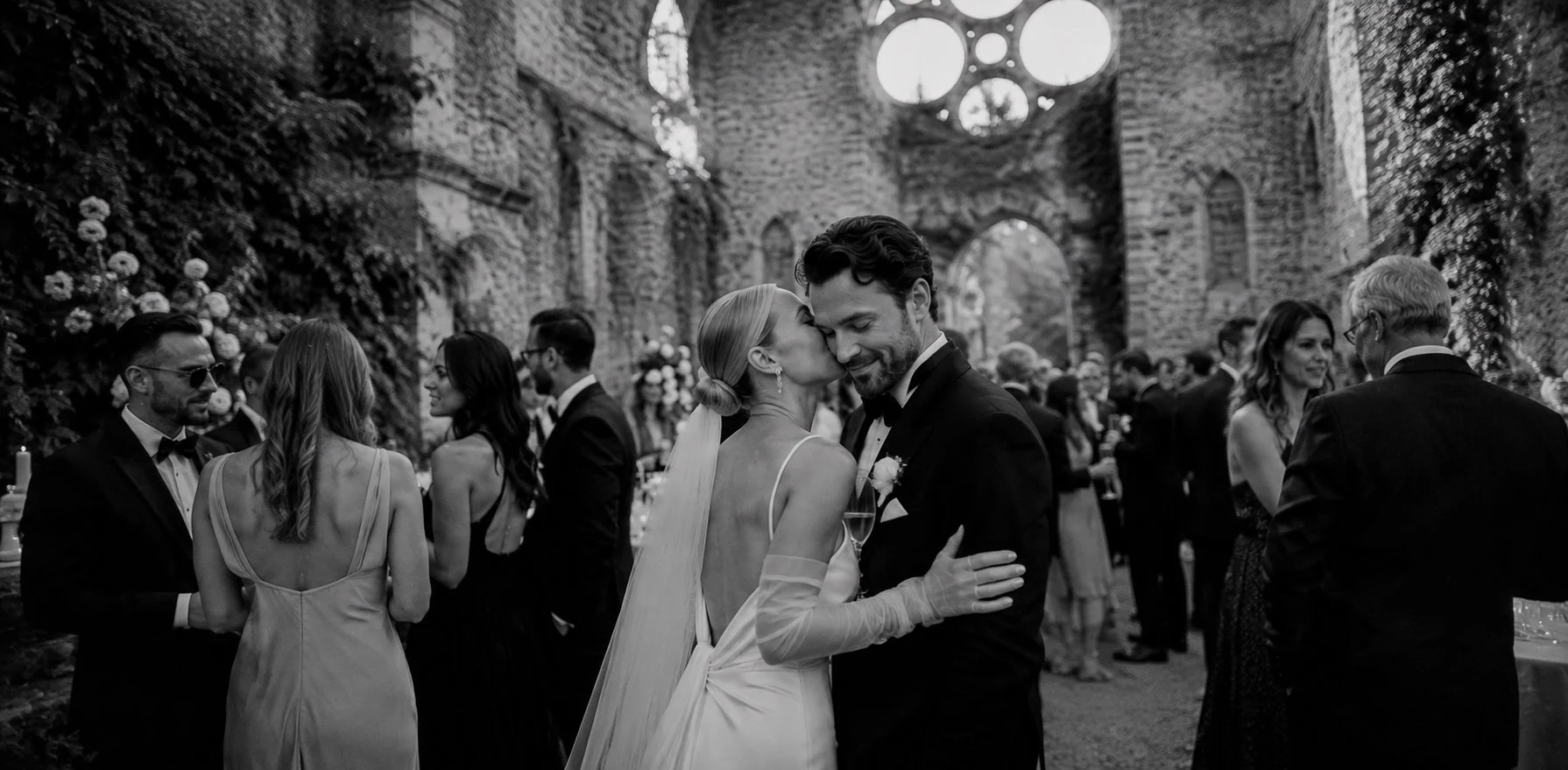
Bride and groom sharing a quiet moment during the cocktail reception at Abbaye des Vaux de Cernay, surrounded by guests beneath the historic abbey ruins.

Even surrounded by loved ones, some moments belong only to the two of them.

She Would Marry a Man With Opinions

Not because agreement is romantic. Because curiosity is.

He would choose his suit as carefully as she chose her gown. He would care about architecture. About books. About music.

He would notice beautiful hotels. He would know the difference between style and fashion. He would laugh easily.

He would never mistake extravagance for elegance.

The most memorable photographs are rarely made by two perfect models.

They are made by two interesting people.

The Photographer Should Eventually Disappear

A photographer who shouts directions every thirty seconds quickly becomes another decoration.

An expensive one.

I believe in guidance.

But only until people forget they are being guided.

The finest photographs usually happen just after everyone believes the photograph is over.

When shoulders relax.

When conversations resume.

When somebody reaches instinctively for somebody else’s hand.

When elegance becomes unconscious again.

A Final Introduction

If Abbaye des Vaux de Cernay were a woman, she would not follow you on Instagram.

She would probably forget where she left her telephone.

She would own exceptionally good coats.

She would dislike unnecessary adjectives.

She would have friends in several countries who remained slightly intimidated by disappointing her.

She would never call herself iconic.

She would leave that to less interesting women.

And if she were choosing a photographer, she would not ask who could make her look beautiful.

She would ask who could make the weekend feel unforgettable.

I suspect we would get along rather well.
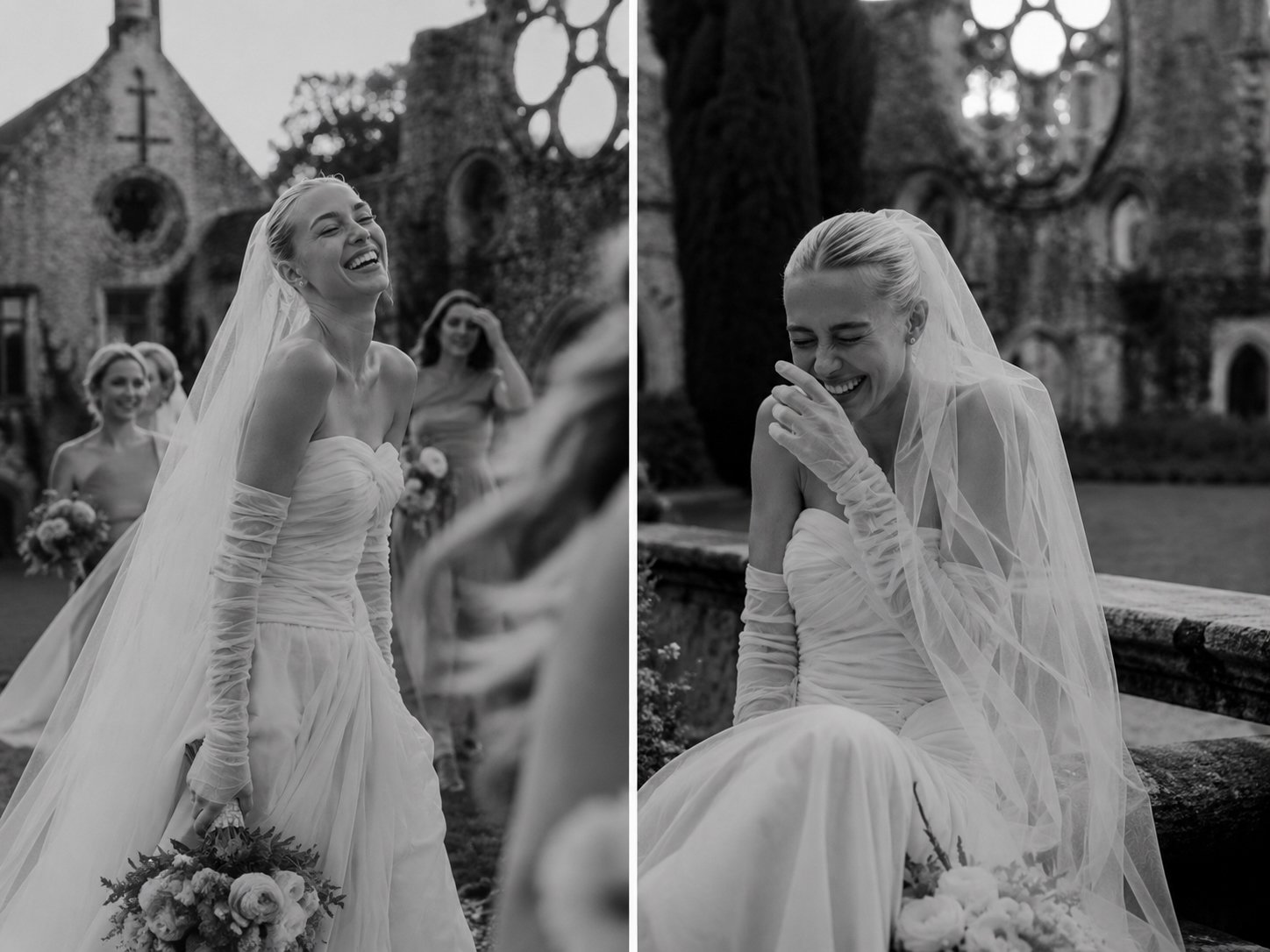
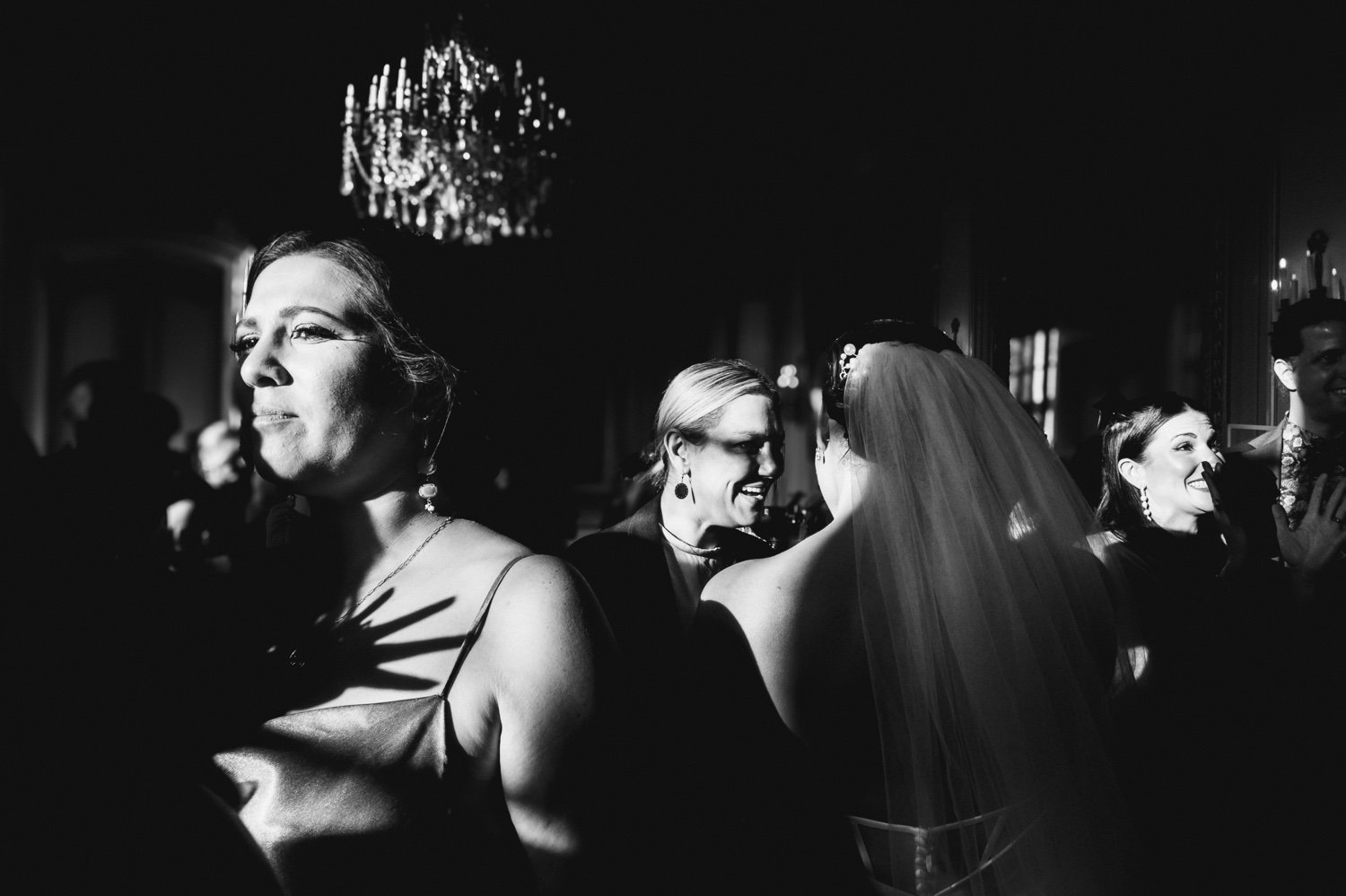
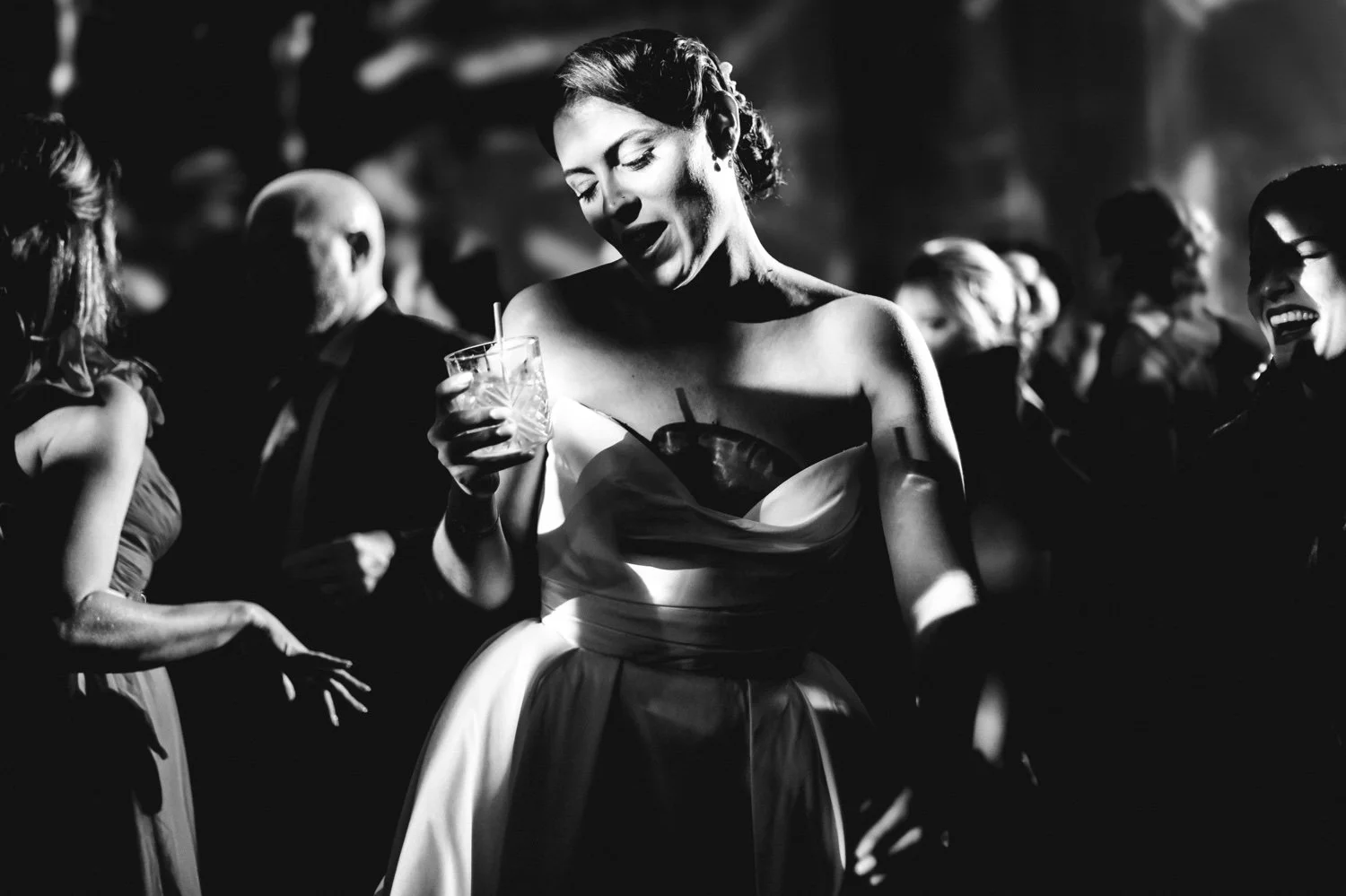
Black and white editorial wedding photograph of a joyful bride laughing with her bridesmaids at Abbaye des Vaux de Cernay, France.

Frequently Asked Questions

Planning Your Wedding at Abbaye des Vaux de Cernay?

If this way of seeing weddings resonates with you, I’d love to hear your plans.

Whether you’re celebrating an intimate weekend or a three-day destination wedding, every story begins with a conversation.
How Much Does a Wedding Photographer Cost in France?

How Much Does a Wedding Photographer Cost in France? A Luxury Wedding Photography Guide

Understanding the Investment Behind Luxury Wedding Photography

If you’re planning a wedding in France, you’ve probably noticed that wedding photography prices vary enormously. Whether you’re organising an intimate celebration in Provence, a château wedding in the Loire Valley or a multi-day destination wedding on the French Riviera, understanding what shapes those prices is far more useful than simply comparing numbers.

“How much does a wedding photographer cost in France?”

It’s usually one of the first questions couples ask. Sometimes even before saying hello. Which is understandable.

Planning a wedding is a little like renovating a beautiful old house.

Every supplier politely explains that this is the one thing you absolutely shouldn’t compromise on.

Flowers.

Music.

Lighting.

Stationery.

Wine.

Cake.

Hair.

Candles.

Napkins, apparently.

At some point, you begin to suspect that the napkins might actually be running the entire wedding.

Choosing the right wedding photographer in France rarely escapes this conversation.

How much?

How many hours?

How many photographs?

Do you offer a drone?

Do we get the RAW files?

The questions are sensible.

They’re simply not the most interesting ones.

Because wedding photography is one of the very few investments you’ll still be living with long after the champagne has been drunk, the flowers have wilted and the dance floor has been dismantled by people you’ve never met.

Whether you’re planning a destination wedding in France or a celebration closer to home, the real question isn’t:

“How much does it cost?”

It’s:

“What exactly am I investing in?”

Those are two entirely different conversations.

One is about numbers.

The other is about value.

And luxury, despite what Instagram occasionally suggests, has never really been about numbers.

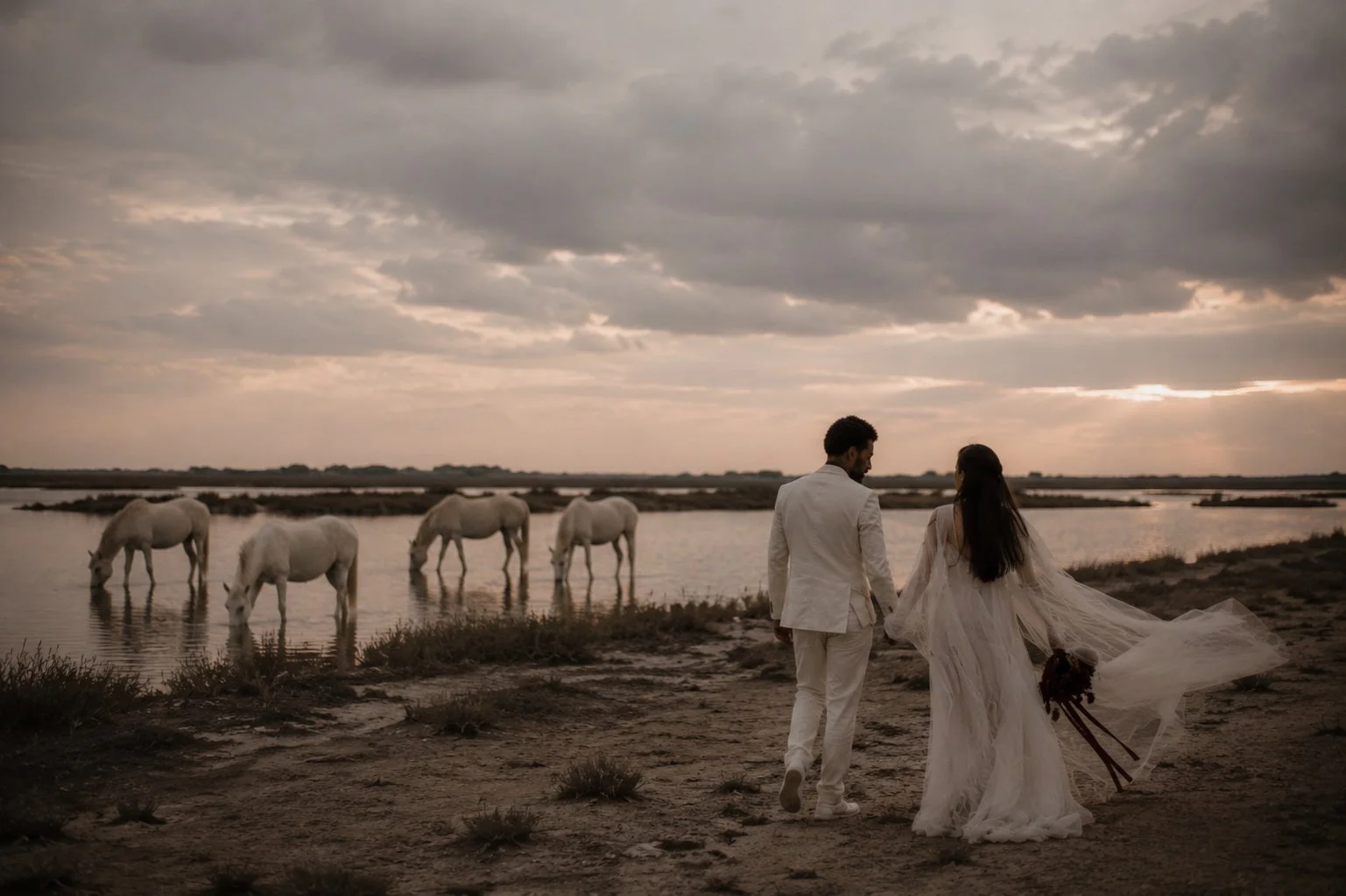
Bride and groom walking through the Camargue at sunset beside white horses during a luxury destination wedding in France.

Luxury destination wedding in the Camargue, France.

A realistic overview of today’s French market

While every wedding photographer structures their collections a little differently, the French market broadly looks something like this. These aren’t official rates, of course. France has no Ministry of Wedding Photography quietly regulating the market.

€1,500–3,000: Emerging photographers, newer businesses, or smaller local celebrations.

€3,000–5,000: Established professionals with consistent experience, full-day coverage and a strong body of work.

€5,000–8,000: Experienced photographers with a distinctive artistic signature, a highly personalised approach and an established reputation.

€8,000–10,000+: Luxury wedding photographers working across France and internationally, often specialising in destination weddings, multi-day celebrations and a bespoke client experience.

Of course, there are exceptions.

There always are.

Photography has a stubborn habit of refusing to fit neatly into spreadsheets.

Fortunately.

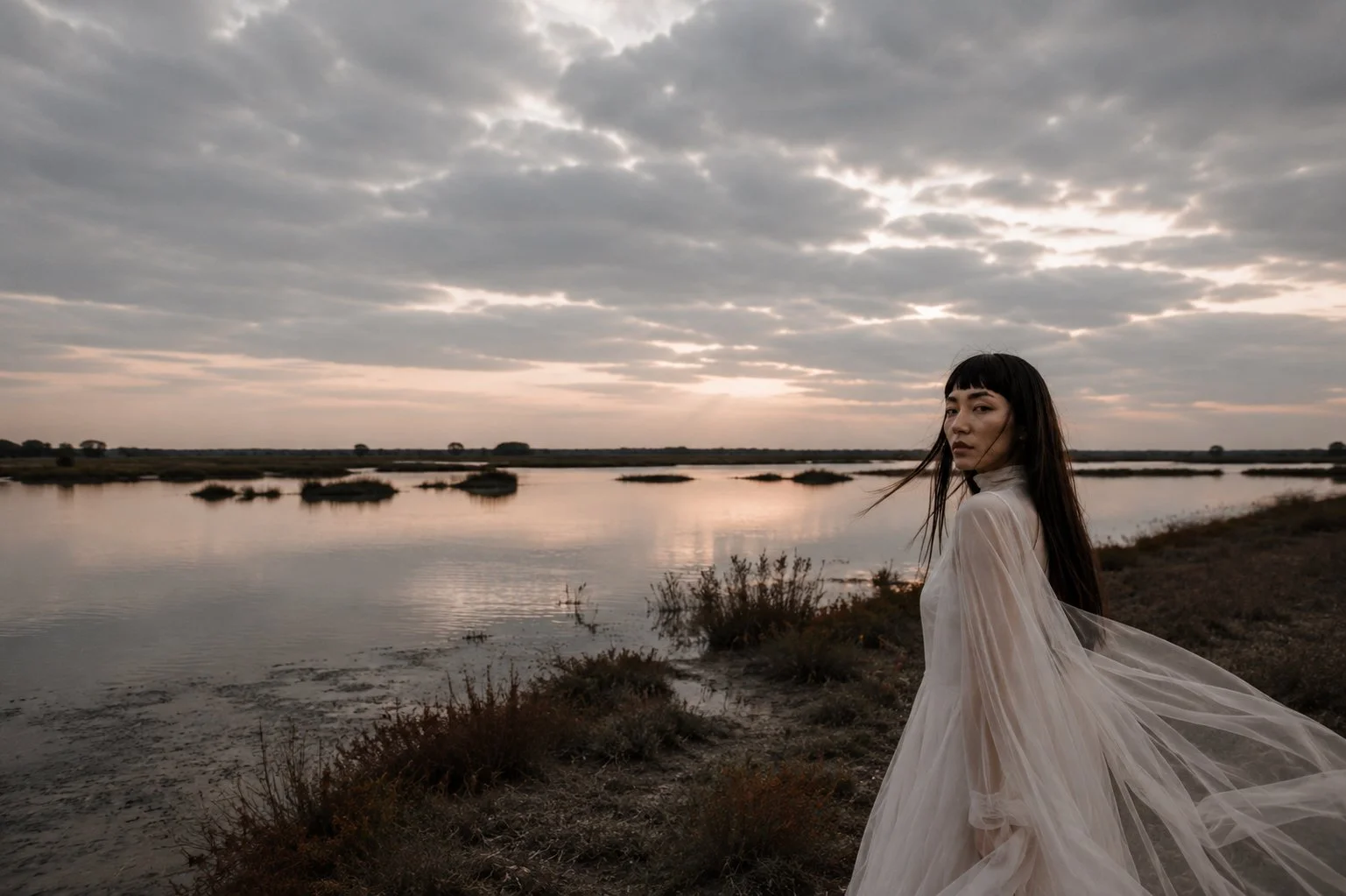
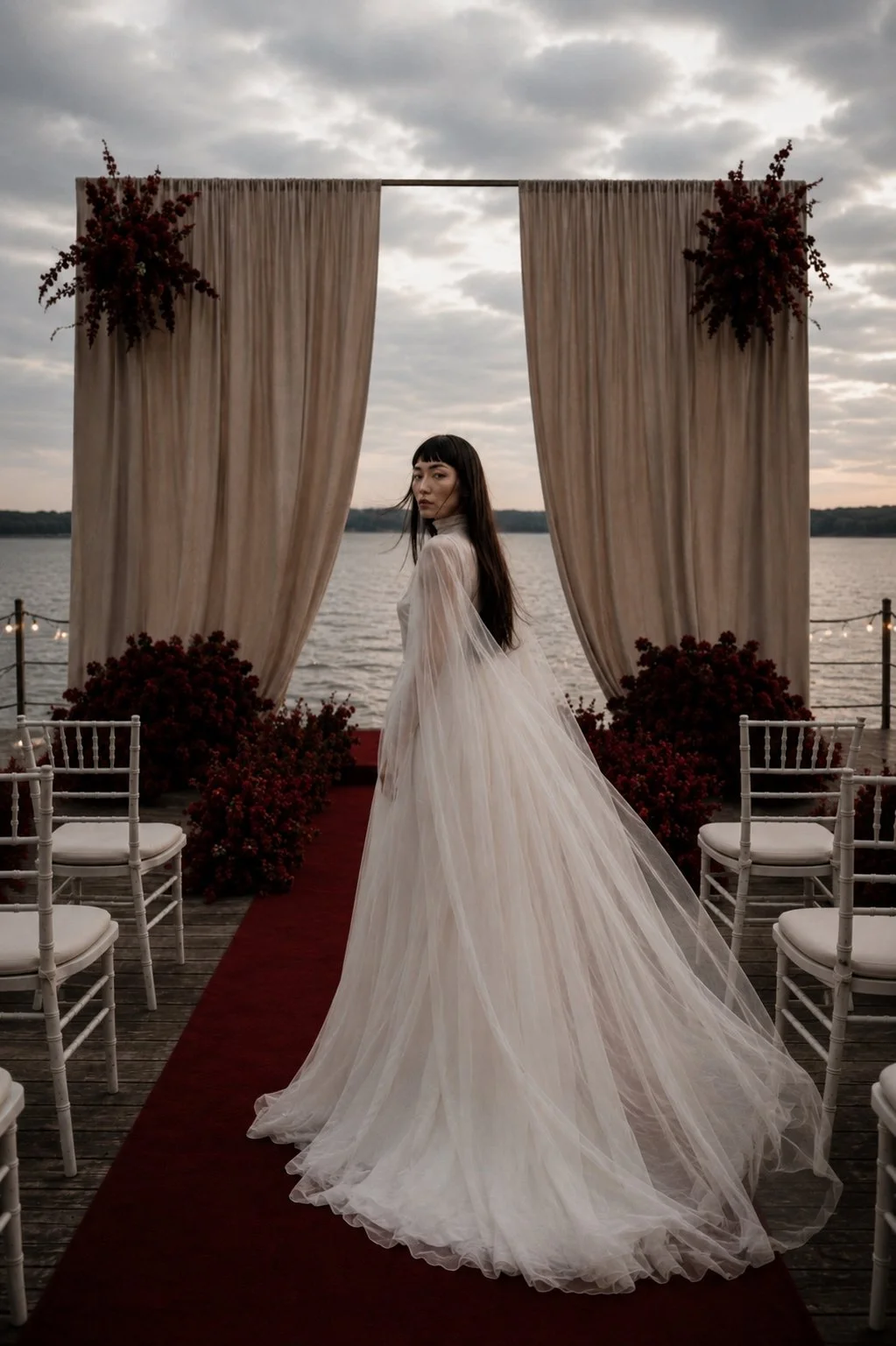
Editorial portrait of a bride  with a couture tulle gown and a  long flowing veil and burgundy bouquet beside a lakeside ceremony in the Camargue. Fine art destination wedding photography in France.

Editorial Fine art destination wedding photography in France.

There is another curious thing about wedding photography

Almost everyone believes they know how to judge it. Until they actually have to choose one.

A beautiful portrait is easy to recognise. Good light. A Loire Valley château behaving impeccably in the background. Perhaps a veil caught by the wind at exactly the right moment, as veils are contractually obliged to do on Instagram.

But a wedding is not one photograph.

It is twelve hours of changing light, changing moods, changing locations and, occasionally, changing plans.

It begins in a quiet bedroom with half-open suitcases, coffee going cold and someone looking for an earring that was definitely on the table five minutes ago.

It moves through ceremonies, family politics, a sudden Provençal thunderstorm, speeches running late, children refusing all reasonable cooperation and dance floors where elegant people make extremely questionable decisions after midnight.

A photographer has to make all of this look coherent.

Not identical. Coherent. That distinction matters.

The soft, luminous photographs from the morning should belong to the same story as a candlelit dinner beneath the plane trees in Provence, the flash-lit dancing and the moment someone’s uncle removes his tie and becomes, quite suddenly, the evening’s main character.

This is why judging a wedding photographer by a handful of carefully selected images can be misleading.

A portfolio shows you what a photographer can create at their best.

A full gallery shows you what they can create consistently.

A full gallery also shows you how they tell a story.

And consistency is where much of the value lies.

Can they photograph a beautiful suite at eleven in the morning and a crowded dance floor at eleven at night?

Can they work with sunlight, shade, rain, candlelight and the particular shade of green produced by emergency venue lighting?

Can they preserve the atmosphere without forcing every situation into the same visual formula?

Can they photograph the grandeur of a French château without losing the intimacy unfolding quietly inside it?

Can they make the wedding look beautiful without making it look as though nobody actually attended?

These are not especially glamorous questions.

They are, however, rather useful ones.

Because wedding photography is not simply the art of producing remarkable images when everything is perfect.

It is the art of producing a remarkable body of work when almost nothing remains perfect for very long.

And this is where price begins to make more sense.

You are not only paying for taste.

You are paying for judgement.

For the ability to decide, very quickly and very quietly, where to stand, what to notice, when to intervene and when to disappear.

Sometimes the most valuable decision a photographer makes is taking the photograph.

Sometimes it is not taking it.

Sometimes it is moving a chair.

Sometimes it is asking everyone to wait thirty seconds.

Sometimes it is quietly stepping back because the moment already belongs to the family, not to the camera.

Sometimes it is understanding that the mother of the bride needs a moment before anyone points a camera at her.

None of it appears on an invoice. Yet all of it quietly shapes the photographs you’ll treasure for the rest of your life.

The Camera Is the Least Interesting Part of Wedding Photography

This may be disappointing to anyone who enjoys discussing lenses over dinner, but expensive equipment does not automatically produce timeless wedding photographs. It merely produces technically capable files.

Which is useful. So is a reliable dishwasher. But neither is known for its emotional intelligence.

The camera cannot anticipate that a father will look away just before walking his daughter into the ceremony because he is trying not to cry.

It cannot sense that two siblings who have barely spoken all morning are about to embrace.

It cannot decide that the better photograph is not the perfectly arranged table, but the bride sitting beneath it five hours later, barefoot, laughing with her closest friend.

Equipment records. The photographer interprets.

That interpretation is what you are commissioning.

A way of noticing. A sense of timing. Visual culture. Emotional intelligence. An instinct for people.

And, ideally, the social intelligence not to turn your wedding into a twelve-hour editorial shoot simply because the wallpaper is attractive.

The finest wedding photography exists in a rather delicate place between control and chance.

Too little direction, and the couple may feel abandoned in front of the camera.

Too much, and the day begins to resemble a campaign for a perfume nobody has yet invented.

The photographer’s role is to shape what needs shaping and leave alone what is already alive.

That is often the difference between photographs that impress people today and photographs that still move them twenty years from now.

That balance takes experience. It also takes restraint.

Restraint rarely appears in a pricing guide.

It is, however, one of the most expensive skills a photographer ever learns.

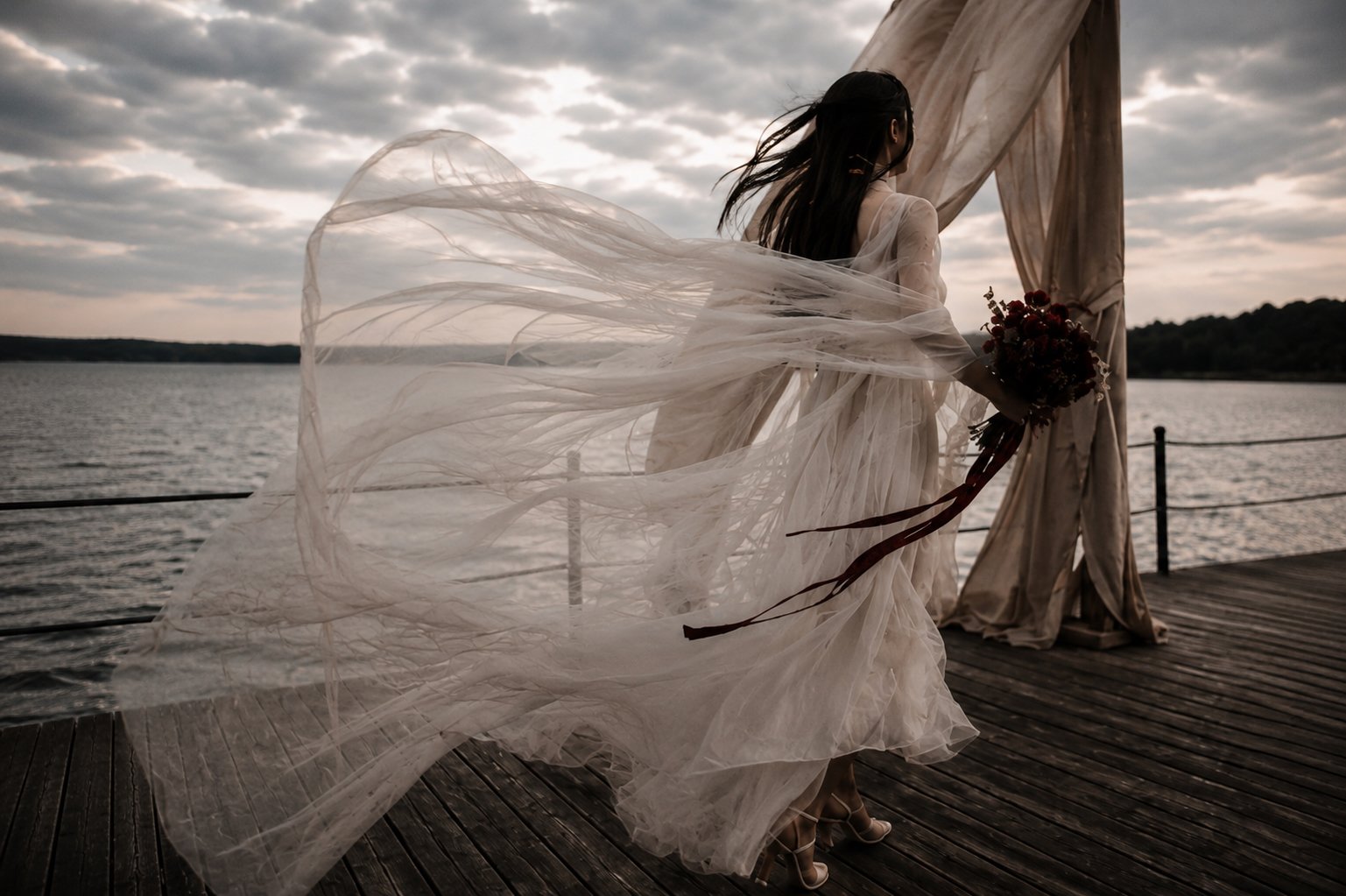
Editorial bridal portrait during a luxury destination wedding in the Camargue, France.

Sunset bridal portrait in the Camargue, France.

So what are you actually investing in?

Not merely coverage. Not merely files. And certainly not twelve hours of someone pressing a button with unusual enthusiasm.

You are investing in the person who will decide how your wedding is visually remembered.

And, whether you realise it or not, you are also placing your trust in them.

On your wedding day, you’ll spend more time with your photographer than with almost any other professional around you.

Long before the ceremony begins, they’ll quietly witness moments that few others ever see: quiet anticipation, nervous laughter, unexpected tears, the final deep breath before everything changes.

The more you trust them, the less aware you become of the camera.

And that is usually when the most honest photographs begin.

Because in the end, you’re not simply choosing someone whose photographs you admire.

You’re choosing someone whose presence allows you to forget, if only for a moment, that a camera is even there.

The person who will translate one complicated, emotional, beautifully imperfect day into a story that still makes sense years later. That is what the finest wedding photography quietly does.

That story will include the obvious moments.

The first look.

The ceremony.

The kiss.

The first dance.

But its real character will often be found elsewhere.

In the hand resting on a shoulder.

The friend watching from the doorway.

The lipstick mark left on a champagne coupe.

The exhausted flower girl asleep beneath a dinner table while the adults continue behaving as though midnight is a perfectly sensible time to begin another course.

These photographs rarely announce themselves as important. They become important later.

And perhaps that is the central misunderstanding around wedding photography.

Before the wedding, couples naturally compare prices. Afterwards, they discover value.

When people have changed. When families have grown. When someone in the photograph is no longer there.

When what once looked like a simple picture becomes evidence of a voice, a gesture, a relationship, an entire version of life.

Perhaps that’s a rather unusual thing to find in a pricing guide.

But it also happens to be the only honest place to begin.

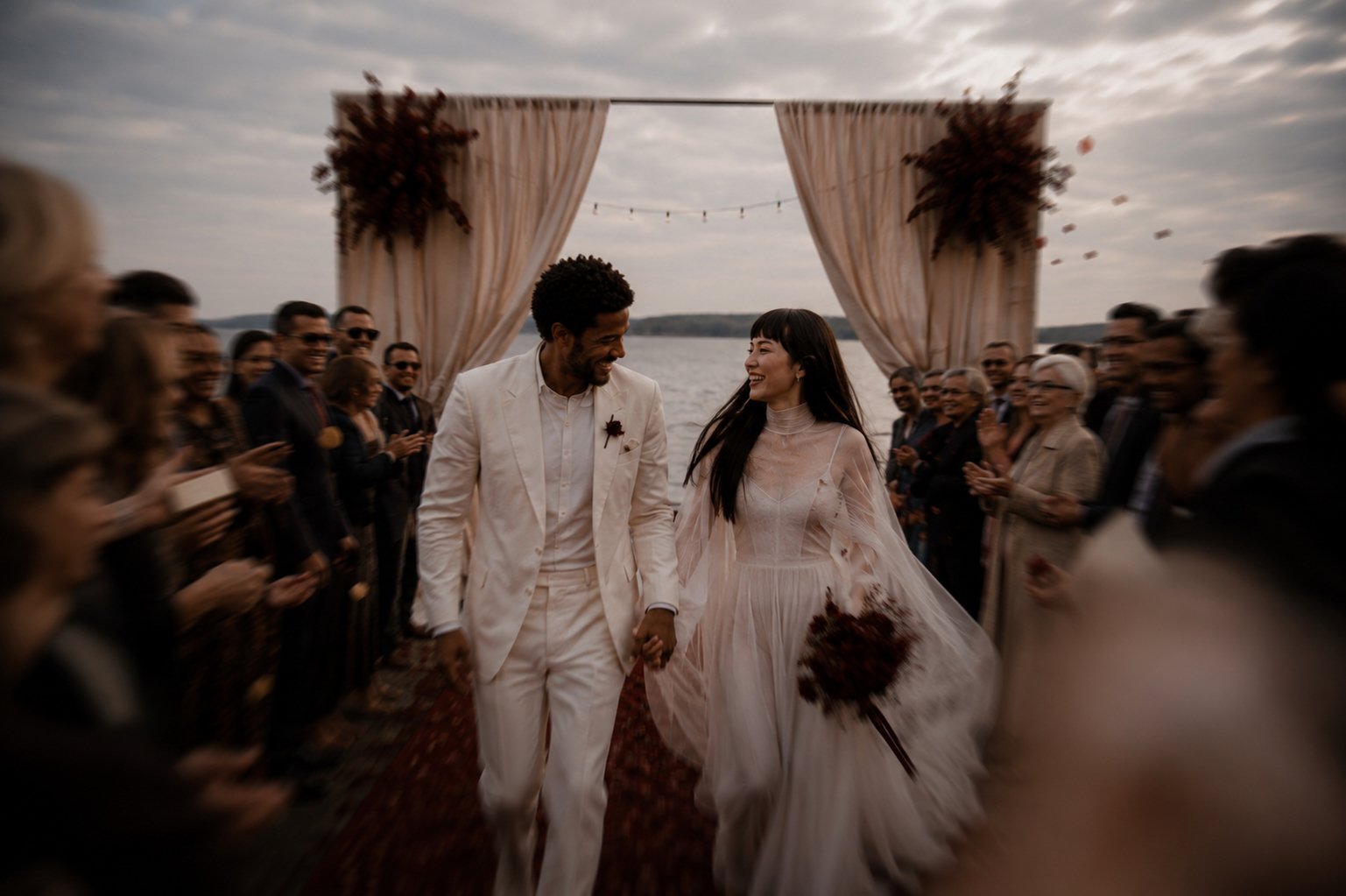
Newlyweds walking hand in hand after a luxury destination wedding ceremony in France.

Joyful ceremony exit during a luxury destination wedding in France.

So… how much does wedding photography actually cost in France?

Let’s answer the question everyone came here for. The honest answer is: it depends.

The longer answer is considerably more interesting.

If you’re planning a wedding in France, you’ll generally find professional wedding photography ranging from around €1,500 to well over €10,000. Luxury wedding photographers in France typically begin around €8,000, particularly for destination weddings, multi-day celebrations and highly personalised commissions.

Wedding photography is one of the few creative professions where two people can appear to be offering almost exactly the same service while operating in completely different worlds.

Both photograph weddings.

Both deliver an online gallery.

Both own expensive cameras.

Yet one charges €2,000.

Another €8,000.

A third perhaps €15,000.

Who’s right? Probably all of them. The difficulty isn’t finding a price. It’s understanding what that price actually includes.

Because pricing in wedding photography isn’t determined by a universal rate card.

It reflects an entire ecosystem:

experience,

artistic signature,

reputation,

demand,

level of service,

the number of weddings accepted each year,

international travel,

post-production,

and, perhaps most importantly,

scarcity.

Luxury has always been surprisingly bad at being inexpensive.

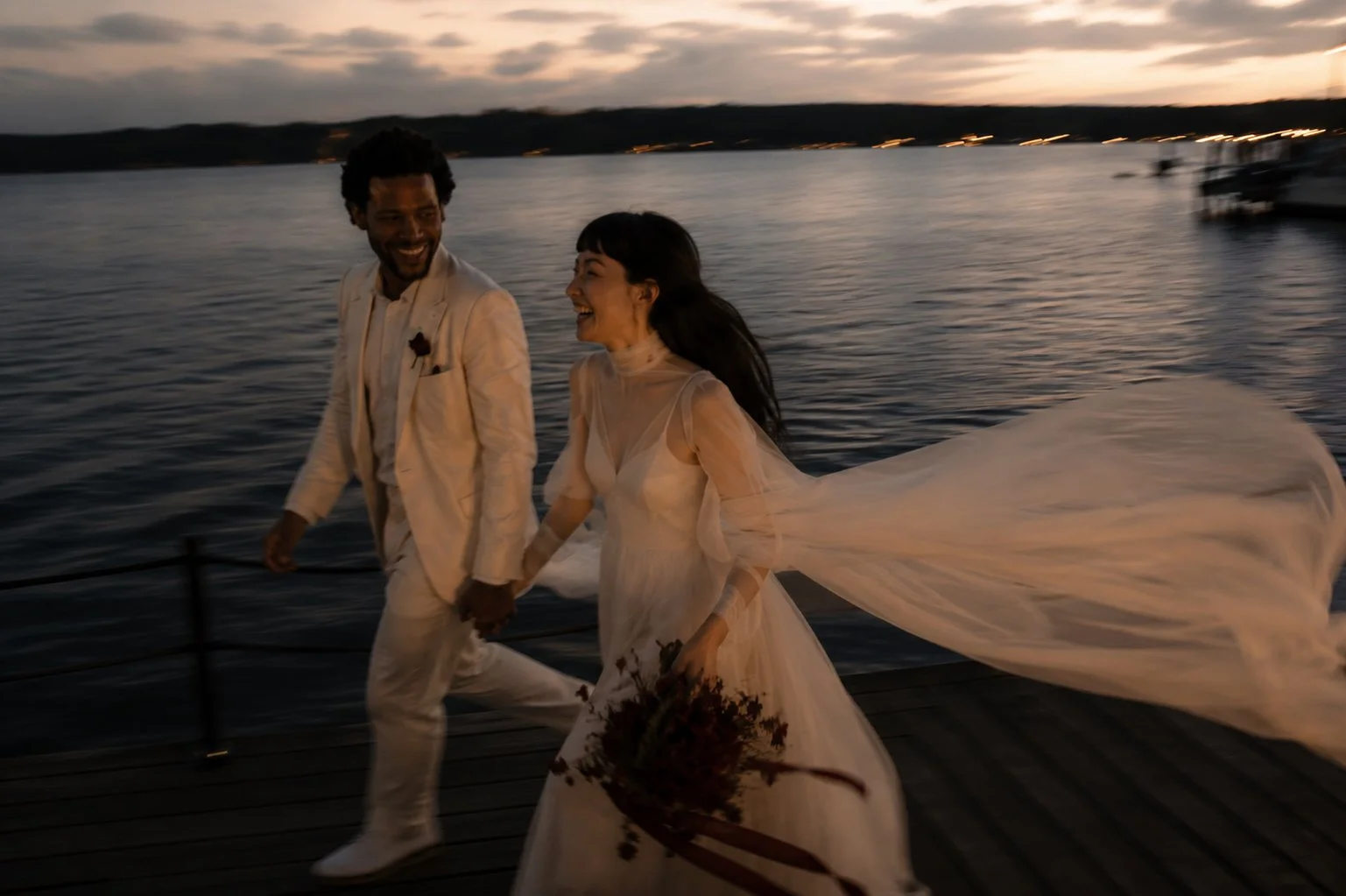
Bride and groom walking hand in hand at sunset after their luxury destination wedding in the Camargue, France.

Bride and groom walking at sunset after a luxury destination wedding in the Camargue, photographed by a high-end wedding photographer in France.

Why the Same Wedding Can Cost Three Times as Much

Imagine three restaurants.

They all serve dinner.

One is a neighbourhood bistro.

One has a Michelin star.

One has a waiting list of six months.

Technically, they’re all serving food.

Yet nobody expects them to cost the same.

Luxury wedding photography in France works in much the same way.

You’re not only paying for the final photographs.

You’re paying for everything that made those photographs possible.

The years spent learning how light behaves inside a twelfth-century chapel.

The confidence to direct twenty impatient family members in under three minutes.

The ability to remain calm when dinner suddenly starts forty-five minutes late.

The judgement to know when to raise the camera… and when to leave it by your side. The experience to recognise the decisive moment before anyone else notices it.

That last one is surprisingly expensive.

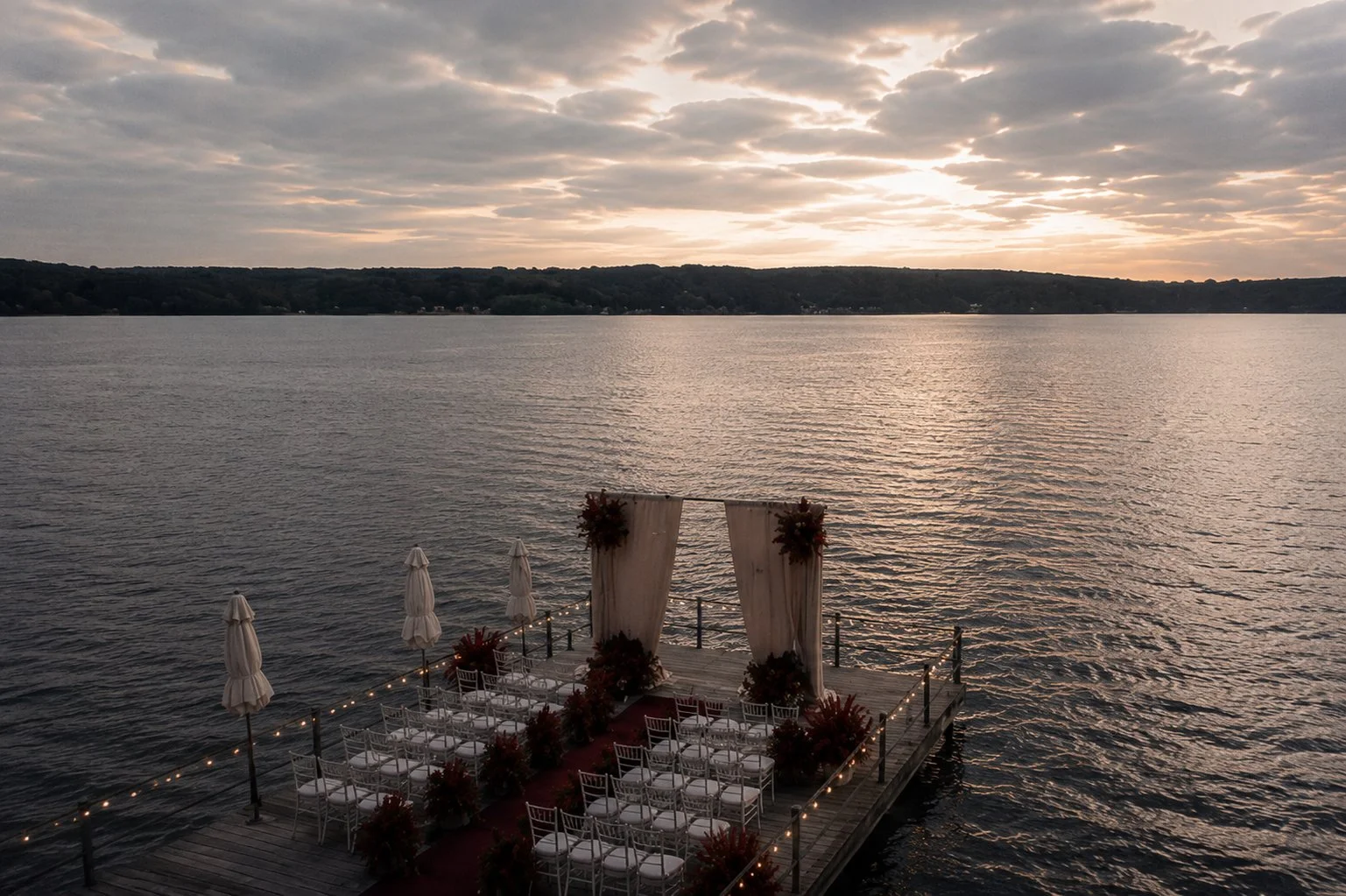
Elegant lakeside ceremony setup for a luxury destination wedding in the Camargue, France, photographed by a high-end wedding photographer.

An intimate lakeside ceremony overlooking the water in the Camargue at sunset.

Luxury isn’t about more photographs.

It’s about fewer compromises.

One of the biggest misconceptions about luxury wedding photography is that it simply means receiving more images.

It doesn’t.

Nobody has ever looked back at their wedding and wished they’d received another eighty-seven photographs of the canapé service.

Luxury is something else entirely.

It means having enough time.

Enough preparation.

Enough experience.

Enough freedom.

Enough attention.

Enough trust.

Enough curiosity to keep noticing what everyone else has stopped seeing.

It means your photographer has the space to notice what everyone else is too busy living.

Because those unnoticed moments are usually the ones that become priceless later.

Editorial bridal portrait during a luxury destination wedding in the Camargue, France, photographed by a high-end wedding photographer.

A timeless bridal portrait captured moments before a luxury destination wedding ceremony in the Camargue.

What You’re Really Paying For

There is a curious misconception surrounding luxury wedding photography.

People often assume the difference between a €2,500 photographer and a €10,000 photographer is mostly a question of talent.

It rarely is. Talent matters, of course.

But beyond a certain level, almost every established photographer understands light. They know how to compose an image. They know when to press the shutter.

The real difference lies elsewhere.

Luxury is built on countless decisions long before it becomes visible in the photographs.

The photographer who accepts forty weddings a year and the photographer who accepts twelve may both be exceptionally talented.

What differs is the way they choose to spend their time. One works at scale. The other works in depth.

Neither model is inherently right or wrong. They simply produce very different experiences.

Because the wedding day itself is only one chapter of the story.

Long before the first guest arrives, there have already been months of conversations.

Emails.

Video calls.

Timelines reviewed and revised.

Advice on the best light rather than simply the most fashionable location.

Conversations with planners.

Travel arrangements.

Equipment checks.

Back-up systems tested.

Insurance renewed.

Weather forecasts watched with perhaps slightly more attention than is entirely healthy.

And once the celebration is over, the work has only just begun.

Thousands of photographs are carefully reviewed.

Hundreds are colour graded one by one.

A narrative is constructed.

Not simply a gallery.

A story.

An album is designed.

Prints are checked.

Final details refined.

The wedding may have lasted twelve hours.

The commission often spans several weeks.

Sometimes several months.

Then comes something far more difficult to invoice.

Experience. Not experience measured in years. Experience measured in situations.

A ceremony that begins forty-five minutes late.

A veil that disappears five minutes before the bride walks down the aisle.

A summer thunderstorm that politely ignores the weather forecast.

A flower girl who refuses every form of negotiation.

A father who suddenly cannot speak during his speech.

A planner quietly solving three problems while smiling as though nothing has happened.

These things are not unusual.

They are weddings. The experienced photographer does not stop them from happening.

They simply know how to move through them without allowing the photographs to inherit the chaos.

That calm is invisible.

Until the moment it isn’t.

Luxury also buys something surprisingly rare today.

Time.

Not simply on the wedding day.

Before it.

After it.

Time to answer thoughtfully rather than quickly.

Time to notice details that others overlook.

Time to refine rather than merely deliver.

Time to discuss an album without looking at the clock.

Time, quite simply, to care.

Because care cannot be automated.

Nor outsourced.

Nor accelerated.

And perhaps most importantly, enough creative space to remain genuinely inspired.

Creativity rarely flourishes on an assembly line.

The photographers who choose to accept twelve weddings each year instead of forty are not necessarily more talented.

They have simply made a different decision.

To invest more deeply in fewer stories.

Luxury wedding photography has never really been about rushing from one wedding to the next.

It has always been about refusing to rush.

A beautifully crafted chair takes longer than a plastic one.

A bespoke suit takes longer than something bought on the high street.

An exceptional meal takes longer than fast food.

Why should wedding photography be any different?

Across today’s luxury wedding market, prices vary considerably.

They reflect reputation, artistic signature, experience, demand, geography, the complexity of the celebration and, perhaps above all, the amount of time a photographer chooses to devote to each couple.

Some photographers build businesses around volume.

Others deliberately photograph only a limited number of weddings each year, allowing themselves the freedom to invest more deeply in every commission.

Neither approach is universally better.

But they are fundamentally different business models.

Which is why asking, “How much does a wedding photographer cost?” is, in many ways, the wrong question.

A more revealing one might be:

How much time, attention, creativity and thought do I want someone to devote to preserving one of the most important days of my life?

Because, in the end, photographs are never really priced by the hour.

They are valued by everything that happened before the shutter was pressed…

…and everything that continues long after it.

Why Luxury Is Built on Scarcity

Luxury has always suffered from a public relations problem.

People tend to believe it begins with price.

It rarely does.

More often, it begins with limitation.

The world’s finest restaurants do not become exceptional because they serve the greatest number of guests.

Quite the opposite.

A Michelin-starred chef knows there is a point beyond which excellence begins to dilute.

Add too many tables, and something quietly disappears.

Precision.

Curiosity.

Attention.

The little details that nobody notices until they are no longer there.

Architecture works in much the same way.

No architect designs fifty remarkable private homes every year.

Not because they lack ambition.

Because thoughtful work has a natural capacity.

Luxury wedding photography belongs to that same family of crafts.

Not because it is rare.

Because genuine attention is.

Every couple deserves to feel as though theirs is the only wedding that matters.

That becomes surprisingly difficult if tomorrow’s celebration has already begun to occupy today’s thoughts.

This is why many photographers working at the highest level deliberately accept only a limited number of commissions each year.

Not to create artificial exclusivity.

Not to appear unattainable.

Simply because attention has limits.

And unlike camera equipment, attention cannot be upgraded every autumn.

It can only be divided.

Luxury has never really been about abundance.

It has almost always been about restraint.

The confidence to say,

“This is enough.”

Enough commissions.

Enough time.

Enough energy.

Enough care.

Enough space to do justice to each story.

There is, perhaps, one final irony.

In almost every industry, success is measured by growth.

Luxury often measures success differently.

Sometimes, the greatest privilege is not having more work.

It is having the freedom to choose your work carefully.

Because the rarest commodity in modern life is no longer money.

It is undivided attention.

And perhaps that is what couples are really investing in.

Not exclusivity.

Not prestige.

Not even photographs.

But the reassuring feeling that, for one extraordinary day, someone has chosen to give their complete attention to preserving the beginning of their family’s history.

Luxury is not about being difficult to book.
It is about having enough time to care.

The Only Price Nobody Talks About

There is one cost almost nobody considers while planning a wedding.

Not because it is insignificant.

Because it is impossible to calculate.

Before the wedding, every decision is judged in the present.

The flowers.

The menu.

The band.

The dress.

The photographer.

Everything is weighed against a budget, a spreadsheet or, occasionally, the opinion of a particularly vocal relative.

It is perfectly reasonable.

Weddings are expensive.

Choices have to be made.

Yet wedding photography behaves rather differently from almost everything else purchased that day.

The flowers begin fading before breakfast the following morning.

The champagne is forgotten.

Even the most extraordinary meal gradually becomes a story told over Christmas lunch.

Photographs follow another timeline entirely.

They appreciate.

Not financially.

Emotionally.

A photograph that feels beautiful a week after the wedding often feels profoundly different twenty years later.

Not because the photograph has changed.

Because life has.

Children begin asking questions.

Faces become younger every year.

Hairstyles become funnier.

Fashion somehow becomes elegant again.

People who once seemed permanently present are suddenly, unexpectedly, absent.

The photograph quietly accumulates meaning.

That is what makes it so unusual.

Very few things we buy become more valuable simply because time has passed.

Most possessions depreciate.

Cars.

Phones.

Furniture.

Even houses require constant care to preserve their value.

Photographs ask for remarkably little.

Simply to survive.

And if they do, they become something extraordinary.

Evidence.

Not merely of how a wedding looked.

But of how a family began.

Perhaps that is why, long before we care about jewellery, furniture or property, we find ourselves opening old family albums.

Trying to recognise faces.

Looking for familiar expressions.

Searching for ourselves in people we never had the chance to know.

No one asks how much those photographs cost.

The question has quietly disappeared.

The only thing that matters is that someone had the foresight to make them.

Seen from that perspective, the question changes one final time.

It is no longer: “How much does wedding photography cost?”

It becomes: “How do we want to be remembered?”

Editorial portrait of a bride and groom at sunset during a luxury destination wedding in the Camargue, photographed by a high-end wedding photographer in France.

Sunset editorial portrait of a couple during a luxury destination wedding in the Camargue, France.

How to Read a Wedding Photographer’s Portfolio (and What Most Couples Miss)

There is another small trap waiting for almost every couple. It usually appears somewhere between Instagram and Pinterest.

It begins with a perfectly reasonable assumption: “If I like these photographs, I’ll probably like the photographer.”

Sometimes that’s true. Sometimes it isn’t.

Because choosing a wedding photographer based on ten beautiful images is a little like choosing a novelist after reading only the final chapter.

You know almost nothing. Every photographer has favourite images.

The extraordinary sunset.

The dramatic veil.

The perfect kiss.

The portrait that wins awards.

Those photographs absolutely deserve their place in a portfolio.

They simply don’t tell the whole story.

A wedding is not made of ten extraordinary moments.

It is made of hundreds of ordinary ones.

And photographing those ordinary moments beautifully is considerably harder.

Ask to See a Full Gallery

If there is one piece of advice I would give every couple, regardless of which photographer they eventually choose, it is this:

Ask to see at least one complete wedding. Not the highlights.

The entire story.

A complete gallery reveals things a portfolio never can.

It shows not only whether a photographer creates beautiful individual photographs, but whether they know how to tell a story.

Can they maintain the same level of quality from morning until midnight?

Do the family photographs feel natural?

Do the speeches still have atmosphere once daylight has disappeared?

Does the dance floor remain elegant without becoming chaotic?

Most importantly, does the gallery still feel coherent after eight hundred photographs?

Consistency is far more difficult than brilliance.

Brilliance happens occasionally. Consistency is a choice.

Look Beyond the Couple

Most portfolios are filled with beautiful couples.

As they should be.

But your wedding is unlikely to consist exclusively of the two of you.

Look instead at everyone else.

Parents.

Grandparents.

Children.

Friends.

How are they photographed?

Do they appear genuinely present?

Or simply decorative?

A wedding photographer is not documenting two people.

They are documenting an entire constellation of relationships.

Twenty years from now, those relationships may become the photographs you treasure most.

Pay Attention to Difficult Light

Beautiful sunshine is reassuring.

It is also remarkably cooperative.

The real test comes elsewhere.

A dark church.

A candlelit dinner.

Heavy rain.

A winter afternoon that disappears by four o’clock.

Almost every wedding eventually asks the photographer to solve a problem.

Those are the photographs worth examining.

Not because they need to be spectacular.

Because they reveal competence.

Anyone can create beautiful photographs when everything goes according to plan.

Professionals reveal themselves when nothing does.

Finally, Ask Yourself One Quiet Question

Not: “Are these beautiful photographs?”

That part is easy. Instead, ask yourself something slightly more personal.

“Can I imagine these photographs belonging to my family?”

Because photography is surprisingly intimate.

You’ll spend more time with your photographer than with almost anyone else on your wedding day.

You’ll invite them into moments that are joyful, emotional and sometimes vulnerable.

The way they observe people will quietly influence the way your memories are preserved.

Technical skill matters.

Experience matters.

Artistic style matters.

But trust matters just as much.

When those things come together, something rather wonderful happens.

You stop thinking about the photographer altogether.

And that, strangely enough, is usually when the most honest photographs begin.

When couples stop performing for the camera, they begin living the day.

That’s usually when the photographs become unforgettable.

Editorial luxury wedding photography in France featuring an elegant couple during a candlelit destination wedding reception at sunset.

The value of a luxury wedding photographer lies in preserving intimate moments that cannot be recreated.

Frequently Asked Questions

A few practical answers for couples planning a luxury wedding in France.

Bride and groom celebrating with their guests during a luxury destination wedding reception in the Camargue, France, photographed by a high-end wedding photographer.

A joyful black-and-white moment during an elegant destination wedding celebration in the Camargue, France.

In the End

Perhaps we’ve been asking the wrong question all along.

Not: “How much does a wedding photographer cost?”

Nor even: “How many hours of coverage do we need?”

But something infinitely simpler. Who do we trust to remember this day for us?

Because memory is a curious thing. It edits. It softens. It exaggerates.

It quietly rearranges the past until stories become smoother than they really were.

Photographs do something rather different. They anchor memory.

They remind us not only of what happened, but of how it felt.

A glance exchanged across a crowded room.

A hand instinctively reaching for another.

The laughter that interrupted a speech.

The silence just before a ceremony began.

These moments rarely seem extraordinary while they are happening.

Life has a habit of disguising its most precious memories as ordinary afternoons.

Only time reveals what mattered.

Perhaps that is why wedding photography is so difficult to value in the present.

Its true worth belongs almost entirely to the future.

One day, many years from now, the flowers will exist only in photographs.

The music will have faded into memory.

The menu will have been forgotten.

Even the dress will spend far more time in a wardrobe than it ever did on a dance floor.

But the photographs will quietly continue doing what they have always done. They will remember.

Not simply how everything looked. But who everyone was.

And perhaps that is the greatest privilege of all. To create something that will outlive the celebration itself.

Something that will one day belong not only to you, but to the people who come after you.

The price will have long been forgotten. The photographs won’t.

Luxury wedding reception in the Camargue, France, with an elegant candlelit dinner table overlooking the water at sunset, photographed in an editorial documentary style.

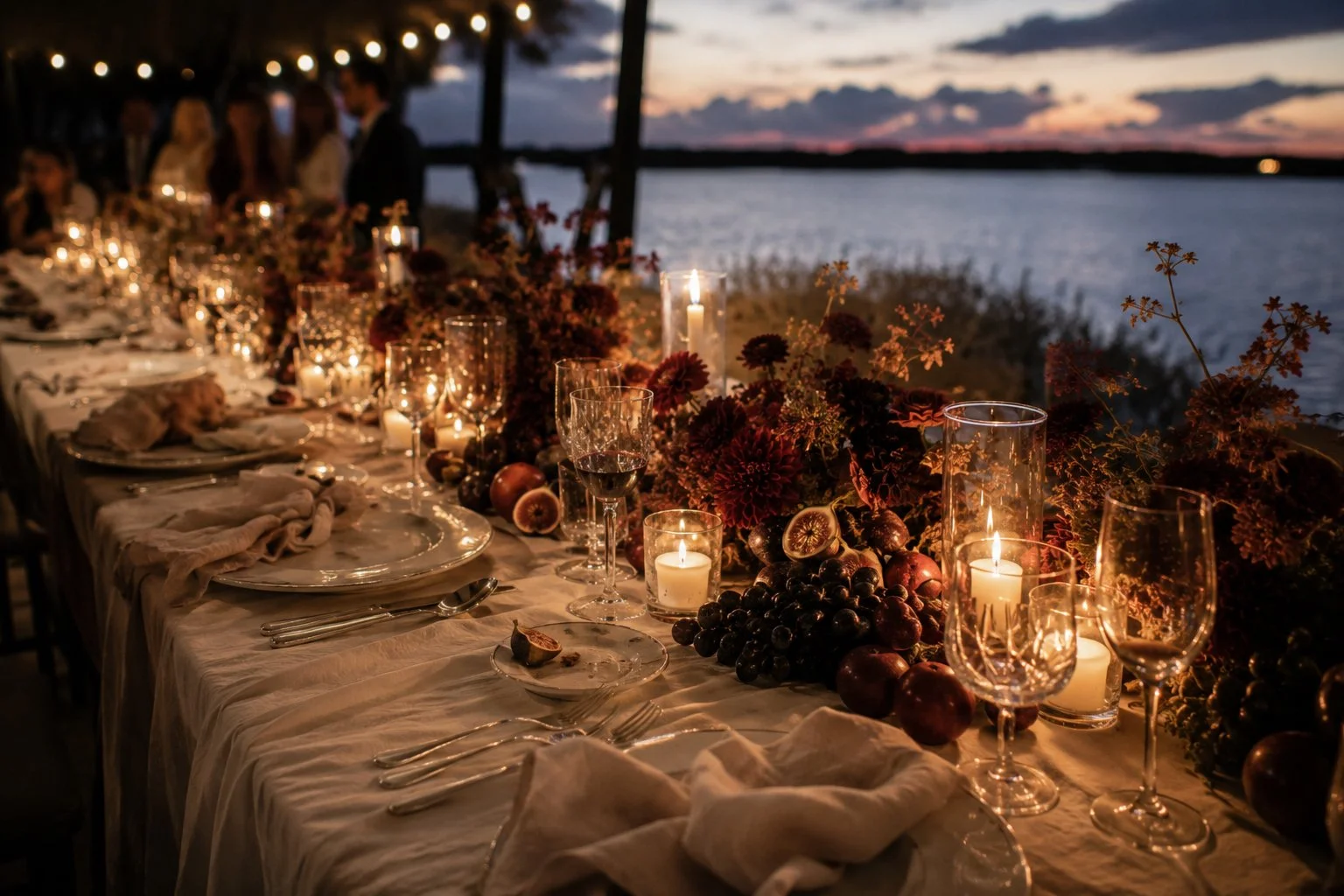
Luxury is often found in the atmosphere rather than in extravagance. A candlelit dinner by the water, where every detail quietly contributes to the memory.

If this article has helped you look at wedding photography a little differently, then it has already done what I hoped it would.

And if, somewhere along the way, you felt that my way of seeing the world resonates with yours…

Whether you’re planning an intimate celebration in Paris, a château wedding in the Loire Valley, a weekend in Provence, the French Riviera or somewhere far more unexpected, I’d be delighted to discover what you’re dreaming up together.

If it feels like the right fit, perhaps we’ll create something timeless.

KALICKY SONJA
How to Choose a Wedding Photographer in France

How to Choose a Wedding Photographer in France

Or perhaps, you’re asking the wrong question

By Sonja Kalicky

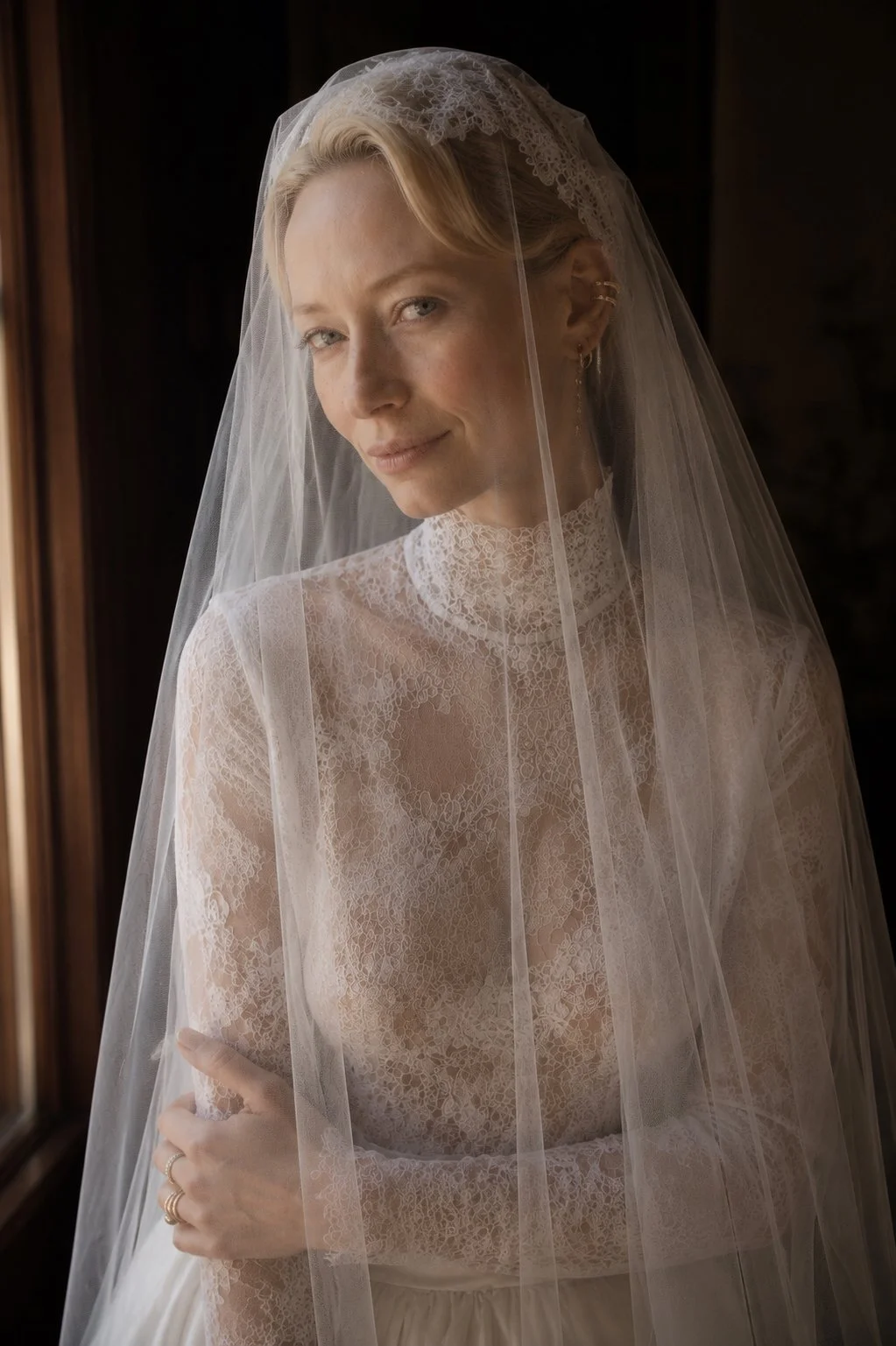
Editorial bridal portrait at Abbaye des Vaux de Cernay in France featuring a bride wearing a delicate lace wedding dress and cathedral veil in soft natural window light.

A quiet moment before the ceremony at Abbaye des Vaux de Cernay.


Choosing a wedding photographer in France looks like a practical decision. It rarely is.

There is one question almost every couple planning a French wedding eventually asks.

“Who is the best wedding photographer in France?”

It’s an understandable question.

Especially when you’re planning a celebration from another country and searching for someone you can trust.

It’s also rather like asking who makes the world’s best perfume.

Or the best novel.

Or the perfect dinner party.

You’ll receive plenty of confident answers.

Most will reveal far more about the person answering than about the work itself.

Photography has always resisted rankings.

Some photographers notice architecture before they notice people.

Others are captivated by fashion.

Or light.

Or emotion.

None of them are wrong.

They simply pay attention to different things.

And attention has an extraordinary habit of becoming memory.

Long after the flowers have faded.

Long after the champagne has become somebody else’s headache.

Long after somebody has finally worked out what on earth to do with the seating plan.

Because weddings are remembered twice. First as they were lived. Then as they were photographed.

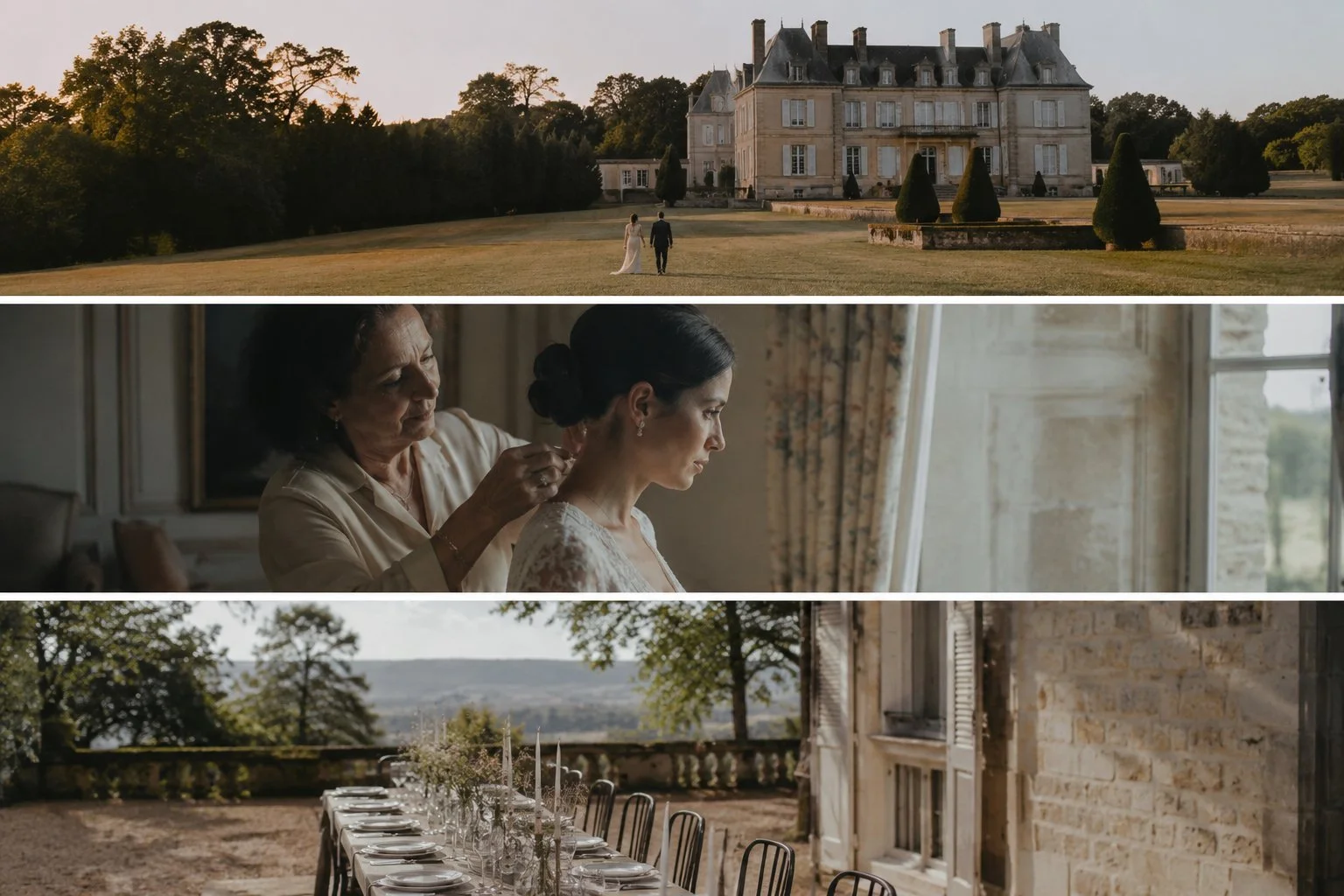
An elegant destination wedding in a French château featuring refined bridal preparations, timeless architecture, intimate portraits and an outdoor reception inspired by the art of French entertaining.

Editorial wedding at a French château with elegant bridal preparations and an outdoor reception overlooking the gardens.

Memory Is More Fragile Than We Think

People like to imagine memory as a beautifully organised archive. It isn’t.

It’s much closer to an old Paris apartment. Things disappear. Others quietly move.

Some rooms remain exactly as you left them. Others become impossible to reconstruct.

Psychologists have known for decades that memory isn’t something we retrieve.

It’s something we rebuild. Again. And again.

If you’re planning a destination wedding in France, that thought is perhaps worth lingering on.

Because long after you’ve returned to New York, London, Toronto or Sydney…

Long after your dress has been carefully wrapped away…

Long after your guests have gone back to their own lives…

Your photographs will quietly begin doing something extraordinary. They won’t simply remind you what happened.

Little by little…They will become part of how you remember it. The photograph of your father waiting outside the ceremony.

The unexpected laughter during dinner. The way your partner looked at you when they thought nobody else was watching.

Years later, it becomes almost impossible to know whether you remember the moment itself……or the photograph.

Perhaps it doesn’t matter. Because either way…

The feeling survives.

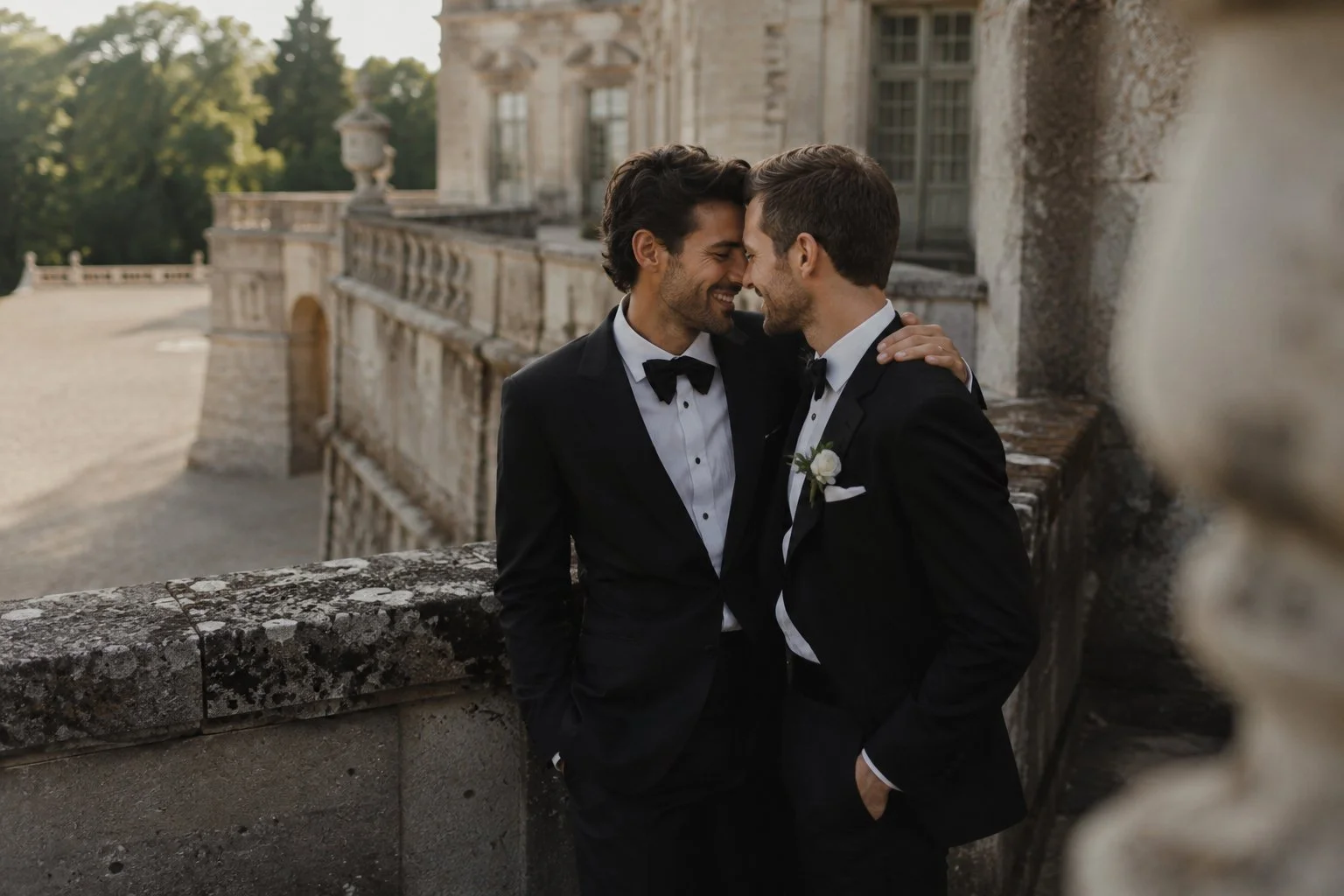
Two grooms sharing a joyful and intimate moment on the terrace of an elegant French château during their destination wedding in France.

Two grooms sharing a joyful and intimate moment on the terrace of an elegant French château during their destination wedding in France.

Taste Is Quieter Than Style

Style has a curious habit of introducing itself.

Taste rarely does.

Perhaps that’s why the most elegant weddings I’ve photographed have almost never been the ones trying hardest to be elegant.

Good taste is remarkably discreet.

Rather like a beautifully cut jacket.

Or a house where every object has clearly been chosen by someone who wasn’t trying to impress anyone.

It doesn’t ask for attention.

It rewards it.

The same is true of wedding photography.

Some images are designed to stop your scrolling.

Others are designed to make you stop twenty years later.

I’ve always been far more interested in the second kind.

The wedding industry, however, occasionally behaves as though beauty could be measured in peonies.

Or candles.

Or the height of a floral installation.

Fortunately, people have always been much more interesting than centrepieces.

Nobody has ever cried because the napkins were beautifully folded.

People cry for people.

Fortunately.

Perhaps that’s why I find myself remembering conversations long after I have forgotten the flowers.

A father quietly straightening his daughter’s veil.

Two brothers laughing before the ceremony.

A grandmother who insists she doesn’t want to dance, then quietly becomes the last person to leave the dance floor.

These are rarely the moments that appear on a mood board.

They are, however, the ones that stay with us.

And, more often than not, they become the photographs families treasure most.

The French have an almost irrational affection for beautiful tables.

We’re also rather attached to long lunches.

Fortunately, both leave plenty of room for conversations.

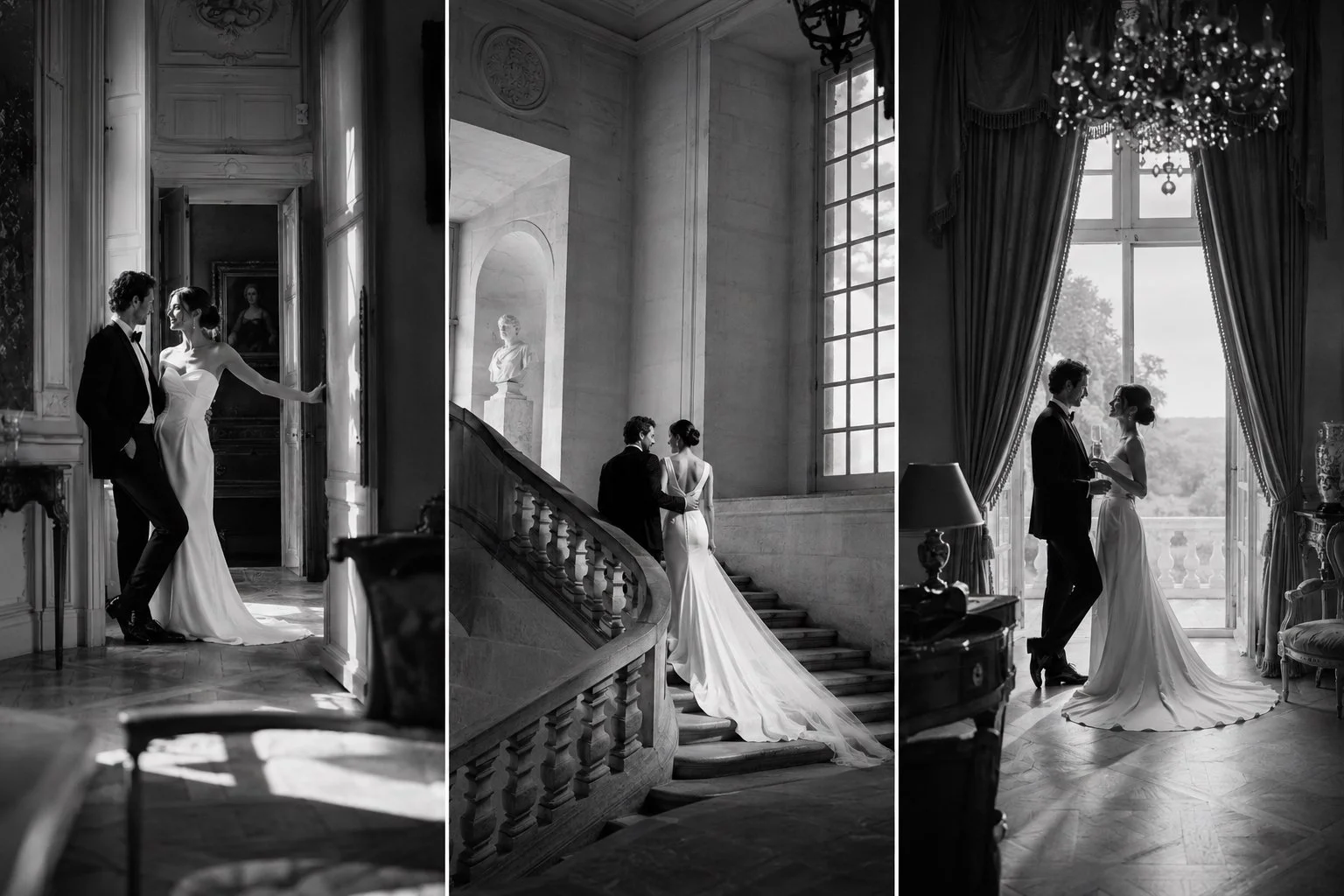
Elegant bride and groom sharing intimate moments inside a historic French château during a luxury destination wedding in France.

Some places don’t need decoration. They simply need people in love.

Presence Is Part of the Photograph

There is something couples rarely consider when choosing a wedding photographer.

For twelve hours, sometimes more, one person will remain quietly by your side.

Long before the first guest arrives.

Long after the last champagne glass has been cleared away.

They will see you before anyone else does.

When your hair is still half-finished.

When the tie refuses to cooperate.

When someone suddenly remembers they forgot the rings.

Weddings have an extraordinary talent for reminding us that perfection was never really invited.

Fortunately.

By the end of the evening, your photographer will probably know the names of your closest friends.

Which child has decided shoes are optional.

Who secretly organised everything.

And exactly where your mother keeps the tissues.

It’s an oddly intimate profession.

Especially when you remember that the day usually begins with complete strangers.

Beautiful photographs are rarely created because someone knows how to use a camera.

They are created because people feel safe enough to forget one is there.

Trust cannot be directed.

Neither can ease.

Both arrive quietly.

Sometimes through conversation.
Sometimes through silence.

Sometimes simply because nobody asks you to perform.

The finest photographers I have met all share one quality.

They understand that not every beautiful moment needs an audience.

Some memories become more beautiful precisely because nobody asked them to happen again.

I’ve often thought that the best compliment a wedding photographer can receive isn’t,“These photographs are beautiful.”

It’s something much simpler. “We forgot you were there.”

Because that means something far more important happened.

People stopped thinking about being photographed…

…and started living their wedding.

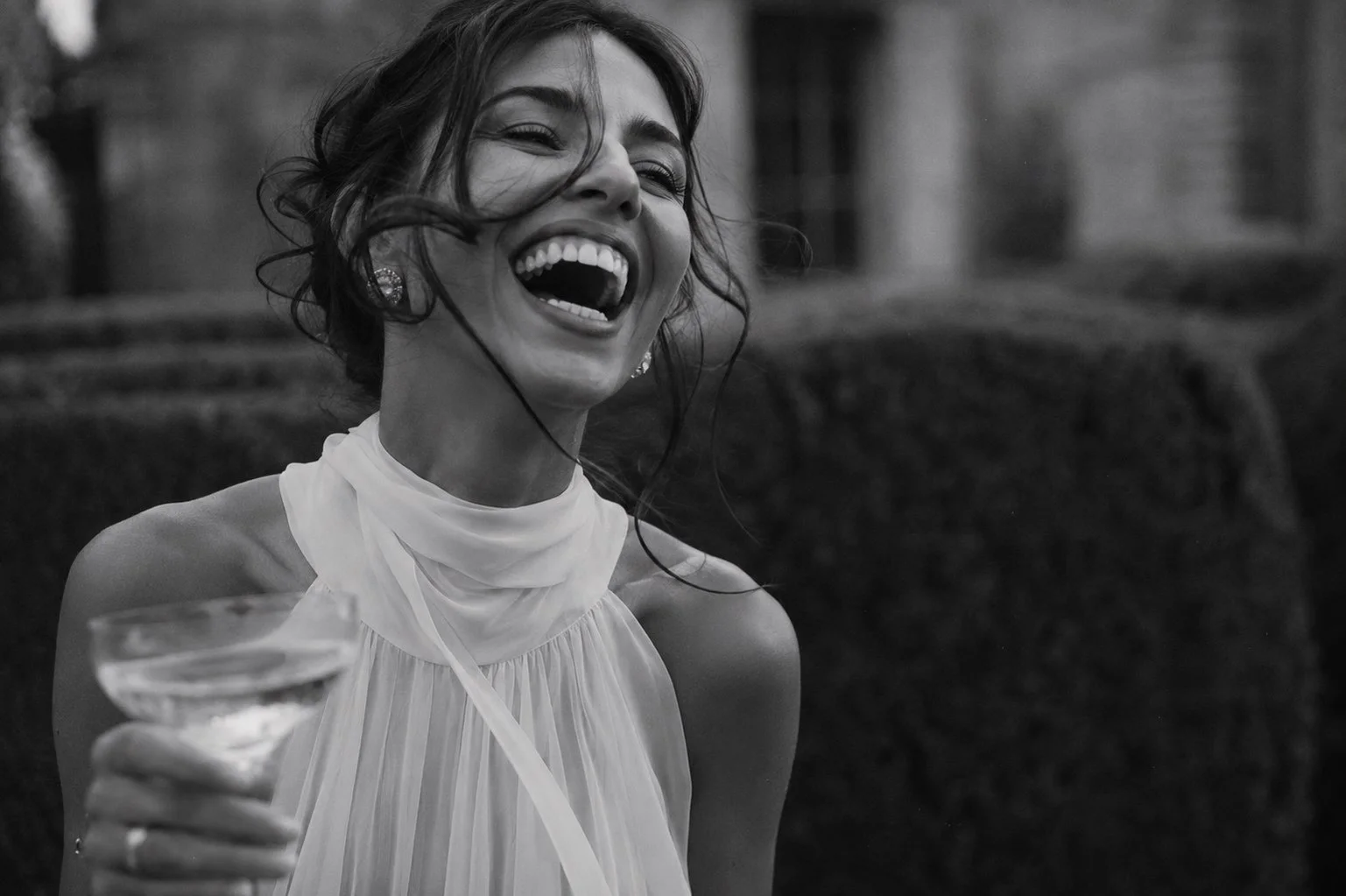
Bride laughing with a champagne coupe during a luxury château wedding in France, captured in timeless black and white.

A wedding should feel like this.

What Every Family Brings

Every family arrives carrying a story no one else can fully see.

Some arrive with decades of shared rituals.

Others with careful new beginnings.

There are reconciliations.

Private jokes.

Children who already know exactly where they belong.

And chairs that remain quietly empty.

Weddings have a curious way of gathering every chapter of a family’s history into a single afternoon.

For a few fleeting hours, several generations inhabit the same room.

That has always fascinated me.

Long before I notice the flowers…

I notice who pours champagne for everyone else before filling their own glass.

Who instinctively reaches for someone’s hand.

Who keeps looking across the room to check that a parent is all right.

Who quietly steps aside because they dislike being the centre of attention.

These gestures never appear on the timeline.

No wedding planner writes,

“16:42 — Father quietly straightens his son’s collar.”

Or,

“18:17 — Grandmother laughs so hard she forgets she’s ninety-two.”

Fortunately.

The best parts of a wedding have always been wonderfully unplanned.

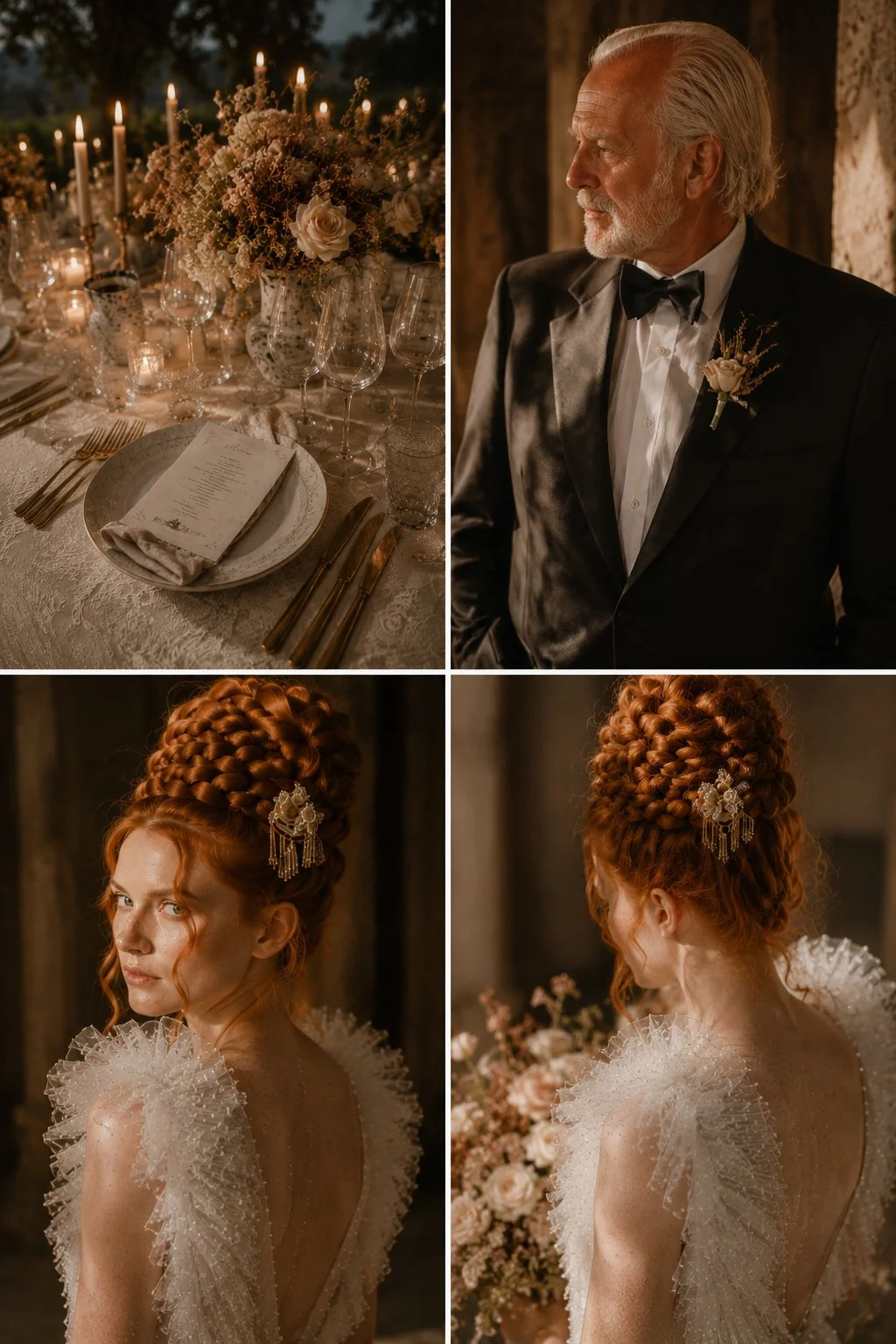
A candlelit wedding reception styled with abundant florals, handcrafted stationery and refined tableware. An editorial approach to luxury wedding details in France.

A candlelit wedding reception styled with abundant florals, handcrafted stationery and refined tableware. An editorial approach to luxury wedding details in France.

I remember asking a bride, almost in passing, whether there was anything I should know before the day began.

She smiled.

“My father doesn’t like being photographed.”

Nothing more.

No explanation.
Just that.

It was enough.

I never asked him to look towards me.

I never suggested another portrait.

Instead, I simply stayed close enough to notice the moments when he forgot I was there.

Late that evening, just before I left, he came over to thank me.

“I completely forgot you were photographing us.”

It remains one of the most meaningful compliments I’ve ever received.

Not because it said anything about the photographs.

But because it told me he had spent the day with his daughter…

…rather than with my camera.

Perhaps that is what thoughtful wedding photography really is.

Not persuading people to become more photogenic.

Allowing them to remain entirely themselves.

Because families have never needed direction.
Only kindness.

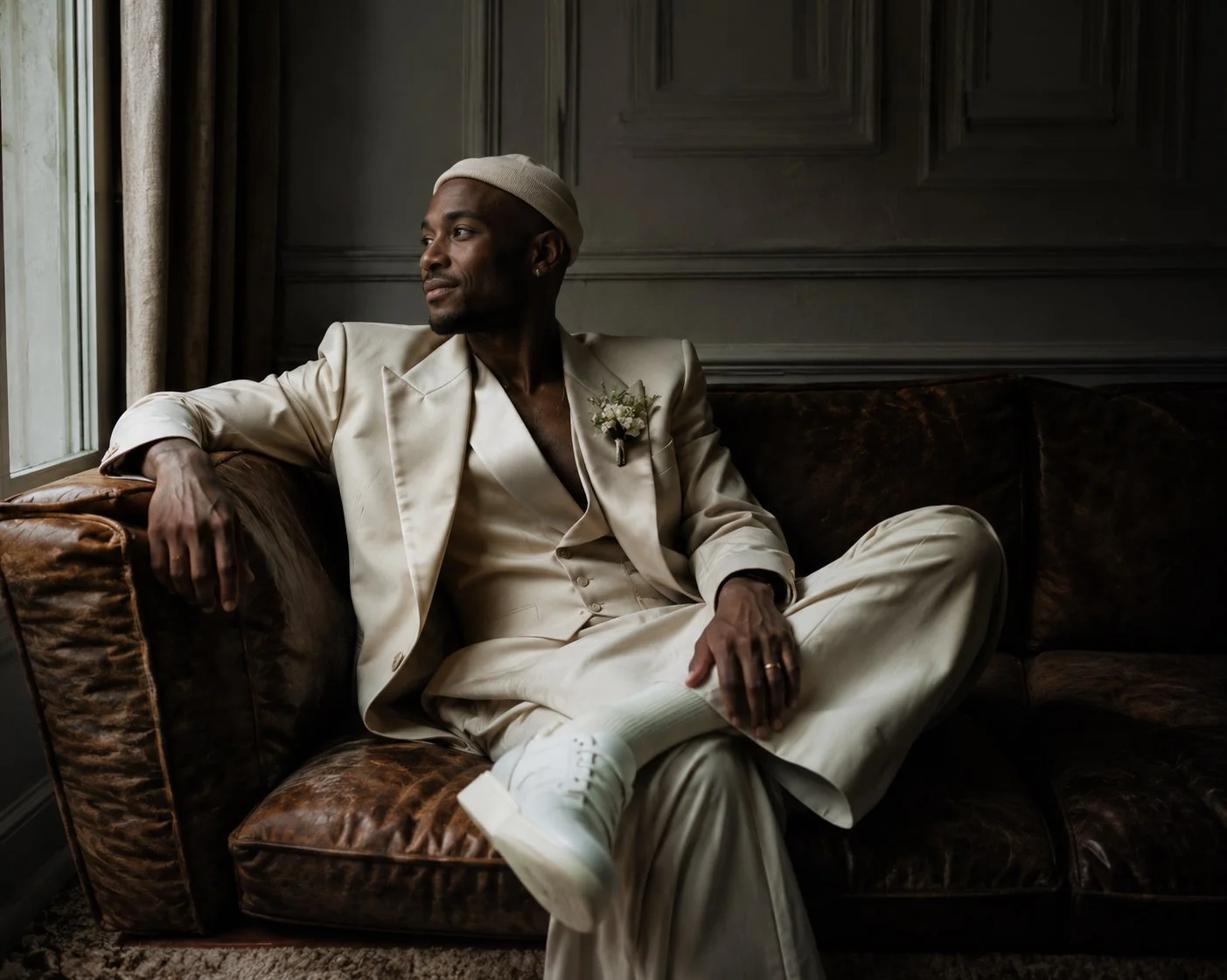
Texte ALT Elegant portrait of a stylish groom in an ivory tailored suit sitting by a window before a luxury wedding in France.

Good Taste Rarely Raises Its Voice

The French have an almost unreasonable affection for beautiful things.

Not necessarily expensive things.

Beautiful things.

A loaf of bread still warm from the bakery.

An old limestone façade after the rain.

A linen tablecloth that has lived through decades of Sunday lunches.

A chair that creaks because four generations have already sat on it.

Perhaps that’s why we have always been slightly suspicious of anything trying too hard.

Good taste has never been particularly interested in making an entrance.

It usually arrives quietly.

Rather like someone wearing The Row.

If you notice it immediately, you’ve probably missed the point.

The same is true of the weddings I remember.

Not the ones with the tallest floral installations.

Or the longest guest lists.

Or the fireworks everyone instinctively films instead of watching.

Those moments are spectacular.

They are also strangely interchangeable.

The weddings that stay with me feel different.

Someone disappears into the kitchen to help the caterers carry plates.

Children invent a game nobody understands.

An uncle opens another bottle because the conversation has become too good to end.

A grandfather quietly removes his jacket before joining the dance floor.

Nobody planned those moments.

Fortunately.

Pinterest has done remarkable things for weddings.

It has also persuaded an entire generation that candles alone are capable of creating intimacy.

They aren’t. People are.

I’ve photographed weddings in extraordinary places.

The kind that appear in architecture magazines. The kind that make everyone instinctively lower their voice.

Beautiful places matter.

Architecture changes the way we move.

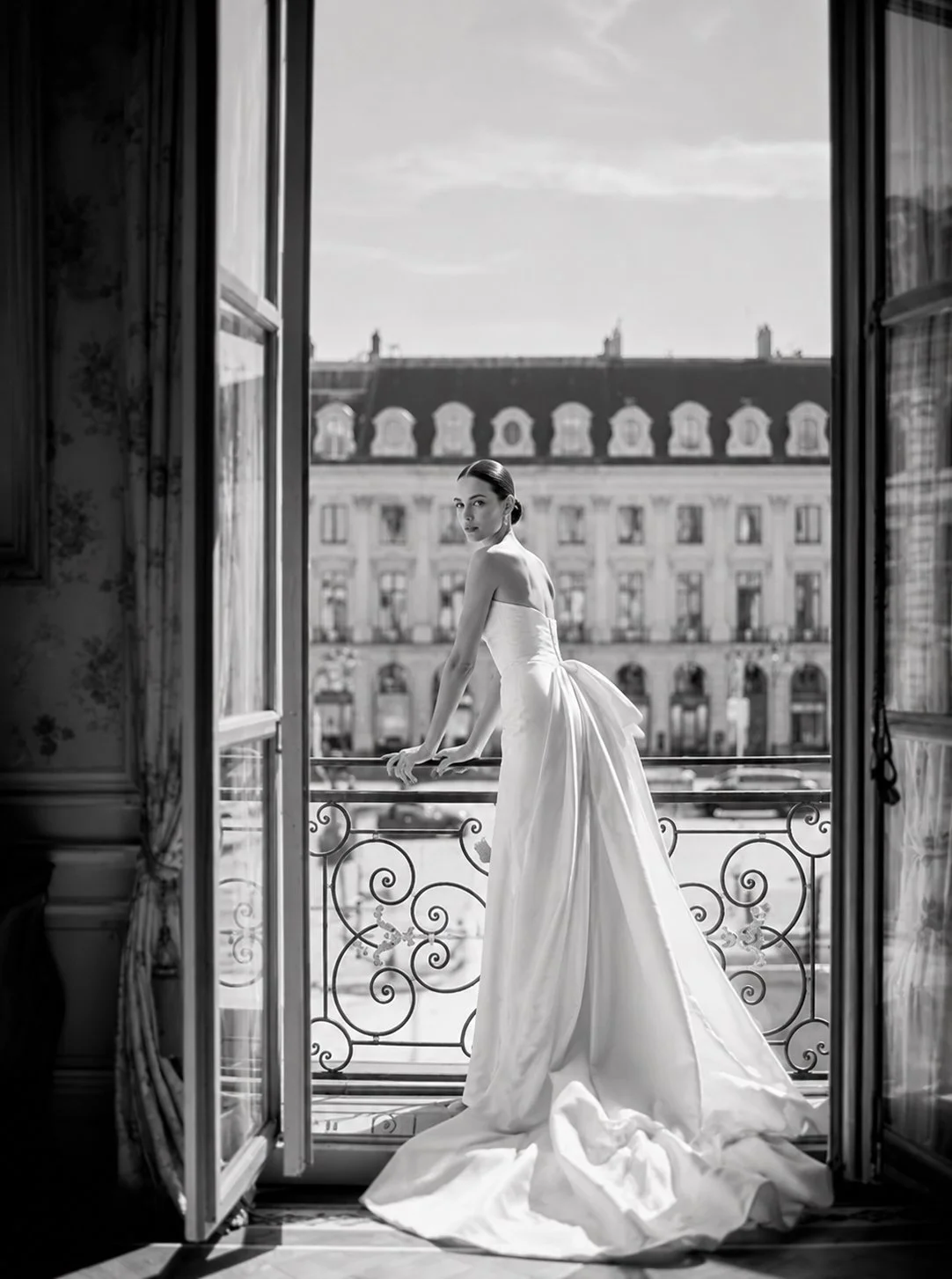
Elegant bride in a couture wedding gown overlooking Place Vendôme from a Parisian balcony.

An editorial bridal portrait overlooking Place Vendôme, captured in timeless black and white. Contemporary Parisian elegance, couture-inspired styling and refined architecture come together in this iconic luxury wedding image.

Light changes the way we feel.

But even the most beautiful château has never hugged a nervous bride.

People do that.

Fortunately.

The older I become, the less interested I am in weddings that resemble perfectly styled editorials.

And the more interested I become in homes that feel as though Apartamento might one day want to photograph them.

Lived in.

Collected slowly.

Never over-explained.

Never trying too hard.

The same is true of photographs.

Some are designed to impress.

Others quietly reveal themselves over time.

Rather like discovering, years later, that the photograph you return to most often isn’t the dramatic portrait at sunset.

It’s the one where your mother is laughing with her head thrown back because somebody has just told a terrible joke.

Or the one where your partner reaches for your hand without realising they have done it.

Those photographs don’t demand attention.
They reward it.

Perhaps that is why I have never been interested in following trends.

Trends are wonderfully entertaining.

Taste is wonderfully patient.

Time, after all, has excellent taste.

And good taste, almost without exception, rarely raises its voice.

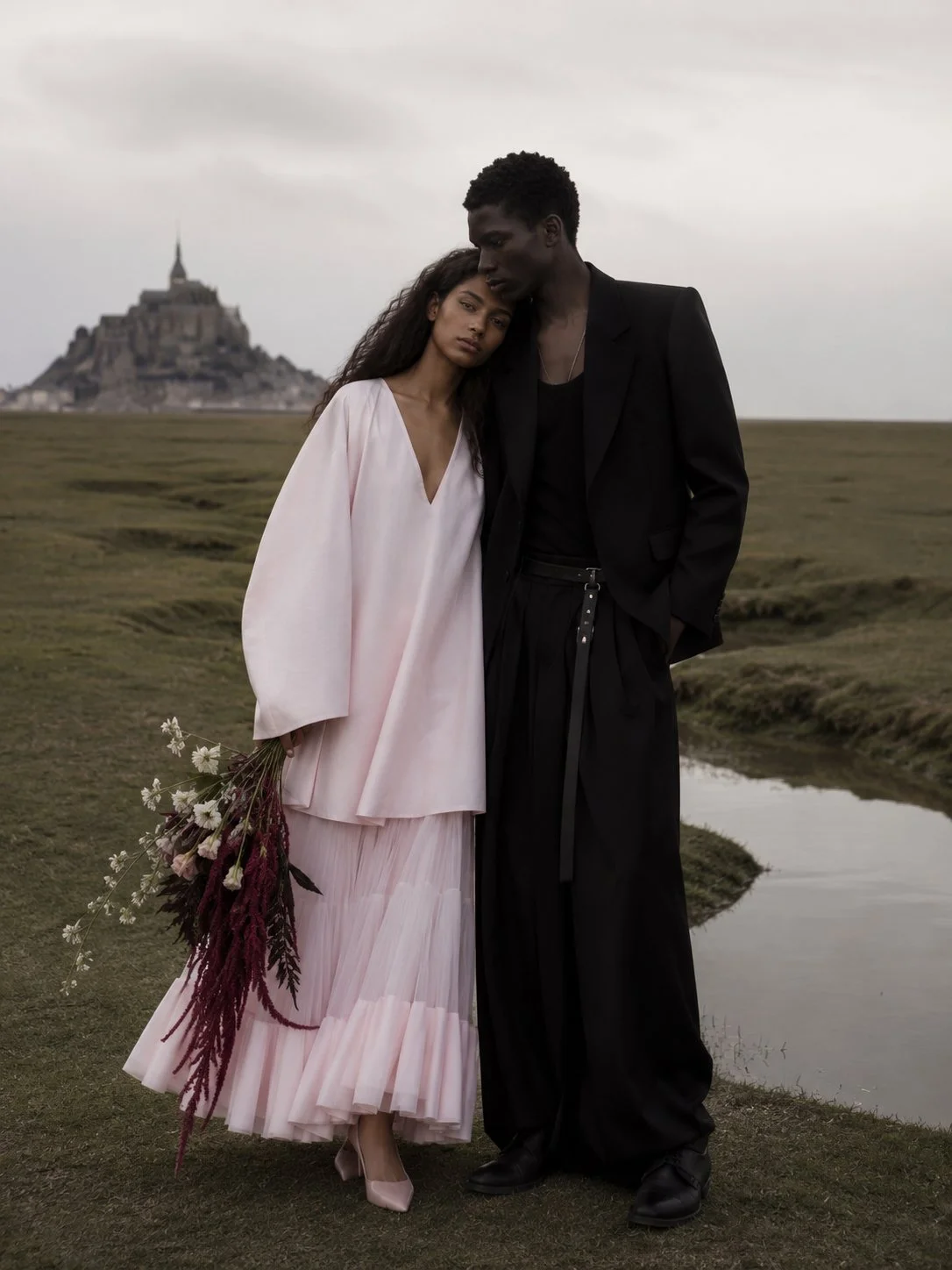
Couple lors d’un mariage au Mont-Saint-Michel en Normandie, photographié dans un style éditorial moderne par une photographe de mariage de luxe en France.

Modern silhouettes at Mont-Saint-Michel.

Time Has Excellent Taste

Time is a remarkably demanding editor.

It has very little patience for trends.

Or performances.

Or anything created merely to impress.

It quietly removes what was fashionable.

And leaves behind what was true.

The photographs that astonish us on the morning after a wedding are not always the ones we return to twenty years later.

Something curious happens with time.

Our eyes become gentler.

We stop admiring perfection.
We begin searching for recognition.
A familiar gesture.
A particular smile.

The way someone stood.

The way someone loved.

Suddenly, the photograph we once overlooked becomes the one we cannot stop returning to.

Not because it is extraordinary.

Because it feels like home.

I’ve often wondered whether photographs become more beautiful with age.

I don’t think they do. I think we do.

We become better at recognising what was already there.

The quiet glance.

The hand resting absent-mindedly on another.

The conversation continuing in the background while nobody noticed the camera.

Those moments never belonged to fashion.

Which is precisely why they survive it.

Perhaps that is all we can really hope for.

Not photographs that remain fashionable.

Photographs that remain familiar.

Because familiarity is another word for love.

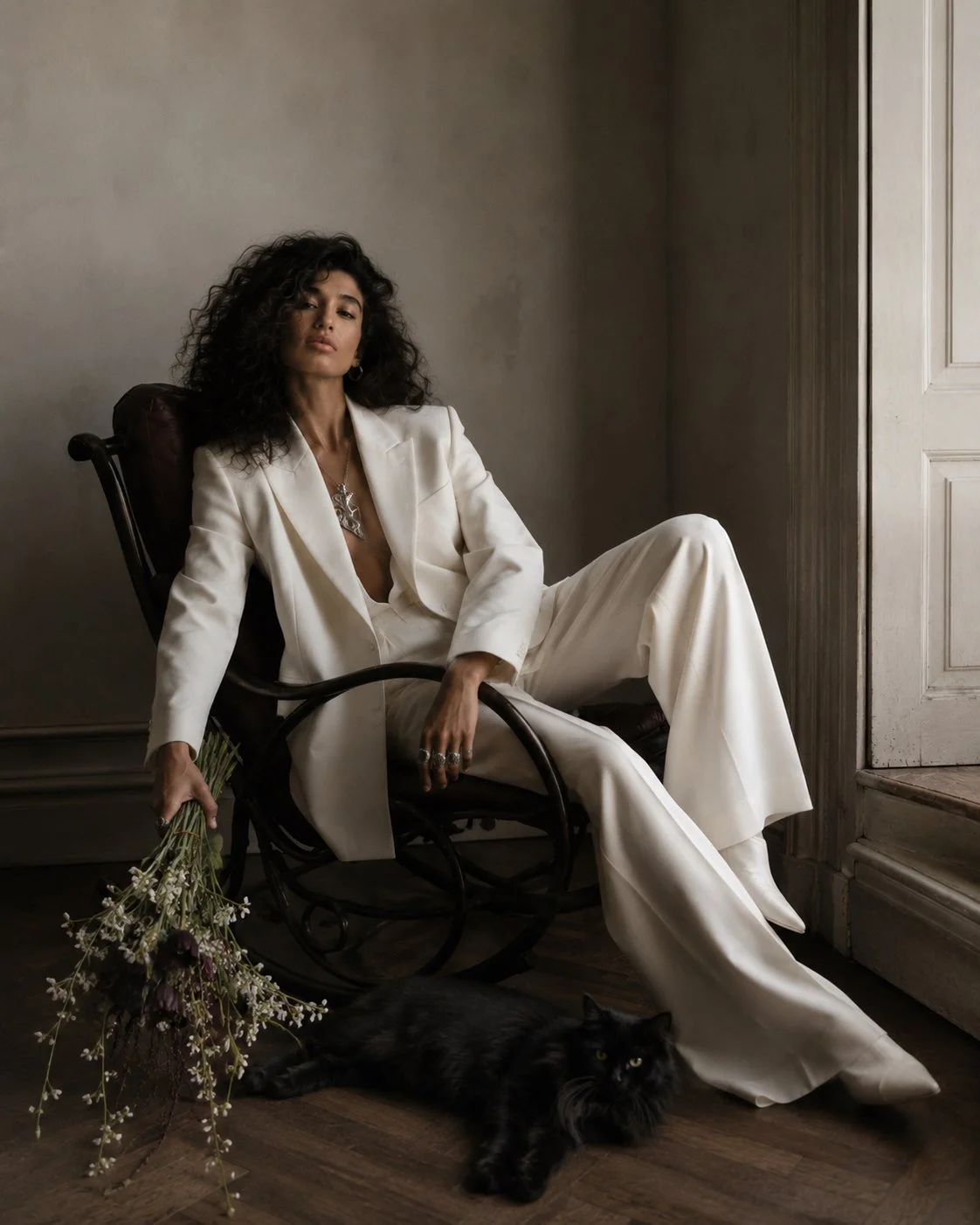
Editorial Fashion Bride in a White Bridal Suit | Luxury Wedding Photographer France

For brides who love fashion as much as romance.

Perhaps, A Better Question

When couples ask me,

“Who is the best wedding photographer in France?”

I still don’t know how to answer. Perhaps because I don’t believe such a person exists.

There are photographers whose eyes are drawn to fashion.

Others to architecture.

Others to emotion.

Others to light.

None of them are right.

None of them are wrong.

They simply notice different things.

The real question has never been who is the best.

It has always been…

Whose way of seeing the world already feels like home to you?

Because one day, your children or perhaps someone who has not even been born yet, will learn who you were through these photographs.

How you laughed. How you danced. How you looked at one another when you thought nobody else was watching.

In the end, that is what you are choosing.

Not simply a photographer.

A witness.

A presence.

A way of seeing.

And, quietly,

a small part of the memory your family will one day inherit.


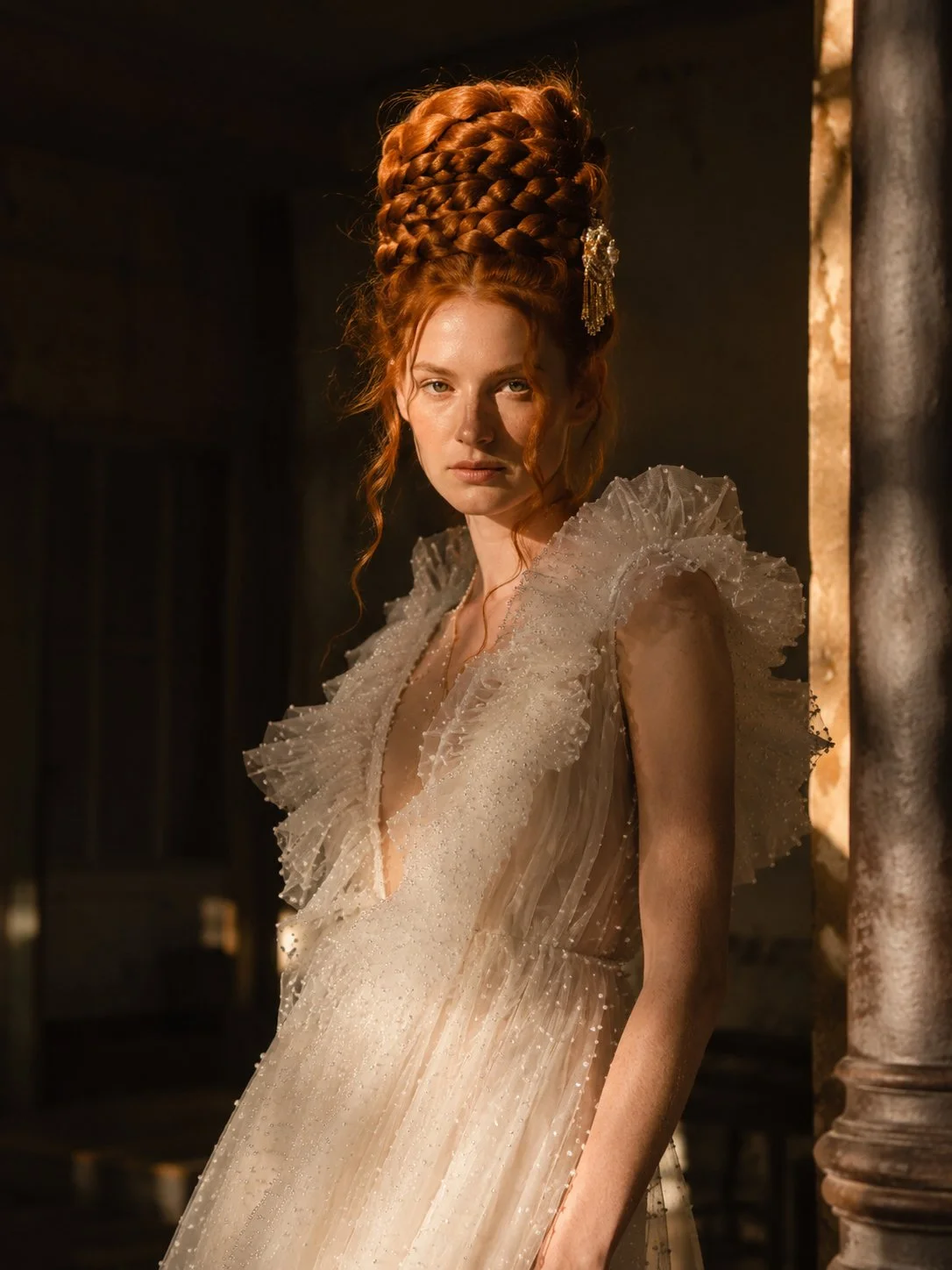
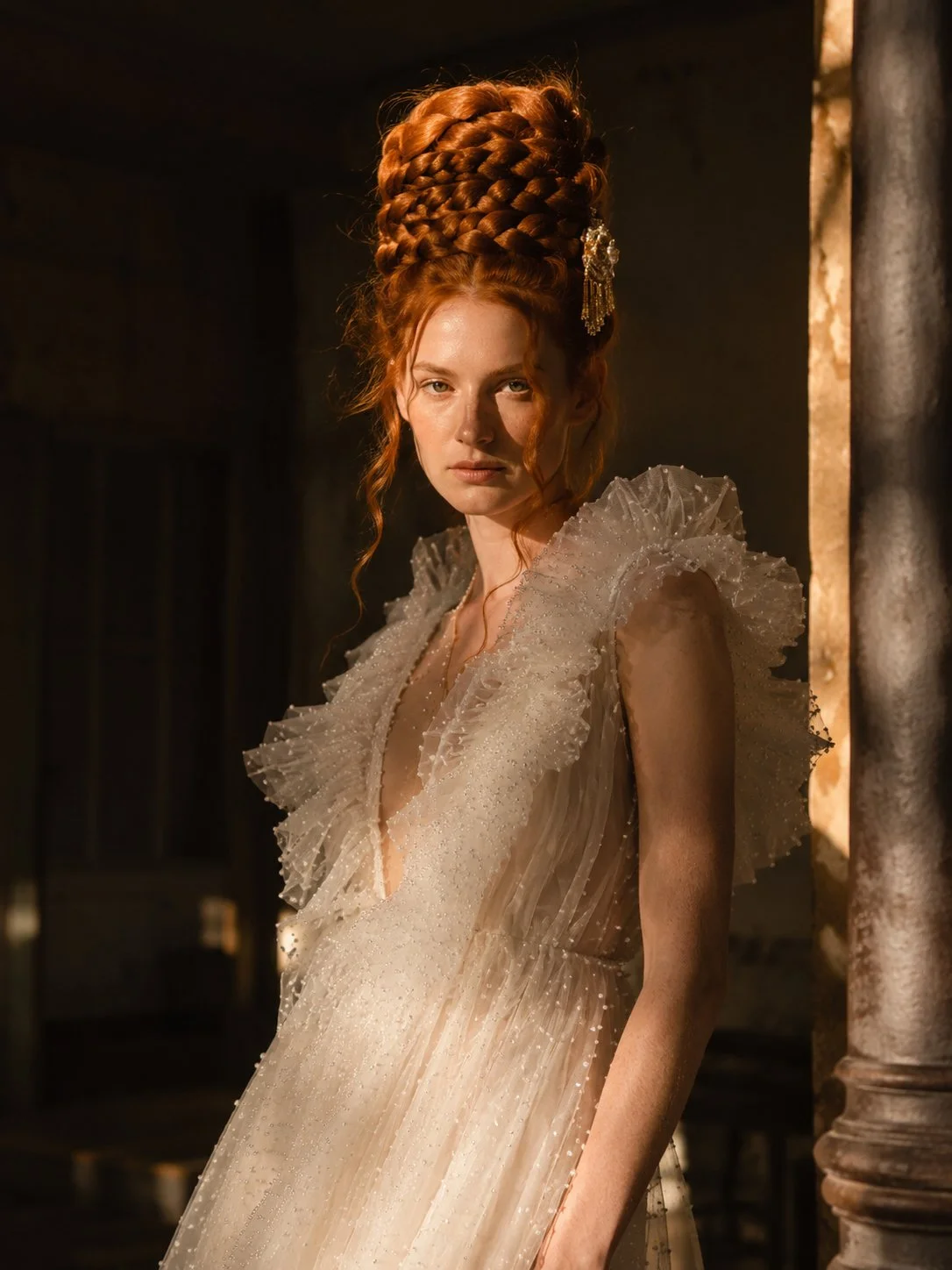
Editorial Redhead Bride | Luxury Wedding Photographer France

Some brides wear couture. Others inhabit it.

KALICKY SONJA
The Most Beautiful Château Wedding Venues Near Paris

The Most Beautiful Château Wedding Venues

Near Paris

A slightly opinionated selection by a wedding photographer


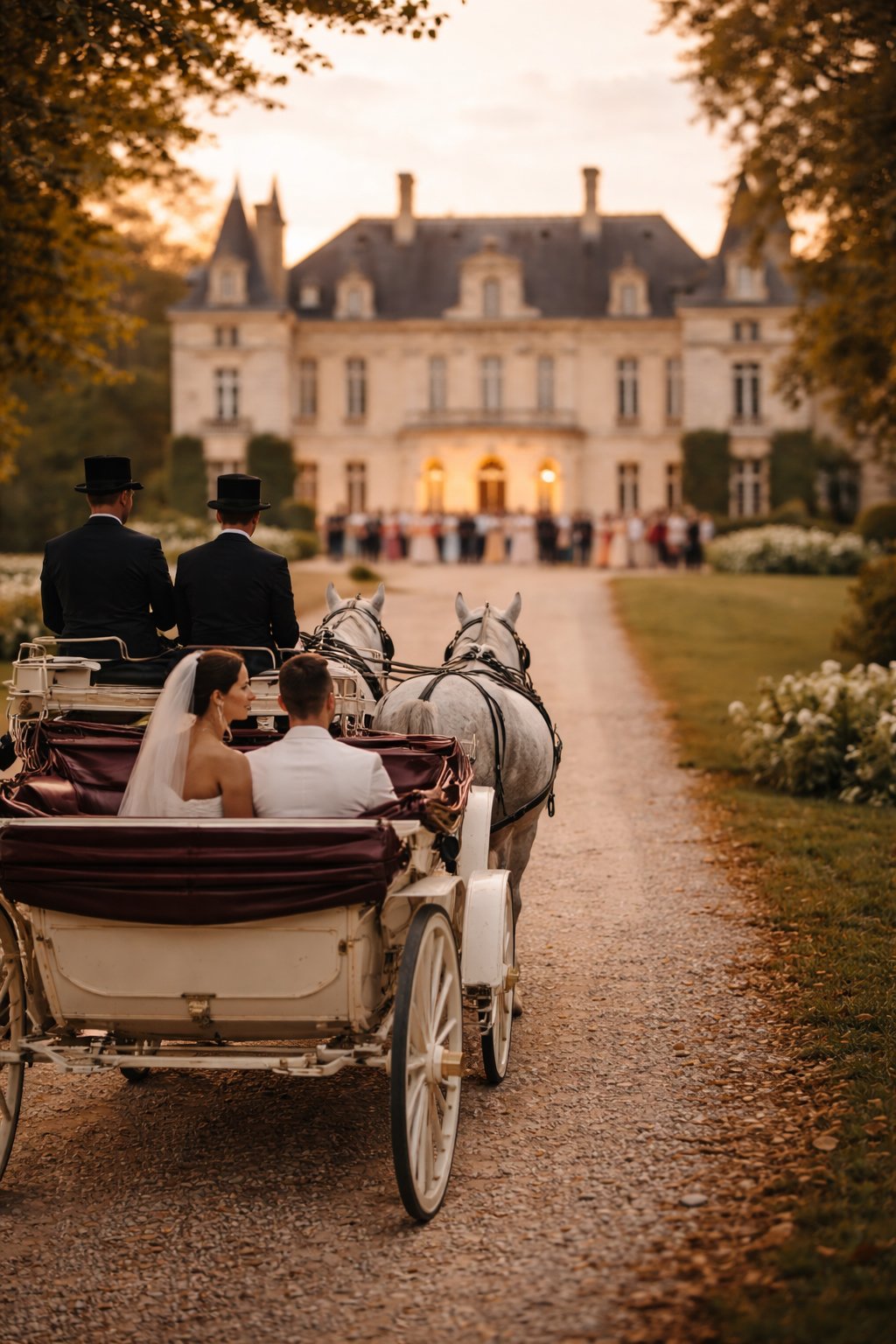
romantic arrival carriage chateau wedding france near paris

Romantic arrival at a French château wedding near Paris, horse-drawn carriage and golden hour atmosphere– Le Joli Studio

Paris has its cafés, its couture houses and its perfectly choreographed boulevards.

But when couples start planning a destination wedding in France, something interesting happens.

They leave the city.

Drive forty minutes beyond the périphérique and the landscape begins to soften. The traffic fades, the roads curve through forests, and behind discreet iron gates appear estates that seem to belong to another century.

Châteaux.

Not the Versailles kind with ticket lines and guided tours.

The real ones.

The ones where gravel crunches under your shoes, where gardens stretch toward the horizon and where dinner sometimes unfolds outside, under a sky threaded with fairy lights and champagne quietly circulating between tables.

For couples travelling from New York, London or elsewhere, these places often feel like stepping inside a film.

Not a historical drama. Something looser. More luminous.

Very French.

As a Paris-based wedding photographer, I spend a surprising amount of time wandering through these estates, watching how the light falls across courtyards, how guests move through gardens, how a staircase suddenly becomes the perfect backdrop for a photograph.

Within an hour of Paris, a surprising number of historic estates open their doors to destination weddings in France.

Here are ten château wedding venues near Paris where weddings rarely feel staged.

Only beautifully lived.

bride descending grand staircase french chateau wedding Baronville

I had the chance to photograph a wedding at Château de Baronville, its grand staircase alone is unforgettable – Le Joli Studio

If you are exploring the world of French château weddings,

you can also discover a broader selection of venues and celebrations photographed across France on my dedicated page.


1. Château de Vallery

The château that secretly loves a party

Region: Burgundy — about 1h30 from Paris

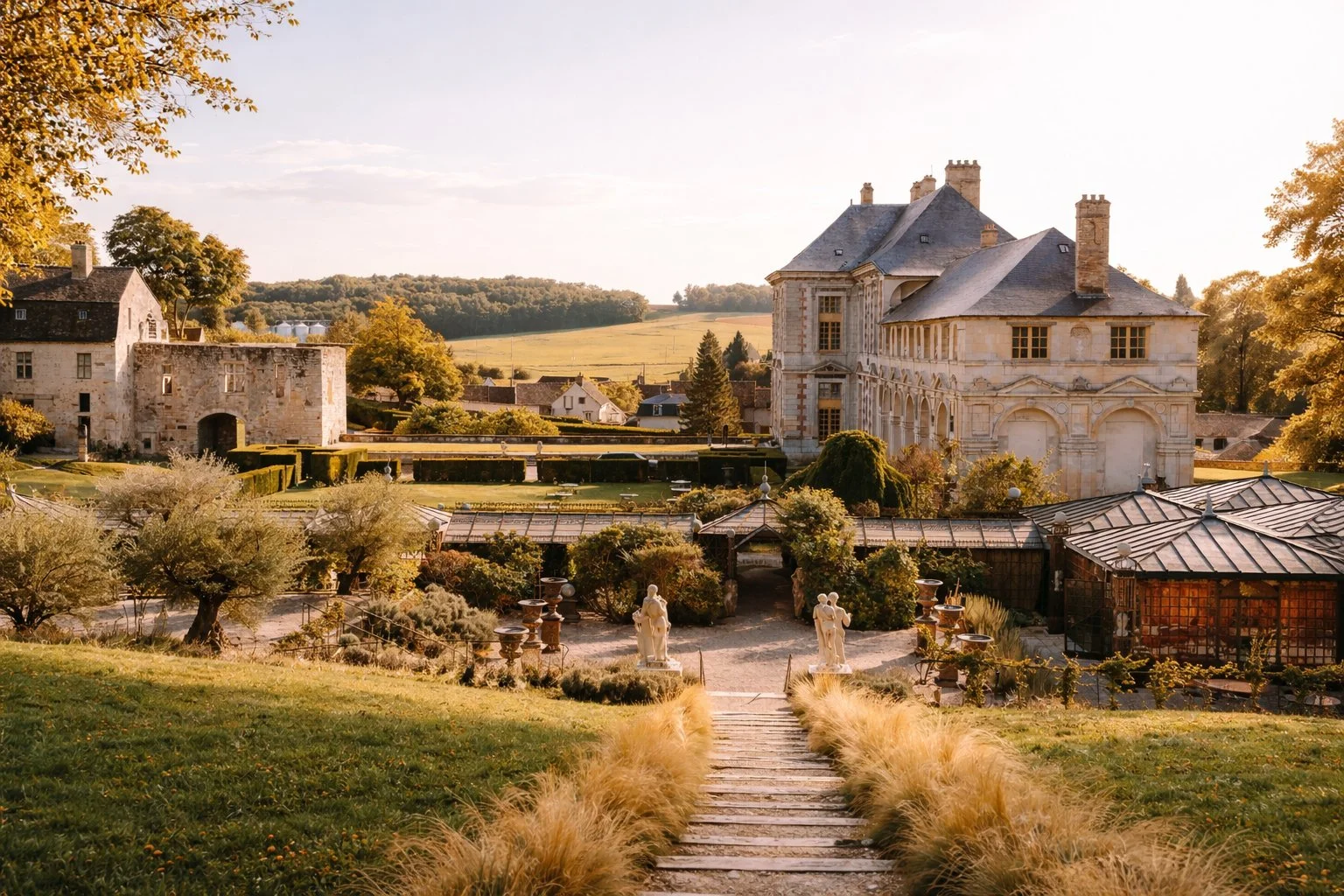
Set in the Burgundy countryside about 1h30 from Paris, Château de Vallery has become one of the most sought-after château wedding venues in France for destination celebrations.

Wedding dinner in the candlelit courtyard of Château de Vallery in Burgundy near Paris – destination wedding in France photographed by Le Joli Studio

Candlelit reception dinner in the courtyard of Château de Vallery, one of the most sought-after château wedding venues near Paris – Le Joli Studio

Some châteaux impress you. Vallery welcomes you.

Built during the Renaissance, the estate revolves around a vast honey-coloured stone courtyard framed by elegant arcades. At sunset the entire place glows as if someone quietly turned up the warmth on the light.

Ceremonies usually take place in the gardens, tall hedges, ancient trees, the countryside stretching beyond. Making it one of the most sought-after destination wedding venues near Paris.

Later, guests drift toward the courtyard.

Tables appear. Candles begin multiplying across the stone. From above, it almost looks like a film set assembling itself.

Somewhere between the second glass of Burgundy wine and the first notes of music, the atmosphere changes. Shoes disappear. Laughter rises against the walls.

Vallery has hosted weddings from London, New York, Dubai and beyond.

And somehow, despite its scale, it always feels intimate.

As if the château itself enjoys the celebration.


Discover Ibrahim & Natalie’s wedding photographed at Château de Vallery.


2. Château de Villette

Versailles energy — without the crowds

Region: Yvelines — about 45 minutes from Paris

Golden hour portraits in the gardens of a château wedding near Paris.

Golden hour portraits in the gardens of a château wedding near Paris.

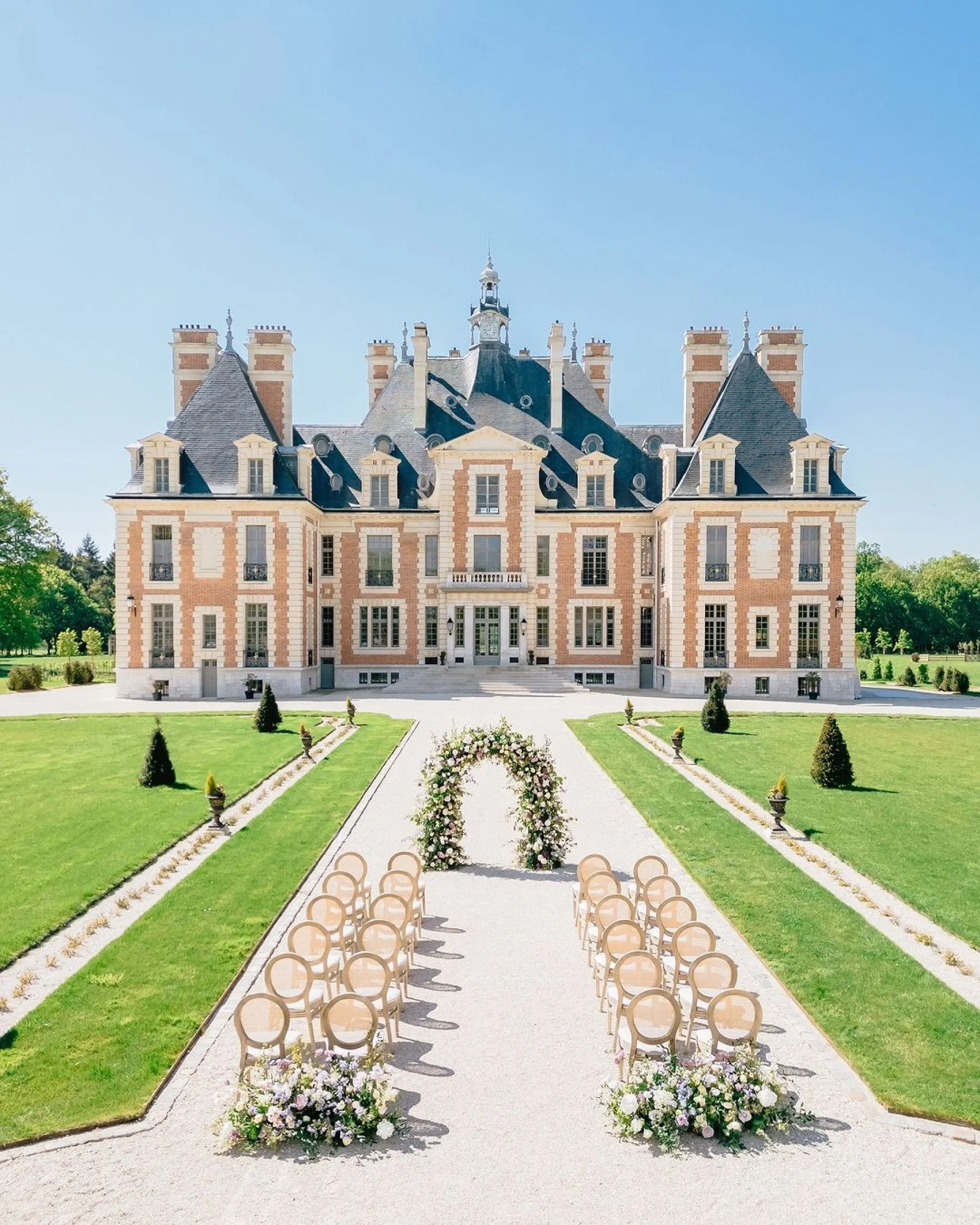
Villette has the quiet confidence of classical French architecture.

Long perspectives. Perfect symmetry. Gardens that stretch toward the horizon like green velvet corridors.

The estate sits within a vast park inspired by the work of André Le Nôtre, the same landscape architect behind Versailles.

But here, everything feels calmer.

Guests wander along reflecting pools. Champagne appears on terraces. The façade of pale stone captures the afternoon light in a way photographers particularly appreciate.

Inside, the salons feel almost cinematic: parquet floors, tall windows, soft candlelight bouncing gently from one wall to the other.

Villette doesn’t try to impress. It simply is. Which might be the chicest thing of all.


3. Château de Champlâtreux

Quiet aristocratic elegance

Region: Val-d’Oise — about 40 minutes from Paris


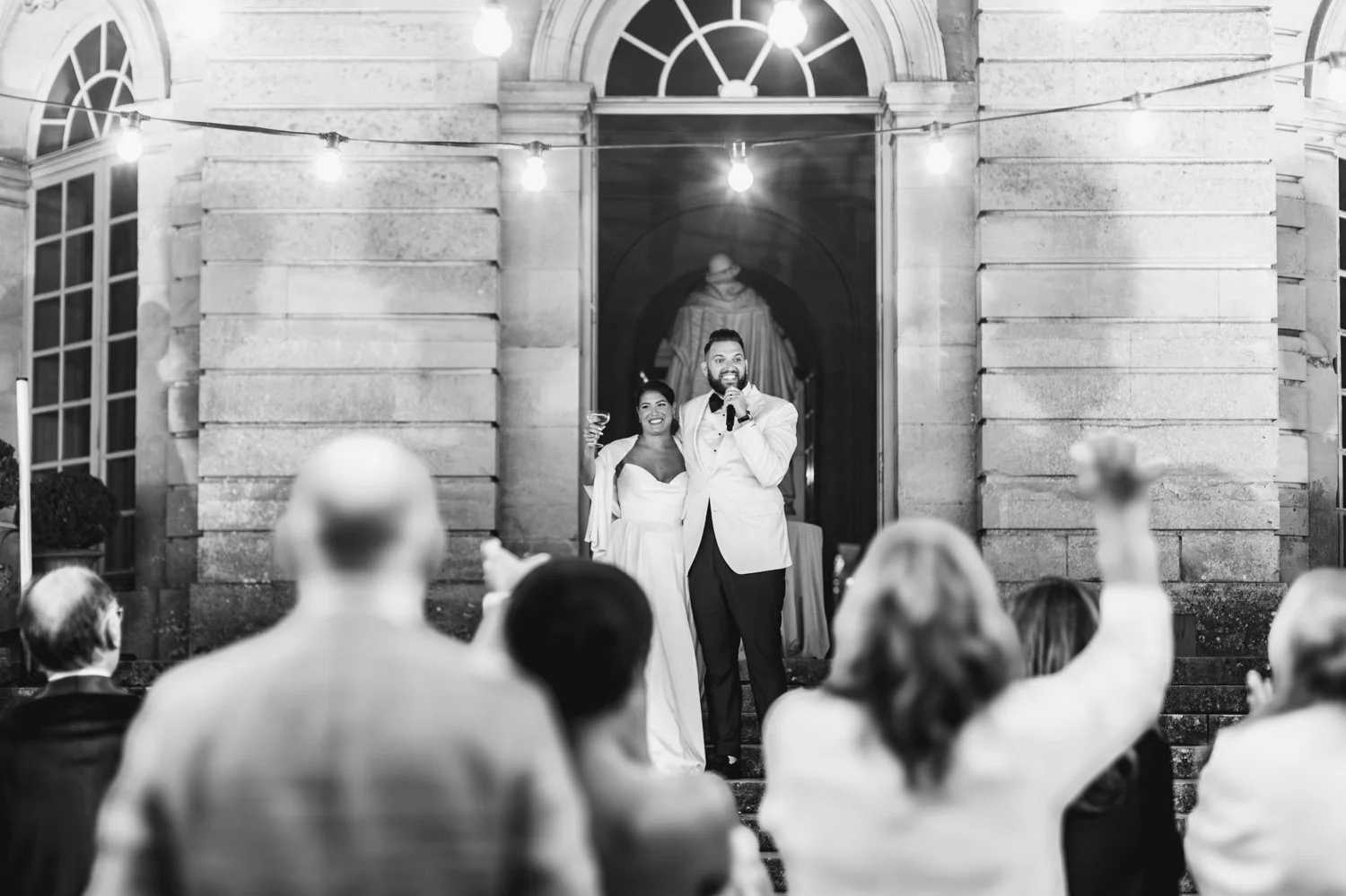
wedding speech during reception at Château de Champlâtreux near Paris luxury château wedding venue

A wedding speech unfolding on the steps of Château de Champlâtreux as the evening reception begins – Le Joli Studio

bride portrait by the window inside Château de Champlâtreux near Paris wedding venue

A quiet moment with the bride inside Château de Champlâtreux before the celebration begins – Le Joli Studio

Champlâtreux is the kind of place that makes guests lower their voices slightly when they arrive.

Not out of intimidation. Out of respect.

The 18th-century façade stretches across the landscape with the kind of symmetry French architects once treated as an art form. Gravel crunches softly beneath arriving guests, and somewhere in the distance church bells from the nearby village sometimes echo across the park.

Ceremonies often take place beneath tall trees in the gardens.

Later, the terrace fills with guests balancing champagne glasses and small plates of delicate French hors-d’œuvre.

As night falls, the château takes on a completely different character.

Windows glow. Music drifts outward. The façade becomes a backdrop for dancing.

Champlâtreux doesn’t shout. It whispers elegance.

Discover the wedding of Dani & Pete photographed at Château de Champlatreux.


4. Château de Farcheville

A medieval castle with editorial drama

Region: Essonne — about 1 hour from Paris

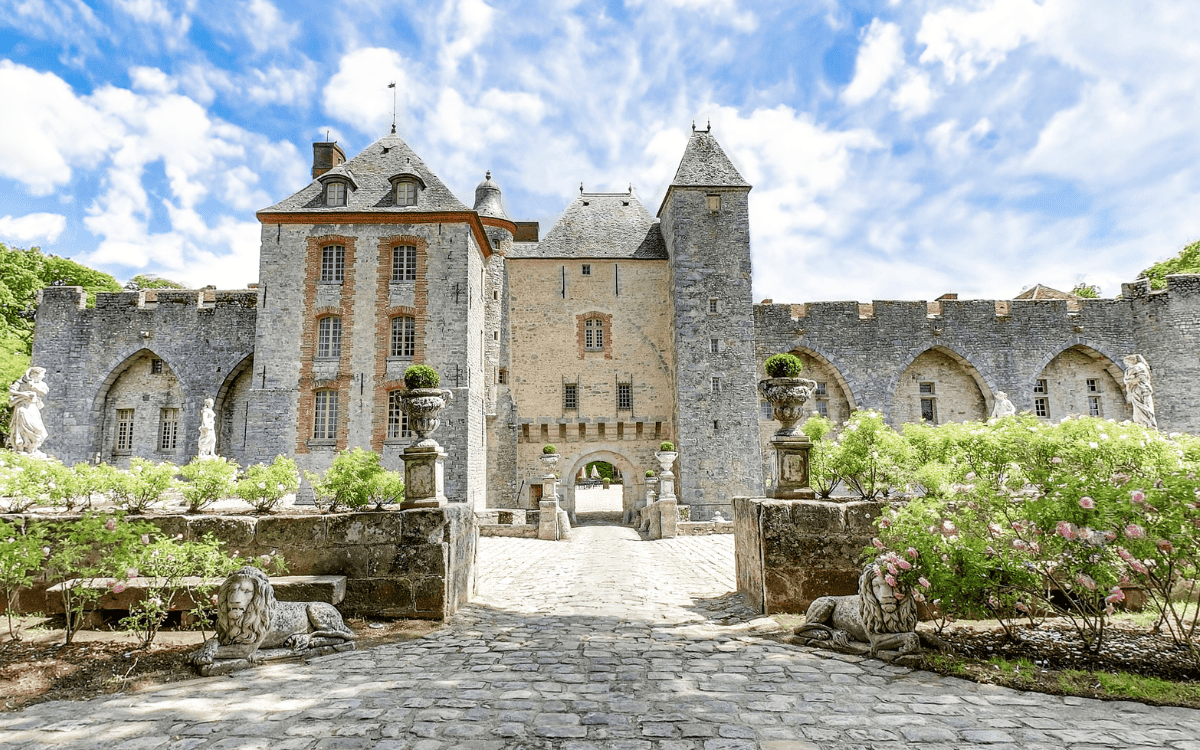
Medieval architecture of Château de Farcheville wedding venue near Paris with stone courtyard and gardens

The medieval architecture of Château de Farcheville creates one of the most dramatic wedding settings near Paris.

Farcheville is something else entirely. This is not the polite elegance of classical architecture.

This is medieval stone, towers and walls that have been standing since the 13th century. The first time you walk through the gates, it feels less like arriving at a wedding venue and more like stepping into a film location. Ceremonies unfold in gardens bordered by ancient walls. Cocktails happen in hidden courtyards where ivy climbs slowly across the stone.

By nightfall the castle becomes theatrical. Light grazes the towers, shadows stretch across the courtyard and music echoes between the walls.

For photographers, it’s extraordinary. Every corner looks like the beginning of a story.


5. Château de Rochefort-en-Yvelines

A château discovered at the end of a forest road

Region: Yvelines — about 1 hour from Paris

Château de Ferrières wedding venue near Paris with grand staircase and Rothschild architecture

Château de Rochefort-en-Yvelines, a romantic château wedding venue hidden in the forests of the Chevreuse Valley near Paris

Rochefort has the discreet charm of places that reveal themselves slowly.

The road curves through the forest. A small village appears. And then, behind a line of trees, the château emerges almost unexpectedly.

Morning light here is beautiful, soft mist sometimes drifting across the lawns while the stone façade catches the first golden reflections of the sun.

Ceremonies unfold in the gardens overlooking the valley.

Later, guests gather in the orangery where long tables glow under candlelight.

It’s a venue that feels romantic without trying too hard. Which is often the best kind.


6. Château de Bourron

A cinematic arrival

Region: Fontainebleau — about 1 hour from Paris

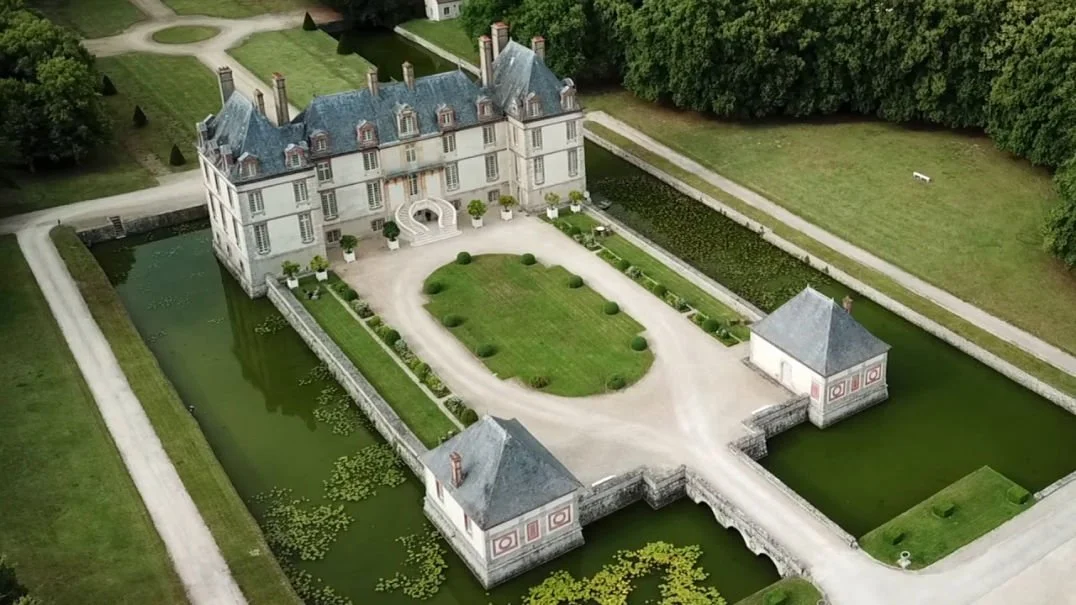
Luxury wedding venue Château de Bourron near Paris surrounded by gardens and moat

Some wedding venues are memorable for their architecture.

Bourron is unforgettable for its entrance.

Two monumental gates open onto a long tree-lined avenue that leads directly toward the château.

Cars roll slowly along the gravel.

Guests lean out of windows to catch a first glimpse of the estate.

And suddenly the entire façade appears at the end of the avenue like something from a film.

Ceremonies unfold in gardens overlooking the Fontainebleau forest.

Later, dinner and dancing move into elegant glass orangeries where the night seems to last forever.


7. Château de Nainville-les-Roches

A discreet gem

Region: Essonne — about 45 minutes from Paris

Luxury outdoor wedding ceremony at Château de Nainville-les-Roches near Paris, France

Outdoor ceremony at Château de Nainville-les-Roches near Paris, one of the most elegant château wedding venues in the Paris region.

Nainville is the sort of château many couples discover late in their search.

And then quietly fall in love with.

The estate sits within a large park just outside Paris and offers beautiful perspectives for outdoor ceremonies.

Its reception spaces blend historic architecture with modern comfort, making it ideal for couples who want the elegance of a château without excessive formality.

It feels intimate.

Almost secret.


8. Château de Verderonne

A garden party dream

Region: Oise — about 1 hour from Paris

Romantic lake view of Château de Verderonne wedding venue near Paris, France

Château de Verderonne Wedding Venue Near Paris

Verderonne is the kind of place where weddings feel effortless.

Roses climb across the gardens.

Fountains murmur quietly in the background.

The château watches peacefully from the edge of the lawn.

Ceremonies unfold in the gardens.

Cocktails stretch across the grass while the sun slowly lowers behind the trees.

By evening, dinner appears under strings of lights and the celebration becomes something joyful and slightly wild.

Less choreography. More spontaneity. Exactly how weddings should feel.


9. Château de Ferrières

Rothschild grandeur near Paris

Region: Seine-et-Marne — about 35 minutes from Paris

Château de Ferrières wedding venue near Paris with grand staircase and Rothschild architecture

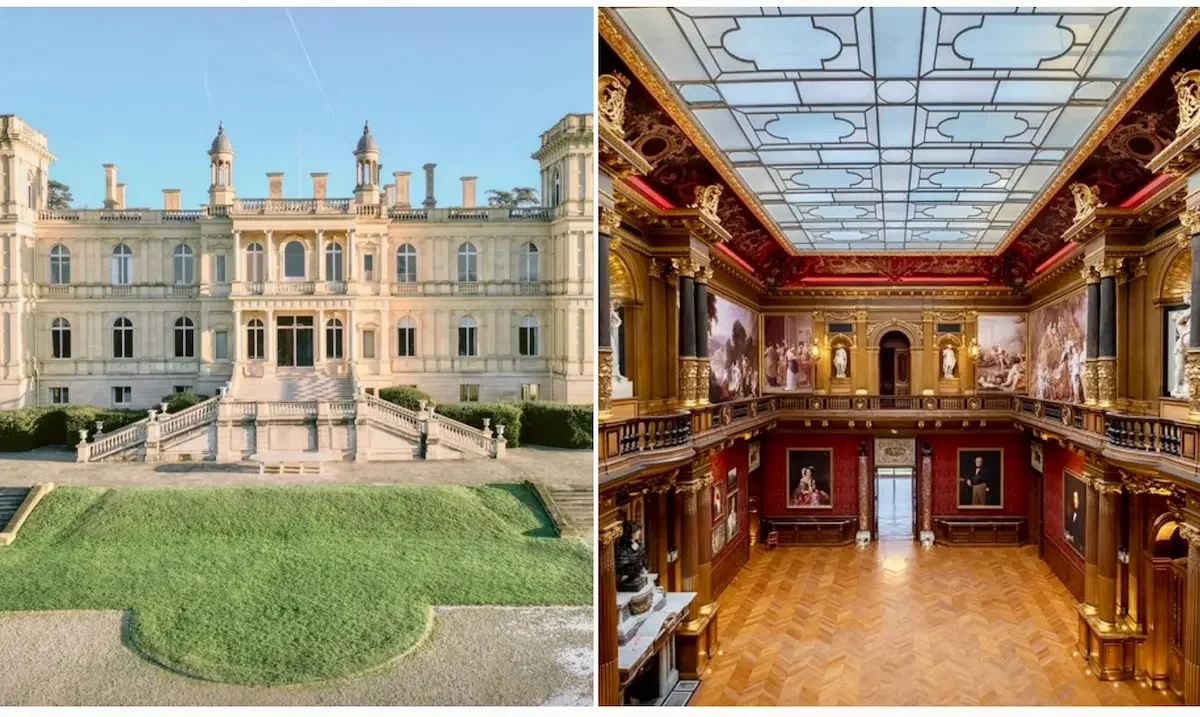
Château de Ferrières, a spectacular 19th-century Rothschild estate near Paris often chosen for luxury weddings and private events.

Some châteaux charm you. Ferrières overwhelms you, in the best possible way

Built in the mid-19th century for Baron James de Rothschild, the château was designed as a statement of wealth, taste and influence. The result is an estate that feels almost palatial: vast stone façades, monumental staircases and interiors that seem made for candlelight and orchestras.

Approaching the château already feels cinematic. The park opens gradually and the architecture appears at the end of the perspective like a carefully staged reveal. Inside, the scale becomes even more striking.

Grand salons stretch from one room to another beneath glittering chandeliers. Marble fireplaces frame the walls. Tall windows flood the rooms with natural light during the day and reflect hundreds of candles once evening falls.

For weddings, the estate offers something rare near Paris: true grandeur.

Ceremonies often unfold in the gardens surrounding the château. Guests wander across the terraces during cocktail hour, champagne glasses catching the last golden light of the afternoon.

Later, receptions move inside the historic salons, where dinner tables line up beneath ornate ceilings and the entire space begins to glow.

By the time the dance floor opens, Ferrières feels less like a historic monument and more like the setting of an elegant European film.

For couples dreaming of a truly spectacular château wedding near Paris, few venues offer such a powerful sense of scale and history.

bride and groom portrait on the monumental staircase of Château de Baronville near Paris wedding venue

Bérengère and Ludovic on the monumental staircase of Château de Baronville before the evening celebration – Le Joli Studio


10. Château de Villiers-le-Mahieu

A château that feels like a perfect country weekend

Region: Yvelines — about 45 minutes from Paris

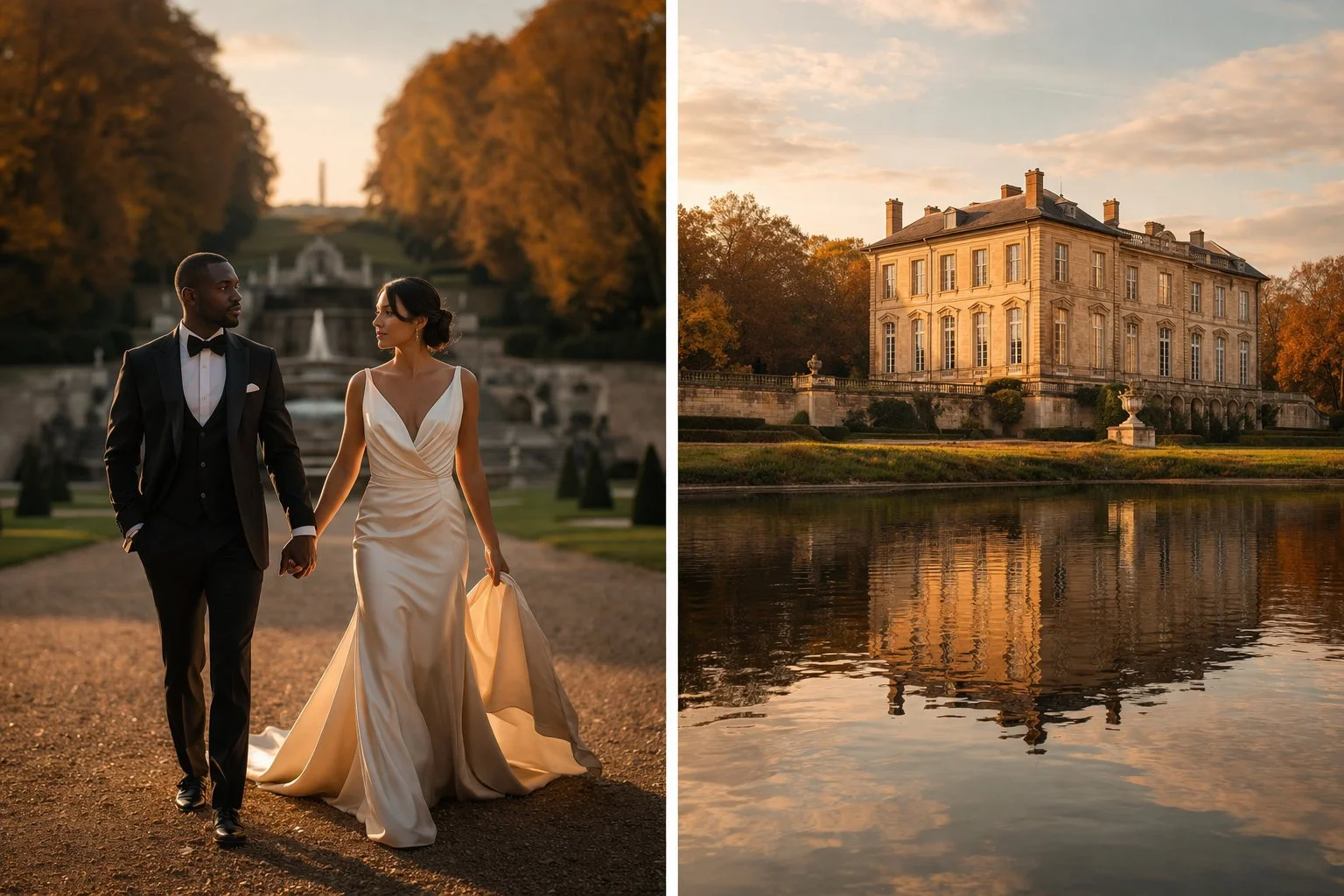
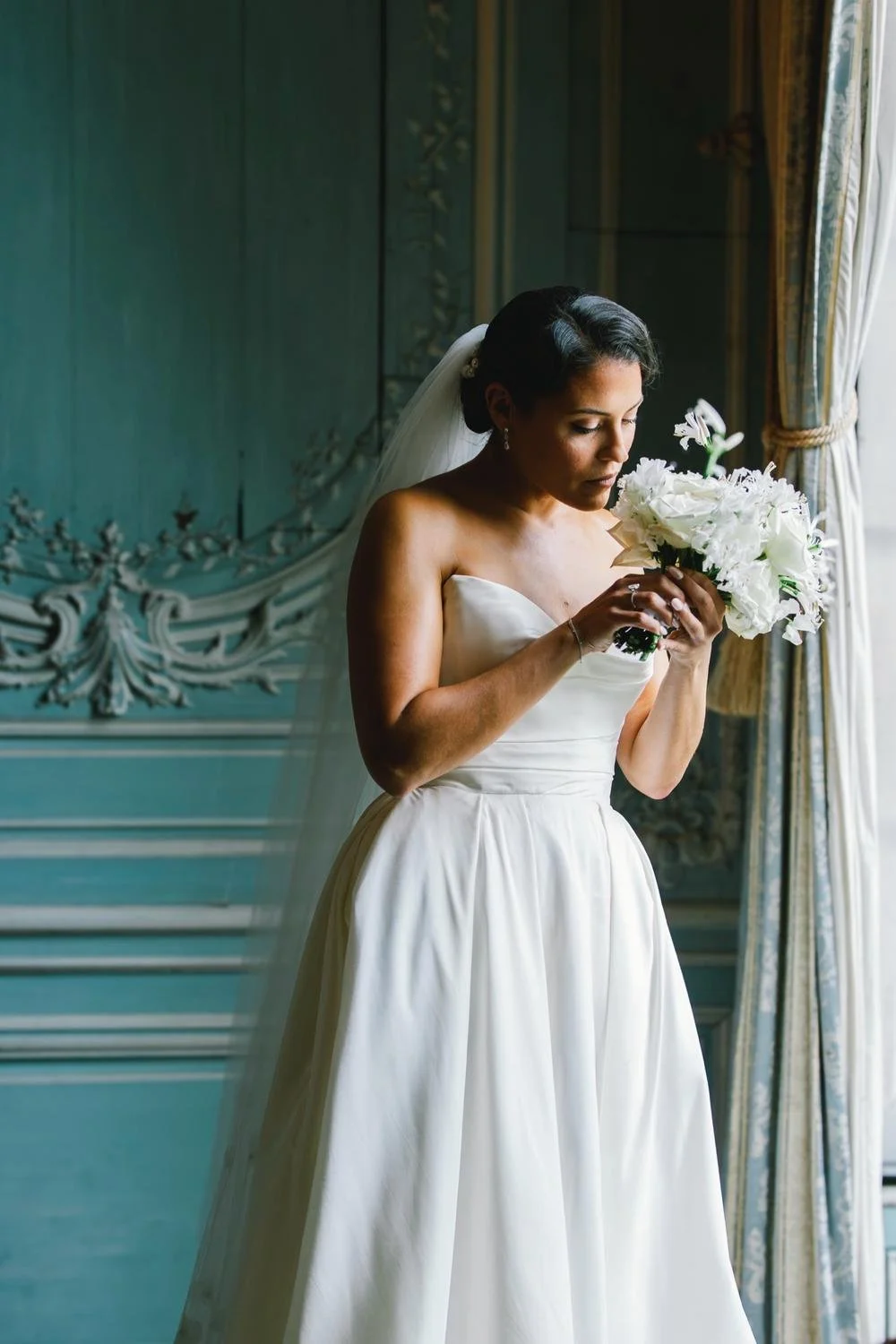
Château de Villiers-le-Mahieu, a charming château wedding venue near Paris surrounded by gardens and water.

Editorial wedding photography of a same-sex wedding celebration at Château de Villiers-le-Mahieu, one of France’s most elegant château wedding venues.

Some wedding venues feel theatrical. Villiers-le-Mahieu feels like a secret country escape.

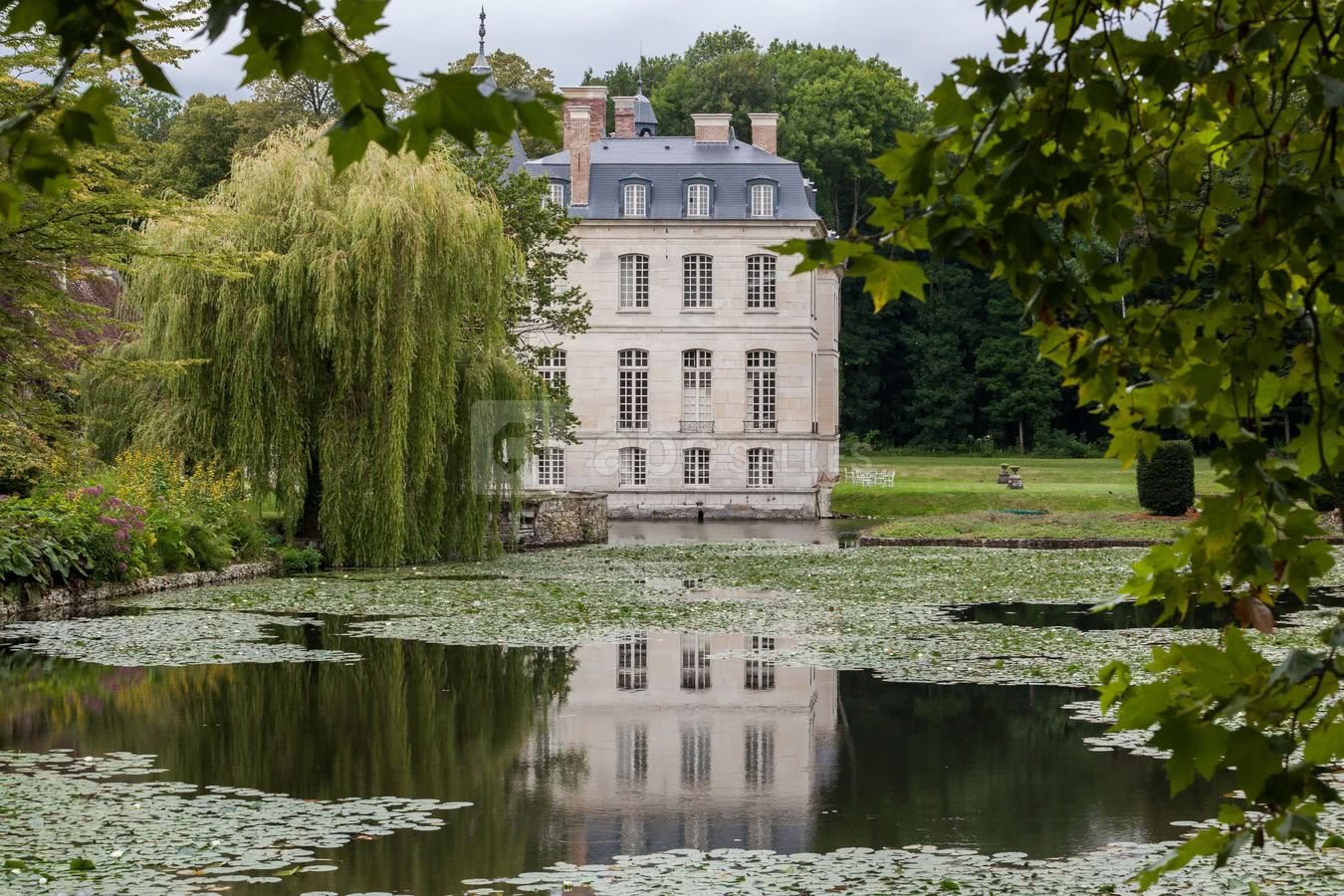
Set in the quiet countryside of the Yvelines, the château sits gently within its own moat, surrounded by gardens and long lawns that seem designed for slow summer afternoons. Arriving here is surprisingly cinematic.

A small bridge leads across the water and suddenly the château appears, reflected in the still surface like a scene from a French novel.

Unlike the grand estates that dominate the Paris wedding scene, Villiers-le-Mahieu has a different energy.

It feels lived in, relaxed, almost like a beautiful private house opened for a celebration. Guests wander between the gardens, the courtyard and the terraces, conversations stretching easily across the afternoon.

Ceremonies often take place beneath the trees, with the château quietly watching from across the water. Later, the celebration shifts naturally toward the reception spaces or elegant tents installed in the park.

What makes Villiers-le-Mahieu special is precisely this balance: historic architecture without stiffness, countryside charm without rustic clichés.

For couples looking for a château wedding near Paris that feels elegant but wonderfully unpretentious, it offers something rare, a celebration that feels less like an event and more like the most beautiful weekend in the French countryside.


Planning a Château Wedding Near Paris

Planning a château wedding near Paris can feel wonderfully romantic,

but like most beautiful things in France, it also follows its own rhythm.

Understanding a few practical elements early on makes the experience far smoother.

The Right Season

Most château weddings take place between April and early October.

Spring brings blooming gardens and soft light.
Summer offers long golden evenings where outdoor dinners stretch late into the night.

Early autumn paints the countryside in warm tones photographers quietly adore.

Budget

For celebrations with 100 to 150 guests, couples often invest between €70,000 and €200,000+

depending on the venue and scale of the celebration.

Many destination weddings also include welcome dinners, rehearsal cocktails and brunches the following day.

Guests don’t simply attend the wedding. They experience an entire weekend.

Guest Count

Most château venues comfortably host between 80 and 200 guests.

The architecture naturally encourages celebration: courtyards for long dinners, gardens for cocktails and elegant staircases that quietly become perfect backdrops for spontaneous photographs. The kind of places where images almost compose themselves.


Logistics

Most estates are located between 40 minutes and 1h30 from Paris,

making them easily accessible for international guests arriving through Charles-de-Gaulle or Orly airports.

Typical celebrations involve guest accommodation nearby, private shuttles and coordination with experienced wedding planners.

Once everything is in place, the celebration tends to unfold naturally.

A cinematic moment during the evening reception at Château de Champlâtreux near Paris – Le Joli Studio

Why Couples Choose a Château Wedding in France

Because something happens here. Cocktails drift across the gardens. Dinner appears under candlelight. Music slowly rises across the courtyard.

And at some point in the evening, the wedding stops feeling organised.

It becomes something closer to a beautifully improvised film scene.

Somewhere between a fashion editorial and a timeless celebration with friends.

Which is perhaps the real magic of a château wedding near Paris. It never feels staged. Only lived.

If you’re looking for even more atmospheric venues, you might also enjoy this selection of cinematic château wedding venues in France


FAQ — Château Weddings Near Paris

How far are château wedding venues from Paris?

Most château wedding venues near Paris are located between 40 minutes and 1h30 from central Paris, often in regions such as Yvelines, Essonne and Val-d’Oise. This distance allows international guests to arrive through Charles-de-Gaulle or Orly airports and reach the countryside estates the same day.

Which château works well for large celebrations?

Some estates near Paris are particularly suited to large-scale destination weddings.

Château de Ferrières, with its monumental salons and grand architecture, is often chosen for very large celebrations.

Château de Vallery is another favourite for international weddings thanks to its spacious courtyard and ability to host multi-day celebrations.

Which château feels more intimate?

Some venues offer a quieter atmosphere while still being close to Paris.

Château de Nainville-les-Roches and Château de Rochefort-en-Yvelines, for example, are often appreciated for their more intimate countryside setting.

Which venues are particularly beautiful for outdoor ceremonies?

Many château weddings near Paris take advantage of gardens, courtyards and terraces.

The parks of Château de Champlâtreux, Château de Verderonne, and Château de Bourron offer particularly elegant outdoor settings for ceremonies and cocktail hours.

Do château weddings near Paris usually last an entire weekend?

Many destination weddings in France unfold over two or three days, allowing guests travelling from abroad to experience the château and surrounding countryside.

Celebrations often include a welcome dinner, the wedding day itself and a relaxed brunch the following morning.


Photographing Château Weddings in France

Château weddings have a rhythm of their own. The light changes slowly across the gardens. Champagne drifts between conversations.

And at some point in the evening, the celebration stops feeling organised and becomes something much more spontaneous.

Exactly the kind of moments I love to photograph.

If you are planning a château wedding in France, near Paris or elsewhere, you can discover more of my work here

KALICKY SONJA
The Most Cinematic Château Wedding Venues in France

The Most Cinematic Chateau Wedding Venues in France


chateau-de-champlatreux-wedding-paris-france.jpg

The elegant façade of Château de Champlâtreux near Paris, where Dani and Pete celebrated their wedding.

France is home to thousands of châteaux.


Across the country, historic estates rise from forests, vineyards, riversides and coastal cliffs. Some are monumental, some intimate, some almost hidden within their landscapes. It is one of the reasons why France has become one of the most sought-after destinations in the world for château weddings.

From the Loire Valley to Provence and the French Riviera, international couples travel here to celebrate their wedding in historic estates surrounded by centuries of architecture, vineyards and remarkable landscapes.

But only a few châteaux possess something rarer than beauty.

They possess atmosphere.

As a wedding photographer working across France, I have learned that a truly remarkable château is not defined only by its architecture.

It is defined by the way light moves across its gardens, the way guests arrive through long tree-lined avenues, the way evening slowly transforms courtyards and terraces into candlelit stages.

Some estates feel intimate and poetic.

Others feel monumental and theatrical. But the most extraordinary ones share a single quality: they turn a wedding into a story that feels almost cinematic.

Across France, from the forests near Paris to the vineyards of Burgundy and the olive groves of Provence, a few châteaux stand apart.

These are places where landscape, architecture and light align perfectly. And where a wedding begins to feel less like an event…

and more like a film unfolding in real time.


Where to find the most beautiful château wedding venues in France

France offers remarkable château wedding destinations across several regions:

Île-de-France: historic estates near Paris such as Champlâtreux or Villette

Loire Valley: romantic Renaissance châteaux surrounded by vineyards

Burgundy: intimate countryside estates perfect for wedding weekends

Provence: olive groves, vineyards and luminous Mediterranean light

French Riviera: dramatic coastal castles overlooking the sea

This diversity is one of the reasons destination weddings in France feel so unique.

Outdoor wedding reception table in the gardens of Château de Champlâtreux near Paris, France

Outdoor wedding dinner set in the gardens of Château de Champlâtreux during Dani and Pete’s celebration.


Château de Champlâtreux

Classical elegance near Paris

Region: Île-de-France (near Paris)

A few kilometres north of Paris, Château de Champlâtreux appears almost suddenly after a long tree-lined avenue.

The architecture is pure eighteenth-century French classicism: balanced proportions, pale stone, elegant symmetry. It feels quiet, aristocratic and timeless.

Groom with his father and best man in the private salons of Château de Champlâtreux near Paris

The groom with his father and best man inside the private salons of Château de Champlâtreux near Paris.


Late afternoon is when the château truly reveals itself. The sun filters through rows of lime trees and warms the façade with a golden glow.

Inside, the grand staircase becomes one of the most dramatic portrait settings in the entire Paris region.

The atmosphere here feels like something from a Sofia Coppola film — refined, intimate, quietly romantic.

Ideas for a wedding experience

  • Many couples arriving from Paris transform the approach into a moment of theatre. Imagine guests arriving in vintage Citroën DS cars, champagne already circulating in the gardens while a jazz trio plays softly beneath the trees.

  • A dinner under a sailcloth tent could slowly transition into a candlelit dance floor beneath the stars.

Many couples combine their château wedding with a few days in the capital, which is why I also love photographing Paris weddings and elopements.

Wedding ceremony setup inside Château de Champlâtreux near Paris

Ceremony setup inside Château de Champlâtreux.

Bride dancing with her father during a wedding celebration at Château de Vaux-le-Vicomte in France

A magical dance moment during a wedding celebration at Château de Champlâtreux.


Château de Vallery

A Renaissance courtyard built for celebration

Region: Burgundy

Some châteaux whisper elegance.

Château de Vallery prefers something louder.

Hidden in the gentle countryside of northern Burgundy, this sixteenth-century Renaissance estate was never designed for discretion. From the moment guests pass through its gates, they step into a vast stone courtyard framed by arcaded galleries, towers and warm golden façades that seem to glow as evening approaches. It feels less like entering a private residence and more like arriving on a stage. And that is exactly why Vallery has become one of the most beloved château wedding venues in France.

Built during the French Renaissance and once owned by Jacques d’Albon de Saint-André, a favourite of King Henry II, the château carries the quiet authority of historic power. Yet its atmosphere is surprisingly relaxed.
The architecture is monumental, but the mood is festive.

Unlike many estates where gardens dominate the setting, here the heart of the celebration is the courtyard itself — an extraordinary open space where long banquet tables, musicians and candlelight transform the château into something closer to a Renaissance festival than a formal reception.


As night falls, lanterns begin to flicker beneath the arcades. Music drifts through the galleries.
Guests wander through the stone corridors with glasses of champagne while laughter echoes against the ancient walls. Some couples choose elegant dinners beneath the arches.

Others push the theatrical spirit even further, transforming the courtyard into an open-air ballroom, with dancing beneath the stars and midnight celebrations that stretch deep into the Burgundian night.

Few places in France capture the joyful chaos of a great wedding quite like Vallery.

This is not a château that asks celebrations to behave politely. It encourages them to become unforgettable.

Discover how Ibrahim and Natalie transformed the Renaissance courtyard of Château de Vallery into an unforgettable celebration.


Château de Challain-la-Potherie

A fairytale château rising above the Loire countryside

Region: Loire Valley

Chateau de Challain la Potherie fairytale castle in the Loire Valley France neo gothic wedding venue

The neo-gothic towers of Château de Challain-la-Potherie rising above the Loire Valley countryside.

Some châteaux are elegant. Some are historic. Château de Challain-la-Potherie is something else entirely.

Rising from the countryside of western Loire Valley, its towers, turrets and elaborate stonework look almost deliberately extravagant — as if someone had decided to build the most unapologetically romantic castle imaginable and simply refused to stop.

The result is magnificent.

Built in the nineteenth century for the industrialist Ernest Guérin, the château embraces the full fantasy of neo-gothic architecture: soaring spires, sculpted façades, grand staircases and interiors that feel closer to theatre sets than to private rooms.

This is not a discreet château.

It is a château that understands drama.

And that is precisely why it works so well for weddings.

Guests arriving through the long avenue first see the towers emerging above the trees like something from a fairy tale. Conversations slow. Cameras appear. The day suddenly feels bigger than expected.

Some couples lean fully into that theatrical spirit.

Horse-drawn carriages rolling across the lawns. Champagne towers rising beside the terraces. String quartets drifting through candlelit salons.

Others go even further, fireworks exploding behind the spires, midnight masquerade balls, or a surprise opera singer appearing on the grand staircase.

At Challain, excess is not a problem. It is part of the charm.

Because when a place already feels slightly surreal, celebration can become wonderfully imaginative.

And that is the quiet secret of this château. It does not merely host weddings.

It encourages them to become a little bit legendary.


Château de Gudanes

A bohemian château above the Pyrenean wilderness

Region: Ariège – French Pyrenees

Chateau de Challain la Potherie fairytale castle wedding venue in the Loire Valley France

The neo-gothic towers of Château de Challain-la-Potherie, one of the most spectacular fairytale castle wedding venues in the Loire Valley.

High above the valleys of the Ariège, where the Pyrenees begin to rise in long forested waves toward the Spanish border, Château de Gudanes feels dramatically removed from the world of classical château weddings.

There are no perfectly manicured parterres here. No Versailles symmetry.

Instead, the château sits alone on its hilltop like a quiet sentinel watching over forests, rivers and distant mountain ridges.

Originally built in the eighteenth century by the Marquis Louis-Gaspard de Sales, the château was once a grand aristocratic residence before falling into near ruin during the twentieth century. For decades it stood abandoned — its plaster crumbling, its rooms slowly reclaimed by wind and weather.

Today, its careful restoration has preserved that fragile beauty.

Walls still carry the marks of time. Light enters through tall windows and spreads across faded floors. And outside, the Pyrenean landscape stretches endlessly in every direction.

The atmosphere is wildly romantic. And very different from the polished elegance of many French estates.

Gudanes attracts couples who want something less traditional — artists, adventurers, travellers who feel more at home in mountains than in formal gardens.

Weddings here often feel like poetic gatherings rather than grand productions.

Long wooden tables set beneath the trees.

Wildflowers gathered from the surrounding meadows.

Music drifting across the valley as the sky slowly darkens.

Some couples organise candlelit dinners in the château’s raw interiors, while others choose outdoor celebrations where the mountains become the true backdrop.

Arrivals can be wonderfully unconventional.

Guests climbing the hill as the château appears through the trees.

Acoustic musicians playing beneath the terraces.

Or a sunset ceremony overlooking the valley where eagles sometimes circle in the thermals above the forest.

In a country famous for its formal estates and manicured gardens, Château de Gudanes offers something far rarer.

A place where landscape, history and a spirit of freedom combine to create a celebration that feels almost untamed.

The kind of wedding that does not try to control the setting.

But lets the mountains write part of the story.


Château de Vaux-le-Vicomte

Monumental beauty

Region: Île-de-France

Château de Vaux-le-Vicomte historic château wedding venue near Paris France

Château de Vaux-le-Vicomte, one of the most iconic château wedding venues near Paris.


Few places in France possess the visual drama of Vaux-le-Vicomte.

Built in the 17th century by Nicolas Fouquet, the château famously inspired the creation of Versailles.

The gardens stretch endlessly into the distance in the signature style of André Le Nôtre.

From a photographer’s perspective, it is extraordinary.

The light moves across the gardens in long horizontal planes, creating one of the most cinematic sunset moments in France.

At night, the château becomes even more spectacular. Hundreds of candles illuminate the gardens and terraces.

Dinner unfolds outdoors while the château glows behind.

It feels almost operatic.

A director like Baz Luhrmann would understand the theatrical possibilities immediately.

Ideas for unforgettable moments:

  • Some couples organise a grand fireworks display above the gardens.

  • Others plan a masked ball inside the château, inspired by Venetian carnivals.

  • One particularly memorable celebration even ended with guests dancing while thousands of candles illuminated the entire estate.

Bride and groom kissing during their wedding ceremony at Château de Champlâtreux near Paris

A wedding ceremony inside Château de Champlâtreux near Paris.


Château de Rochefort-en-Yvelines (Château Porgès)

A hilltop folly above the valley

Region: Vallée de Chevreuse, Île-de-France

Aerial view of Château Porgès in Rochefort-en-Yvelines surrounded by forest near Paris

Aerial view of Château Porgès in Rochefort-en-Yvelines.

Perched high above the landscapes of the Vallée de Chevreuse, the Château de Rochefort, originally built as the Château Porgès in the early 20th century, has always carried a reputation for extravagance.

Commissioned by the wealthy diamond merchant Jules Porgès, the château was conceived almost as an architectural folie: a grand residence designed less for restraint than for pleasure and celebration.

The result is striking.

Château Porgès in Rochefort-en-Yvelines historic château wedding venue near Paris


Generous salons, vast terraces and sweeping views open toward the surrounding countryside, creating a rare feeling of space just 35 minutes from Paris.

Because the château sits above the valley, the light behaves beautifully here. Late afternoon sun washes across the stone façade while the distant hills fade into soft blue tones, an extraordinary moment for portraits that feel both intimate and cinematic.

Rochefort is a place that invites bold celebrations.


Cocktails on the panoramic terraces as the sun sets over the valley.

Dinner beneath chandeliers in the grand salons.

And later, music drifting back outdoors as the celebration continues under the night sky.

It is generous, slightly extravagant and unapologetically theatrical, exactly what a hilltop château should be.


Domaine de Candé

A love story already written

Region: Loire Valley

Domaine de Candé château wedding venue in the Loire Valley France

Domaine de Candé, a historic château wedding venue in the Loire Valley.

Hidden within the Loire Valley, Château de Candé carries a remarkable romantic history.

It was here in 1937 that the Duke of Windsor married Wallis Simpson, a wedding that captivated the world.

The château feels elegant and intimate rather than monumental. Surrounded by peaceful parkland and mature trees, the atmosphere is almost contemplative.

Morning light here is particularly beautiful. Soft mist sometimes rises from the landscape, creating a painterly atmosphere for portraits.

If cinema had to claim Candé, one might imagine the delicate aesthetic of Jane Campion or the romantic realism of Joe Wright.

Ideas for a refined celebration

  • The Loire Valley is also one of France’s great wine regions. Many couples organise private wine tastings in nearby vineyards the day before the wedding.

  • Dinner on the estate might feature regional gastronomy paired with local wines, turning the wedding weekend into a truly immersive experience.


Château d’Estoublon

Provence at its most cinematic

Region: Provence – Alpilles

Château d'Estoublon olive estate wedding venue in the Alpilles Provence France

Château d’Estoublon in the Alpilles, a historic olive estate in Provence.

In the heart of the Alpilles, surrounded by ancient olive groves and vineyards shimmering under the southern sun, Château d’Estoublon embodies the dream many international couples imagine when they think of a wedding in Provence.

The estate dates back to the 15th century, but centuries of refinement have transformed it into one of the most elegant olive and wine estates in southern France.

Arriving here feels immediately different from the grand northern châteaux.

The air carries the scent of wild herbs and olive leaves. Cicadas begin their evening chorus as the sun lowers behind the limestone hills of the Alpilles. And slowly the château appears, pale stone glowing in the Provençal light.

Light, olive trees and Provençal colour

For photographers, Estoublon offers a rare palette.

Rows of olive trees create rhythmic patterns across the landscape while vineyards stretch toward the horizon. The light in Provence is famously luminous, bathing the estate in warm tones that feel almost painterly.

During golden hour the entire property seems to glow.

Dusty paths turn amber.

Stone walls soften into honey-coloured tones.

And the sky fades slowly from pale blue into lavender and rose.

It is the kind of landscape that could belong to a film by Luca Guadagnino, sensual, sun-drenched and quietly luxurious.

A Provençal wedding weekend

What makes Château d’Estoublon particularly appealing for destination weddings is the way celebrations can unfold across the estate.

A welcome dinner beneath centuries-old plane trees the night before. The ceremony framed by olive groves and vineyards. Cocktails beside the château as the sun sets across the Alpilles.

Dinner might follow in the courtyard under long garlands of lights, where Provençal cuisine: seasonal vegetables, grilled fish, local wines and the estate’s own olive oil, turns the evening into a true Mediterranean feast.

As evening falls, long tables begin to glow under strings of lights, glasses of rosé catch the last golden reflections of the sun, and the sound of laughter drifts slowly through the olive trees.

And the next morning, brunch among the olive groves.

Relaxed, elegant and deeply rooted in the rhythms of southern France, the kind of place where a wedding feels less like an event and more like a celebration of the landscape itself.


Château de Villette

The “Little Versailles”

Region: Île-de-France, near Paris

Château de Villette aerial view — luxury wedding venue near Paris

Aerial view of Château de Villette, a grand 17th-century estate near Paris surrounded by formal gardens and water features.

Hidden in the countryside north-west of Paris, Château de Villette is often called “Le Petit Versailles”, and the nickname is not an exaggeration. The château was built in the seventeenth century and surrounded by gardens attributed to André Le Nôtre, the legendary landscape architect behind Versailles. Everything here is designed around symmetry, perspective and scale.

Long reflecting pools stretch toward the horizon.

Perfectly aligned avenues guide the eye across the landscape.

And the château rises at the centre like the quiet anchor of the entire composition.

Arriving at Villette has something of a cinematic quality.

The road opens onto the gardens, the reflecting pools suddenly appear, and the château reveals itself slowly beyond the water.

It is the kind of entrance that immediately changes the rhythm of the day.

Guests pause.

Cameras appear.

And the celebration begins to feel larger than life.

Light, reflections and the art of perspective

For photographers, Villette is extraordinary because the entire estate is built around light and perspective.

The long reflecting basins mirror the sky, doubling the sense of space and turning even simple portraits into something almost painterly.

During summer evenings, golden light glides slowly across the lawns before touching the stone façade of the château.

This moment lasts only a few minutes, but it creates some of the most extraordinary portrait light in the Paris region.

The reflections deepen, the sky softens and the entire estate begins to glow.

A wedding here easily unfolds like a carefully composed film, somewhere between the visual precision of Stanley Kubrick and the romantic historical worlds of Joe Wright.

A château made for elegant celebrations

What makes Villette particularly appealing for international couples is its balance between grandeur and intimacy.

It offers the aesthetic of Versailles, but within the privacy of a family estate where a celebration can unfold naturally over several days.

  • A welcome dinner beneath the trees the night before.

  • Cocktails beside the reflecting pool as the sun sets across the gardens.

  • A candlelit dinner that slowly turns into dancing beneath the stars.

Some couples even arrive along the garden axis in vintage cars or horse-drawn carriages, transforming the long perspectives of the estate into a kind of ceremonial procession.

It is theatrical, refined and unmistakably French, exactly the kind of place where a wedding begins to feel like a story.


Château de la Napoule

Gothic fantasy on the Mediterranean

Region: French Riviera (Côte d’Azur)

Château de la Napoule on the French Riviera near Cannes, historic seaside wedding venue

Château de la Napoule on the French Riviera near Cannes.

Few wedding venues in France feel as dramatic as Château de la Napoule.

Perched directly above the Mediterranean just outside Cannes, the château seems almost suspended between sea and sky.

Its current form owes much to the American sculptor Henry Clews, who rebuilt the medieval ruins in the early twentieth century and transformed them into a curious and poetic residence, part Riviera villa, part gothic dream.

The result is unlike any other château in France.

Stone towers rising above the sea.

Palm trees swaying in the coastal wind.

Bougainvillea spilling across ancient walls.

And beyond it all, the endless blue of the Mediterranean.

Light, sea air and Riviera colour

Photographically, the setting is extraordinary.

The sea reflects light constantly, bathing the château in shifting tones throughout the day.

Late afternoon is particularly magical.

The sun begins to sink behind the Esterel hills, the sky slowly turns shades of coral and violet, and the Mediterranean catches the last light like liquid glass.

Portraits taken along the seaside terraces feel almost surreal, somewhere between a fashion editorial and a film still.

It is easy to imagine the architectural symmetry appealing to Wes Anderson, while the Riviera glamour would feel perfectly at home in a James Bond opening scene.

Riviera arrivals and unforgettable evenings

Few places offer such cinematic possibilities for a wedding arrival.

Some couples choose to arrive by boat from Cannes, stepping ashore beneath the château walls as guests watch from the terraces.

Others prefer a more relaxed Riviera rhythm.

Sunset cocktails overlooking the sea.

A candlelit dinner in the courtyard as the air cools and the scent of salt drifts in from the water.

Music rising slowly as the night deepens over the Mediterranean.

Many celebrations extend over several days — with welcome dinners along the Croisette, boat excursions to the Îles de Lérins, or relaxed brunches the following morning beside the sea.

It is theatrical, sensual and unmistakably Riviera.

Pure cinema.

Why couples choose château weddings in France

France offers an extraordinary variety of château wedding venues, from the Loire Valley and Normandy to Provence and the French Riviera.

For international couples dreaming of a destination wedding in France, these historic estates combine architecture, landscape and gastronomy in ways that few places in the world can offer.

For couples dreaming of a château wedding in France, the question is rarely whether such places exist.

The question is simply which one will become part of your story.

Photographing a wedding in a French château

In historic estates like these, light becomes the most important element. The most beautiful moments rarely happen during formal portraits.

They happen in transitions.

The quiet walk through gardens during golden hour.

The moment candles are lit as evening falls.

The deep blue sky that appears just after sunset.

That is when the architecture, landscape and emotion align.

And when they do, the photographs begin to feel less like documentation and more like cinema.

You can also explore a selection of destination weddings I photographed in France.

Planning your château wedding in France

If you are dreaming of a destination wedding in France, these venues offer some of the most remarkable settings in Europe.

Each château carries its own atmosphere, landscape and rhythm.

And each celebration becomes a story shaped by that place.


Best season for a château wedding in France

Spring and early summer offer the softest light and blooming gardens, particularly in the Loire Valley and Burgundy.

Late summer brings long golden evenings, ideal for outdoor dinners in château courtyards.

In Provence, September and early October remain wonderfully warm, with vineyards and olive groves glowing under the Mediterranean sun.

That seasonal rhythm is one of the reasons château weddings in France feel so cinematic.

Fireworks celebration during a château wedding at Château de Villette in France

A spectacular fireworks moment during a wedding celebration at Château de Villette near Paris.

Designing a château wedding with character

French châteaux invite creativity. And the most unforgettable celebrations rarely follow predictable formulas.

Some couples arrive at the ceremony in vintage Rolls-Royces or Jaguars.

Others organise hot-air balloon flights above the estate at sunset.

Cocktails might feature signature drinks inspired by the region:

  • lavender and champagne in Provence,

  • elderflower spritz in the Loire Valley,

  • or citrus-infused cocktails along the Riviera.

Dinner themes can become theatrical experiences: a Venetian masked ball, a candlelit garden banquet or even a late-night jazz club atmosphere inside the château’s salons.

The key is always the same. Let the place guide the celebration.


Planning a château wedding in France?

If you are dreaming of a destination wedding in a French château, whether in Paris, the Loire Valley, Burgundy or Provence, I would love to hear about your plans.

Discover real celebrations photographed across France or share your vision for your wedding weekend.

View Château Weddings in France.

Once you’ve found the place, the next decision may be even more important: choosing the person who will shape how you remember it.

KALICKY SONJA
10 Confidential Wedding Venues in Paris for Intimate, Editorial Weddings

When the Unexpected Meets Intention…

Paris is not rare. Intention is.

Some venues are made for grandeur, others for performance. The ones that stay with you are quieter: places where aesthetics serve meaning, where privacy feels natural, and where a celebration can unfold without spectacle.

This is a curated selection of confidential wedding venues in Paris, chosen for couples who value discretion, strong visual identity, and an intimate editorial atmosphere. Not a directory. A filter.

Before you choose, decide what you want the day to feel like:

  • Discreet and intimate, with space to breathe

  • Architectural and editorial, for clean lines and strong images

  • Warm and lively, without losing elegance

  • Central and iconic, without being touristic

For each venue below, you’ll find who it suits and who it doesn’t. That’s how you avoid the wrong “perfect” place.

Some places invite you to observe. Others invite you to step inside the story.

  1. Musée des Arts Forains: The Show Begins Here

Between a Carousel and a Magic Lantern, Where Dreamy Scenes Come to Life

Nestled between a whimsical carousel and a magical lantern, the Musée des Arts Forains served as the backdrop for an enchanting scene in Woody Allen’s Midnight in Paris. If you look closely, you might still catch the shadow of Jeff Koons, camera in hand, seeking inspiration among the museum's mesmerizing automata. This captivating venue offers a truly cinematic atmosphere for couples seeking a unique, artistic setting for their luxury wedding in Paris. Let us help you capture the magic of your day in this dreamlike space, where every corner is a work of art.

Capacity: Up to 200 guests | Indicative Price: Starting at €12,000

Welcome to a World Where Reality Meets Imagination

At the Théâtre du Merveilleux, your guests will find themselves captivated by enchanting automata, dazzling carousels, and an atmosphere that feels straight out of a waking dream. Forget the ordinary—here, everything is wonder.

Why Choose This Venue?

  • For those with a deep appreciation for poetry and suspended moments.

  • Because a wedding should be magical—literally.

Photographic Touch: Every Setting Tells a Story

Under soft lighting and dancing shadows, every corner of the Théâtre du Merveilleux holds a story waiting to be captured. Your wedding photos will be infused with a magical aura, as each scene transforms into a fairy-tale moment. Let the enchantment of this unique venue shine through in every frame, creating timeless memories for you and your guests.

Contacts :

  • Address : 53 Avenue des Terroirs de France, 75012 Paris

  • Tel : +33 (0)1 43 40 16 22

  • Email : contact@arts-forains.com

  • Website : arts-forains.com


2. Pétrelle: The Bohemian Secret

Tucked Away in a Quiet Alley, Pétrelle is the Hidden Gem Shared Only Among the Privileged

Pétrelle is a secret address known only to those in the know. An intimate house where each mismatched chair tells its own story, where wildflowers seem to have been picked just for you. It’s a wedding that feels like an impressionist painting: unique, vibrant, and moving. If you’re searching for a venue that offers both charm and character, Pétrelle is the perfect canvas for your unforgettable day.

Capacity: Up to 50 guests | Indicative Price: Starting at €5,000

Why Choose This Venue?

For bohemian souls seeking a venue that mirrors their unique style.
Because intimacy and style make for an unbeatable combination.

Photographic Touch: Soft light play, natural compositions, and an artistic aesthetic come together to create a photo reportage filled with poetry and charm.

Contacts :

  • Address : 34 Rue Pétrelle, 75009 Paris

  • Tel : +33 (0)1 42 82 11 02

  • Email : contact@petrelle.fr

  • Site Web : petrelle.fr


3. Abbaye des Vaux de Cernay: A Wedding Between History and Serenity

It is said that the Cistercian monks, masters of silence, found inspiration here as they observed nature. Their presence can still be felt in every stone, steeped in mystery.

Capacity: Up to 200 guests | Indicative Price: Starting at €18,000

With its tranquil pond and sun-drenched ruins, the Abbaye des Vaux de Cernay offers a captivating setting for vows that echo through the centuries.

Why Choose This Venue?

For lovers of nature and spiritual atmospheres.
Because every stone holds a thousand-year-old story.

Photographic Touch: Imagine photos where light plays hide-and-seek between Gothic arches, with a backdrop of landscapes straight out of a Celtic fairy tale. Each shot captures the enchanting interplay of nature and architecture, creating timeless memories of your wedding day.

Contacts :

  • Adresse : Route d’Auffargis, 78720 Cernay-la-Ville

  • Tel : +33 (0)1 34 85 23 00

  • Email : contact@abbayedesvauxdecernay.com

  • Site Web : abbayedesvauxdecernay.com


4. The Barn: Country Elegance on the Doorstep of Paris

This venue, once a farm, has been restored by passionate individuals who dreamed of merging rustic charm with refinement. Today, it stands as an idyllic setting where weddings exude authenticity.

Capacity: Up to 120 guests | Indicative Price: Starting at €10,000

Under twinkling fairy lights and within a country-inspired décor, The Barn is the perfect anti-palace for those who love elegant simplicity.

Why Choose This Venue?

For its bucolic setting and warm, inviting spaces.
Because a country wedding can be incredibly chic.

Photographic Touch: The expansive green spaces and soft, late-afternoon light create photos filled with serenity and authenticity, capturing the true essence of your special day

Contacts :

  • Address : Rue de la Grange aux Bois, 91400 Milly-la-Forêt

  • Tel : +33 (0)1 60 70 20 00

  • Email : contact@thebarn.com

  • Site Web : thebarn.com


5. Le Train Bleu: Traveling Elegance

Did you know this iconic venue witnessed the golden age of train travel, welcoming everyone from aristocrats to spies seeking discretion? Today, it continues to embody timeless elegance, with every detail telling a story.

Capacity: Up to 150 guests | Indicative Price: Starting at €20,000

With its sumptuous frescoes and sparkling chandeliers, this Belle Époque jewel is perfect for those dreaming of a wedding beyond time.

Why Choose This Venue?

For couples who wish to immerse their guests in a Belle Époque ambiance.
Because here, every moment becomes a story worth telling.

Photographic Touch: The richness of the frescoes and the intimacy of the salons create a warm, opulent atmosphere, perfect for portraits that look like they belong in a painting.

Contacts :

  • Address : Place Louis-Armand, 75012 Paris

  • Tel : +33 (0)1 43 43 09 06

  • Email : contact@le-train-bleu.com

  • Site Web : le-train-bleu.com


6. Musée Rodin: Sculpted Romance

There was a time when the lawns were tended by garden goats. Though they have disappeared, the romance remains. Under the watchful eye of The Thinker, exchange your vows surrounded by poetry and masterpieces.

Capacity: Up to 150 guests | Indicative Price: Starting at €15,000

A place where art and nature meet. The impeccable gardens of the Musée Rodin, adorned with the sculptor's most iconic works, provide an unparalleled backdrop for a wedding where every detail breathes poetry.

Why Choose This Venue?

For art lovers and aesthetes who dream of an inspiring setting.
Because few places blend culture and romance so seamlessly.

Photographic Touch: The iconic sculptures and the natural light of the gardens create living masterpieces, where posing feels effortless and every moment is captured as if painted.

Contacts :

  • Address : 77 Rue de Varenne, 75007 Paris

  • Tel : +33 (0)1 44 18 61 10

  • Email : reservations@musee-rodin.fr

  • Site Web : musee-rodin.fr


7. Le Georges - Centre Pompidou: The Artistic View from an Exceptional Rooftop

Perched atop the iconic Centre Pompidou, Le Georges offers a stunning panoramic view of Paris, blending modern elegance with breathtaking art. This unique rooftop venue is perfect for couples seeking a wedding that is both chic and artistic, with sweeping vistas of the city’s skyline and a contemporary atmosphere that embodies Parisian sophistication. Celebrate your special day where art and luxury meet, with the Eiffel Tower, Montmartre, and the Seine as your backdrop.

Capacity: Up to 100 guests | Indicative Price: Starting at €15,000

Why Choose This Venue?

  • For lovers of modern design and spectacular views.

  • Because nothing compares to a sunset over Paris.

Photographic Touch: The clean lines and panoramic city views transform every shot into a work of art, creating timeless memories of your unforgettable day.

Contacts :

  • Address : Place Georges-Pompidou, 75004 Paris

  • Tel : +33 (0)1 44 78 47 99

  • Email : contact@legeorges.fr

  • Site Web : legeorges.fr


8. Hôtel Particulier Montmartre: Refined Intimacy

Tucked away in a verdant alley, this refuge once inspired Picasso, who is said to have sketched the first lines of Les Demoiselles d’Avignon here. Today, it’s a living masterpiece where art and love intertwine.

Capacity: Up to 60 guests | Indicative Price: Starting at €12,000

Hidden in a leafy lane, this hôtel particulier is a bubble of serenity in the heart of Montmartre. With its enchanting gardens and carefully curated interiors, it’s a true ode to romance.

Why Choose This Venue?

  • For couples who dream of a secret, almost clandestine wedding.

  • Because intimacy is the new luxury.

Photographic Touch: Every corner, from the lush paths to the elegantly decorated salons, invites you to capture precious moments, creating timeless memories in this enchanting setting.

Contacts :

  • Address : 23 Avenue Junot, 75018 Paris

  • Tel : +33 (0)1 53 41 81 40

  • Email : contact@hotelparticuliermontmartre.com

  • Site Web : hotelparticuliermontmartre.com


9. Grand Véfour: Tradition and Refinement Under the Arcades of Palais Royal

Napoleon and Josephine whispered state secrets here, while the rebellious Colette savored exquisite dishes and crafted intoxicating tales. Your story will undoubtedly find its place here.

Capacity: Up to 50 guests | Indicative Price: Starting at €20,000

Under the arcades of Palais Royal, Grand Véfour is both a gastronomic and historical gem. Intimate and elegant, this venue is perfect for a wedding where every detail matters.

Why Choose This Venue?

  • For lovers of haute cuisine and heritage.

  • Because classic elegance never goes out of style.

Photographic Touch: The richly decorated interiors and adjacent gardens create a sumptuous and timeless backdrop, perfect for capturing your wedding memories in a setting of unparalleled elegance.

Contacts :

  • Address : 17 Rue de Beaujolais, 75001 Paris

  • Tel : +33 (0)1 42 96 56 27

  • Email : contact@grand-vefour.com

  • Site Web : grand-vefour.com


10. A Final Gift: The Pompadour Room at Le Meurice, Just Steps from the Louvre

Because I can't resist offering you one last gem, here’s the Pompadour Room at Le Meurice. It’s a true sanctuary of luxury, a tribute to royal splendor where every detail exudes the extraordinary. It’s even said that Salvador Dalí, a regular at the hotel, let his imagination run wild between two glasses of champagne.

Capacity: Up to 80 guests | Indicative Price: Starting at €30,000

Why Choose This Venue?

  • For couples who wish to experience a piece of Parisian history in a setting as sumptuous as it is timeless.

  • Because here, the wedding becomes a spectacle – grand, theatrical, yet always profoundly elegant.

Photographic Touch: The gilded details, frescoes, and expansive mirrors create the perfect backdrop for dramatic and glamorous photos. It’s a venue where every shot feels like an opera scene, full of elegance and emotion.

Contacts :

  • Adresse : 228 Rue de Rivoli, 75001 Paris

  • Téléphone : +33 (0)1 44 58 10 10

  • Email : contact@lemeurice.com

  • Site Web : lemeurice.com


Le Joli Studio photographs weddings and elopements in France and abroad for couples drawn to aesthetics, place and meaning.

A remarkable venue deserves a photographer who sees beyond architecture.

If you’re planning an intimate celebration in Paris whether you already have a venue or you’re still shaping the vision, feel free to reach out.