
How Much Does a Wedding Photographer Cost in France?
How Much Does a Wedding Photographer Cost in France? A Luxury Wedding Photography Guide
Understanding the Investment Behind Luxury Wedding Photography
If you’re planning a wedding in France, you’ve probably noticed that wedding photography prices vary enormously. Whether you’re organising an intimate celebration in Provence, a château wedding in the Loire Valley or a multi-day destination wedding on the French Riviera, understanding what shapes those prices is far more useful than simply comparing numbers.
“How much does a wedding photographer cost in France?”
It’s usually one of the first questions couples ask. Sometimes even before saying hello. Which is understandable.
Planning a wedding is a little like renovating a beautiful old house.
Every supplier politely explains that this is the one thing you absolutely shouldn’t compromise on.
Flowers.
Music.
Lighting.
Stationery.
Wine.
Cake.
Hair.
Candles.
Napkins, apparently.
At some point, you begin to suspect that the napkins might actually be running the entire wedding.
Choosing the right wedding photographer in France rarely escapes this conversation.
How much?
How many hours?
How many photographs?
Do you offer a drone?
Do we get the RAW files?
The questions are sensible.
They’re simply not the most interesting ones.
Because wedding photography is one of the very few investments you’ll still be living with long after the champagne has been drunk, the flowers have wilted and the dance floor has been dismantled by people you’ve never met.
Whether you’re planning a destination wedding in France or a celebration closer to home, the real question isn’t:
“How much does it cost?”
It’s:
“What exactly am I investing in?”
Those are two entirely different conversations.
One is about numbers.
The other is about value.
And luxury, despite what Instagram occasionally suggests, has never really been about numbers.
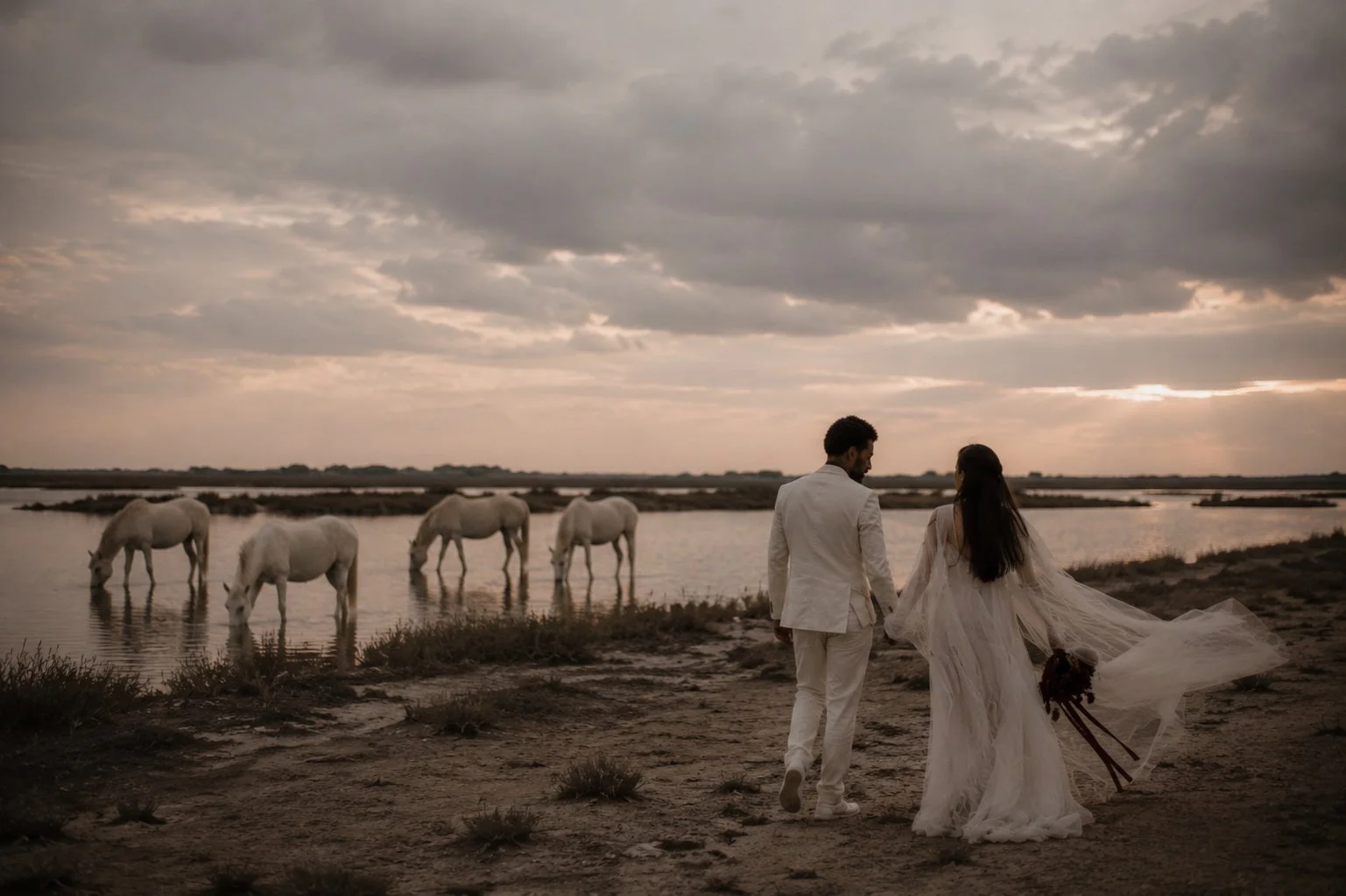
Luxury destination wedding in the Camargue, France.
A realistic overview of today’s French market
While every wedding photographer structures their collections a little differently, the French market broadly looks something like this. These aren’t official rates, of course. France has no Ministry of Wedding Photography quietly regulating the market.
€1,500–3,000: Emerging photographers, newer businesses, or smaller local celebrations.
€3,000–5,000: Established professionals with consistent experience, full-day coverage and a strong body of work.
€5,000–8,000: Experienced photographers with a distinctive artistic signature, a highly personalised approach and an established reputation.
€8,000–10,000+: Luxury wedding photographers working across France and internationally, often specialising in destination weddings, multi-day celebrations and a bespoke client experience.
Of course, there are exceptions.
There always are.
Photography has a stubborn habit of refusing to fit neatly into spreadsheets.
Fortunately.
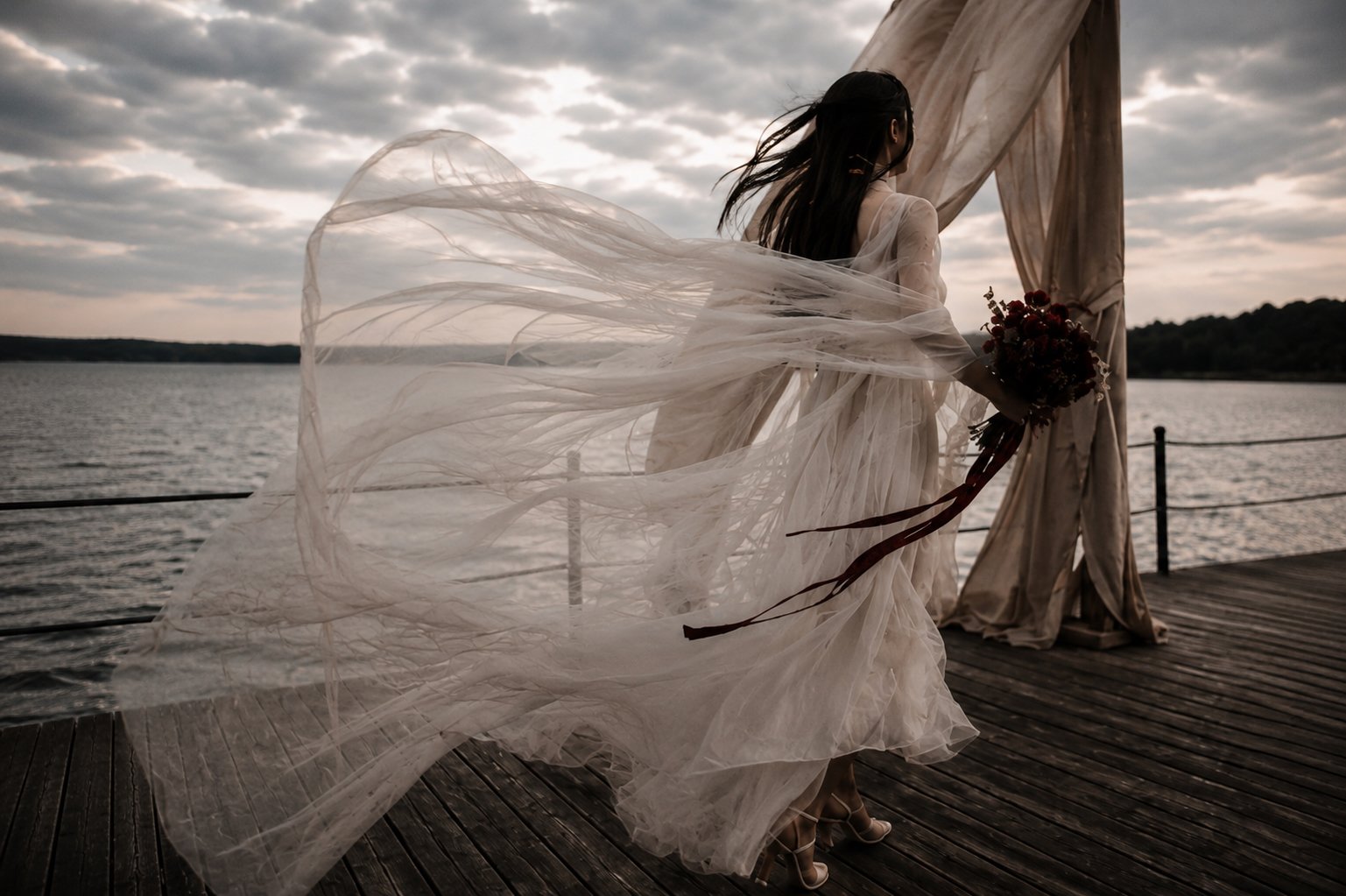
Editorial Fine art destination wedding photography in France.
There is another curious thing about wedding photography
Almost everyone believes they know how to judge it. Until they actually have to choose one.
A beautiful portrait is easy to recognise. Good light. A Loire Valley château behaving impeccably in the background. Perhaps a veil caught by the wind at exactly the right moment, as veils are contractually obliged to do on Instagram.
But a wedding is not one photograph.
It is twelve hours of changing light, changing moods, changing locations and, occasionally, changing plans.
It begins in a quiet bedroom with half-open suitcases, coffee going cold and someone looking for an earring that was definitely on the table five minutes ago.
It moves through ceremonies, family politics, a sudden Provençal thunderstorm, speeches running late, children refusing all reasonable cooperation and dance floors where elegant people make extremely questionable decisions after midnight.
A photographer has to make all of this look coherent.
Not identical. Coherent. That distinction matters.
The soft, luminous photographs from the morning should belong to the same story as a candlelit dinner beneath the plane trees in Provence, the flash-lit dancing and the moment someone’s uncle removes his tie and becomes, quite suddenly, the evening’s main character.
This is why judging a wedding photographer by a handful of carefully selected images can be misleading.
A portfolio shows you what a photographer can create at their best.
A full gallery shows you what they can create consistently.
A full gallery also shows you how they tell a story.
And consistency is where much of the value lies.
Can they photograph a beautiful suite at eleven in the morning and a crowded dance floor at eleven at night?
Can they work with sunlight, shade, rain, candlelight and the particular shade of green produced by emergency venue lighting?
Can they preserve the atmosphere without forcing every situation into the same visual formula?
Can they photograph the grandeur of a French château without losing the intimacy unfolding quietly inside it?
Can they make the wedding look beautiful without making it look as though nobody actually attended?
These are not especially glamorous questions.
They are, however, rather useful ones.
Because wedding photography is not simply the art of producing remarkable images when everything is perfect.
It is the art of producing a remarkable body of work when almost nothing remains perfect for very long.
And this is where price begins to make more sense.
You are not only paying for taste.
You are paying for judgement.
For the ability to decide, very quickly and very quietly, where to stand, what to notice, when to intervene and when to disappear.
Sometimes the most valuable decision a photographer makes is taking the photograph.
Sometimes it is not taking it.
Sometimes it is moving a chair.
Sometimes it is asking everyone to wait thirty seconds.
Sometimes it is quietly stepping back because the moment already belongs to the family, not to the camera.
Sometimes it is understanding that the mother of the bride needs a moment before anyone points a camera at her.
None of it appears on an invoice. Yet all of it quietly shapes the photographs you’ll treasure for the rest of your life.
The Camera Is the Least Interesting Part of Wedding Photography
This may be disappointing to anyone who enjoys discussing lenses over dinner, but expensive equipment does not automatically produce timeless wedding photographs. It merely produces technically capable files.
Which is useful. So is a reliable dishwasher. But neither is known for its emotional intelligence.
The camera cannot anticipate that a father will look away just before walking his daughter into the ceremony because he is trying not to cry.
It cannot sense that two siblings who have barely spoken all morning are about to embrace.
It cannot decide that the better photograph is not the perfectly arranged table, but the bride sitting beneath it five hours later, barefoot, laughing with her closest friend.
Equipment records. The photographer interprets.
That interpretation is what you are commissioning.
A way of noticing. A sense of timing. Visual culture. Emotional intelligence. An instinct for people.
And, ideally, the social intelligence not to turn your wedding into a twelve-hour editorial shoot simply because the wallpaper is attractive.
The finest wedding photography exists in a rather delicate place between control and chance.
Too little direction, and the couple may feel abandoned in front of the camera.
Too much, and the day begins to resemble a campaign for a perfume nobody has yet invented.
The photographer’s role is to shape what needs shaping and leave alone what is already alive.
That is often the difference between photographs that impress people today and photographs that still move them twenty years from now.
That balance takes experience. It also takes restraint.
Restraint rarely appears in a pricing guide.
It is, however, one of the most expensive skills a photographer ever learns.
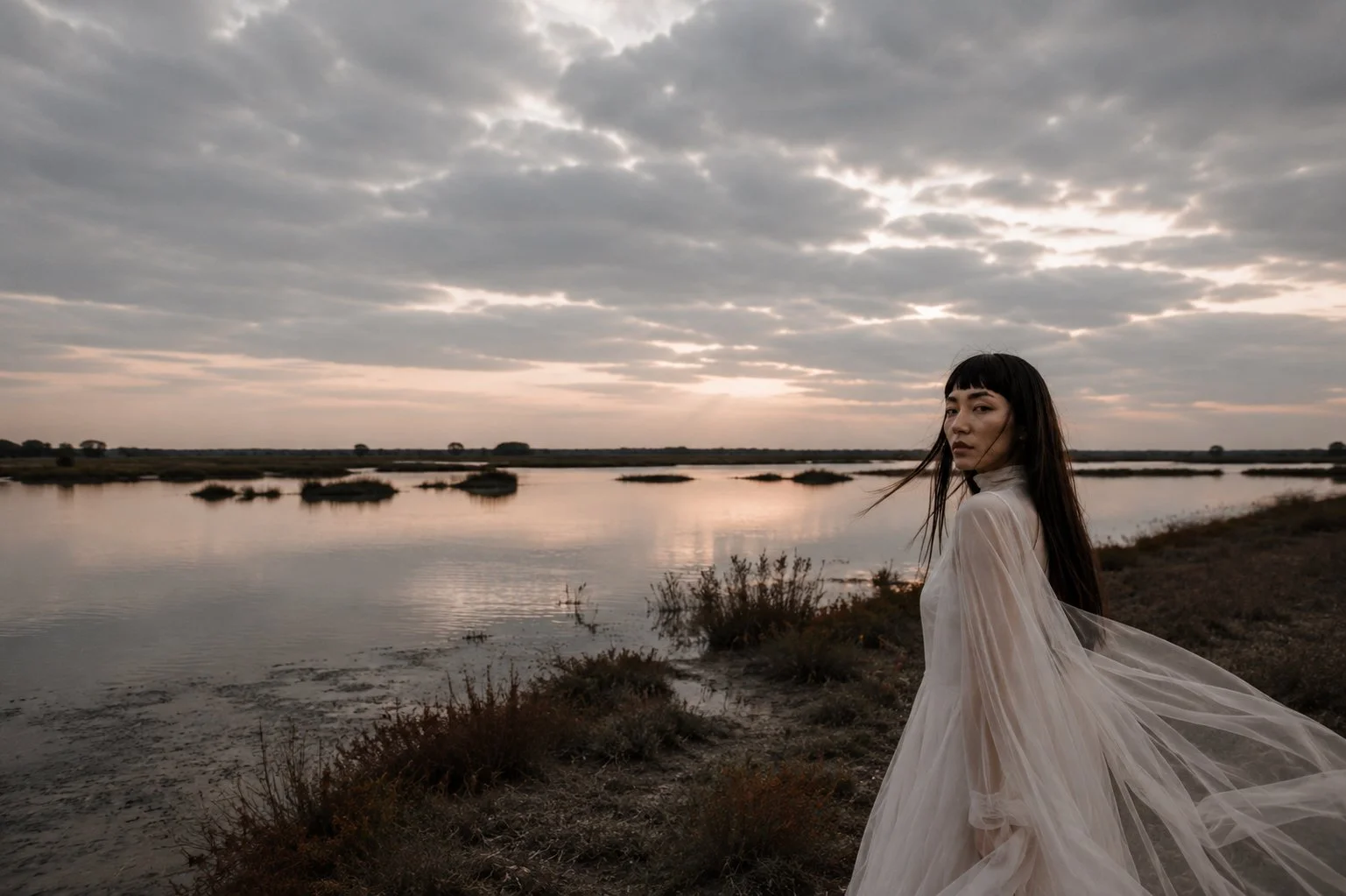
Sunset bridal portrait in the Camargue, France.
So what are you actually investing in?
Not merely coverage. Not merely files. And certainly not twelve hours of someone pressing a button with unusual enthusiasm.
You are investing in the person who will decide how your wedding is visually remembered.
And, whether you realise it or not, you are also placing your trust in them.
On your wedding day, you’ll spend more time with your photographer than with almost any other professional around you.
Long before the ceremony begins, they’ll quietly witness moments that few others ever see: quiet anticipation, nervous laughter, unexpected tears, the final deep breath before everything changes.
The more you trust them, the less aware you become of the camera.
And that is usually when the most honest photographs begin.
Because in the end, you’re not simply choosing someone whose photographs you admire.
You’re choosing someone whose presence allows you to forget, if only for a moment, that a camera is even there.
The person who will translate one complicated, emotional, beautifully imperfect day into a story that still makes sense years later. That is what the finest wedding photography quietly does.
That story will include the obvious moments.
The first look.
The ceremony.
The kiss.
The first dance.
But its real character will often be found elsewhere.
In the hand resting on a shoulder.
The friend watching from the doorway.
The lipstick mark left on a champagne coupe.
The exhausted flower girl asleep beneath a dinner table while the adults continue behaving as though midnight is a perfectly sensible time to begin another course.
These photographs rarely announce themselves as important. They become important later.
And perhaps that is the central misunderstanding around wedding photography.
Before the wedding, couples naturally compare prices. Afterwards, they discover value.
When people have changed. When families have grown. When someone in the photograph is no longer there.
When what once looked like a simple picture becomes evidence of a voice, a gesture, a relationship, an entire version of life.
Perhaps that’s a rather unusual thing to find in a pricing guide.
But it also happens to be the only honest place to begin.
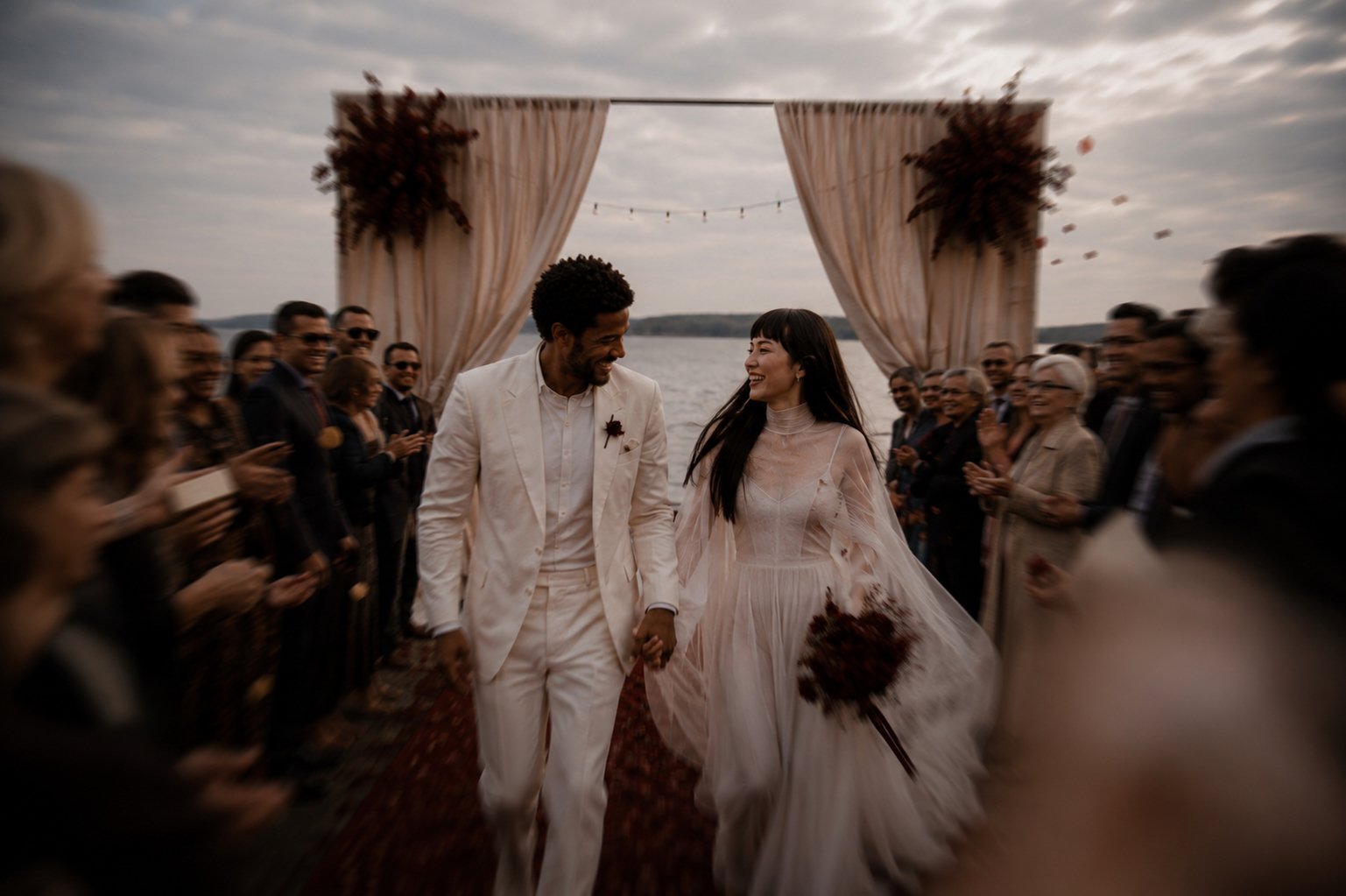
Joyful ceremony exit during a luxury destination wedding in France.
So… how much does wedding photography actually cost in France?
Let’s answer the question everyone came here for. The honest answer is: it depends.
The longer answer is considerably more interesting.
If you’re planning a wedding in France, you’ll generally find professional wedding photography ranging from around €1,500 to well over €10,000. Luxury wedding photographers in France typically begin around €8,000, particularly for destination weddings, multi-day celebrations and highly personalised commissions.
Wedding photography is one of the few creative professions where two people can appear to be offering almost exactly the same service while operating in completely different worlds.
Both photograph weddings.
Both deliver an online gallery.
Both own expensive cameras.
Yet one charges €2,000.
Another €8,000.
A third perhaps €15,000.
Who’s right? Probably all of them. The difficulty isn’t finding a price. It’s understanding what that price actually includes.
Because pricing in wedding photography isn’t determined by a universal rate card.
It reflects an entire ecosystem:
experience,
artistic signature,
reputation,
demand,
level of service,
the number of weddings accepted each year,
international travel,
post-production,
and, perhaps most importantly,
scarcity.
Luxury has always been surprisingly bad at being inexpensive.
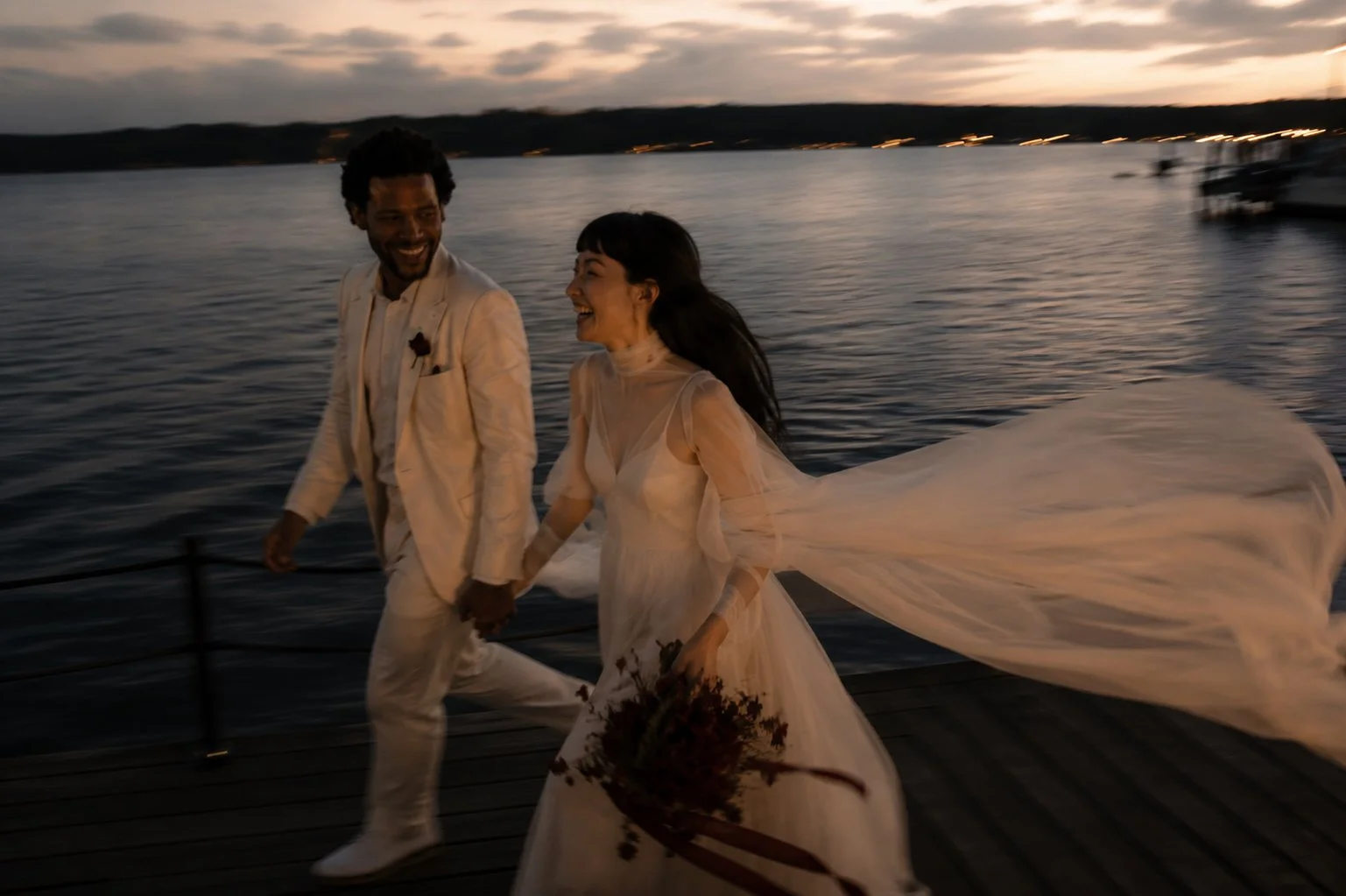
Bride and groom walking at sunset after a luxury destination wedding in the Camargue, photographed by a high-end wedding photographer in France.
Why the Same Wedding Can Cost Three Times as Much
Imagine three restaurants.
They all serve dinner.
One is a neighbourhood bistro.
One has a Michelin star.
One has a waiting list of six months.
Technically, they’re all serving food.
Yet nobody expects them to cost the same.
Luxury wedding photography in France works in much the same way.
You’re not only paying for the final photographs.
You’re paying for everything that made those photographs possible.
The years spent learning how light behaves inside a twelfth-century chapel.
The confidence to direct twenty impatient family members in under three minutes.
The ability to remain calm when dinner suddenly starts forty-five minutes late.
The judgement to know when to raise the camera… and when to leave it by your side. The experience to recognise the decisive moment before anyone else notices it.
That last one is surprisingly expensive.
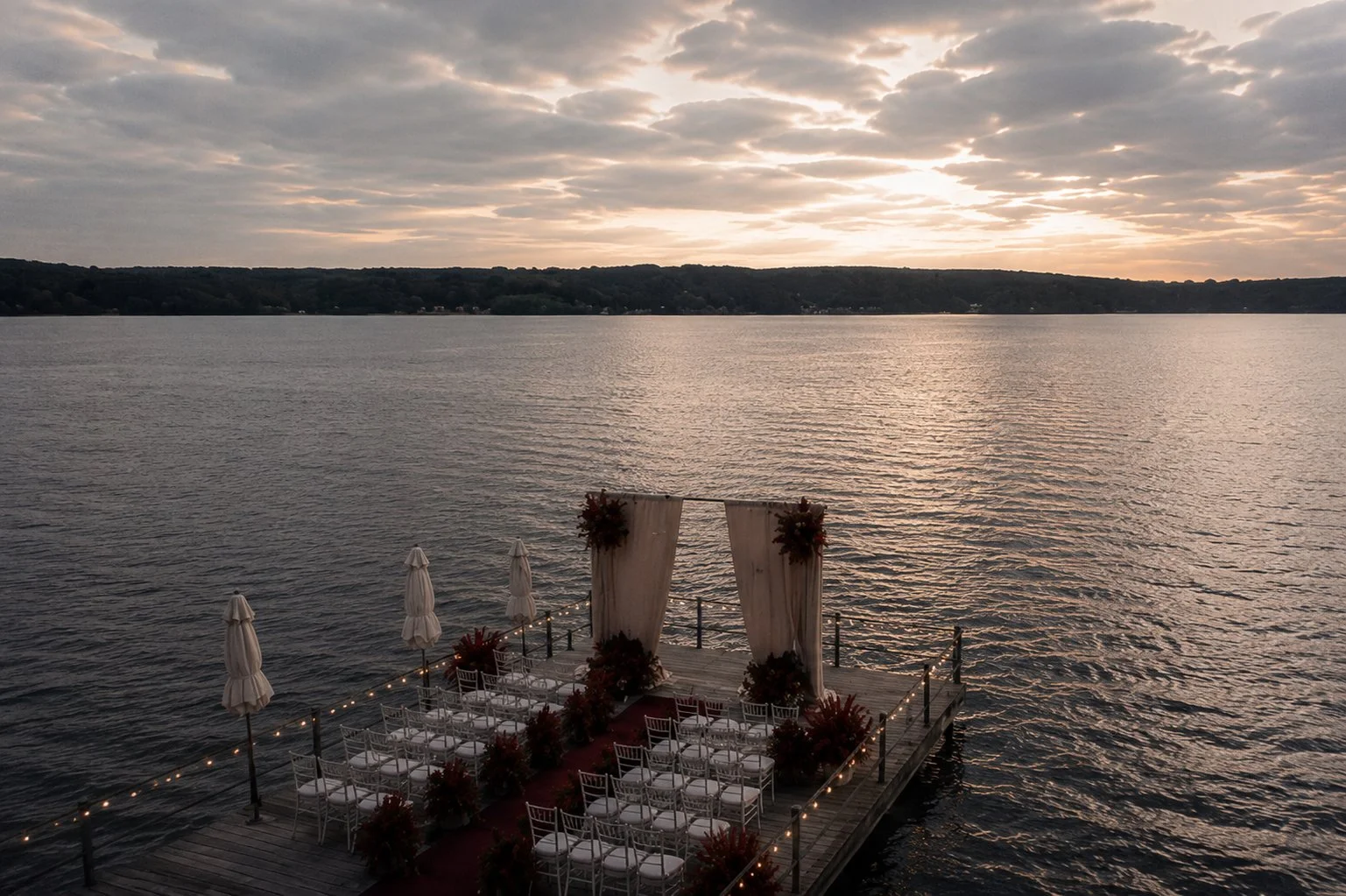
An intimate lakeside ceremony overlooking the water in the Camargue at sunset.
Luxury isn’t about more photographs.
It’s about fewer compromises.
One of the biggest misconceptions about luxury wedding photography is that it simply means receiving more images.
It doesn’t.
Nobody has ever looked back at their wedding and wished they’d received another eighty-seven photographs of the canapé service.
Luxury is something else entirely.
It means having enough time.
Enough preparation.
Enough experience.
Enough freedom.
Enough attention.
Enough trust.
Enough curiosity to keep noticing what everyone else has stopped seeing.
It means your photographer has the space to notice what everyone else is too busy living.
Because those unnoticed moments are usually the ones that become priceless later.
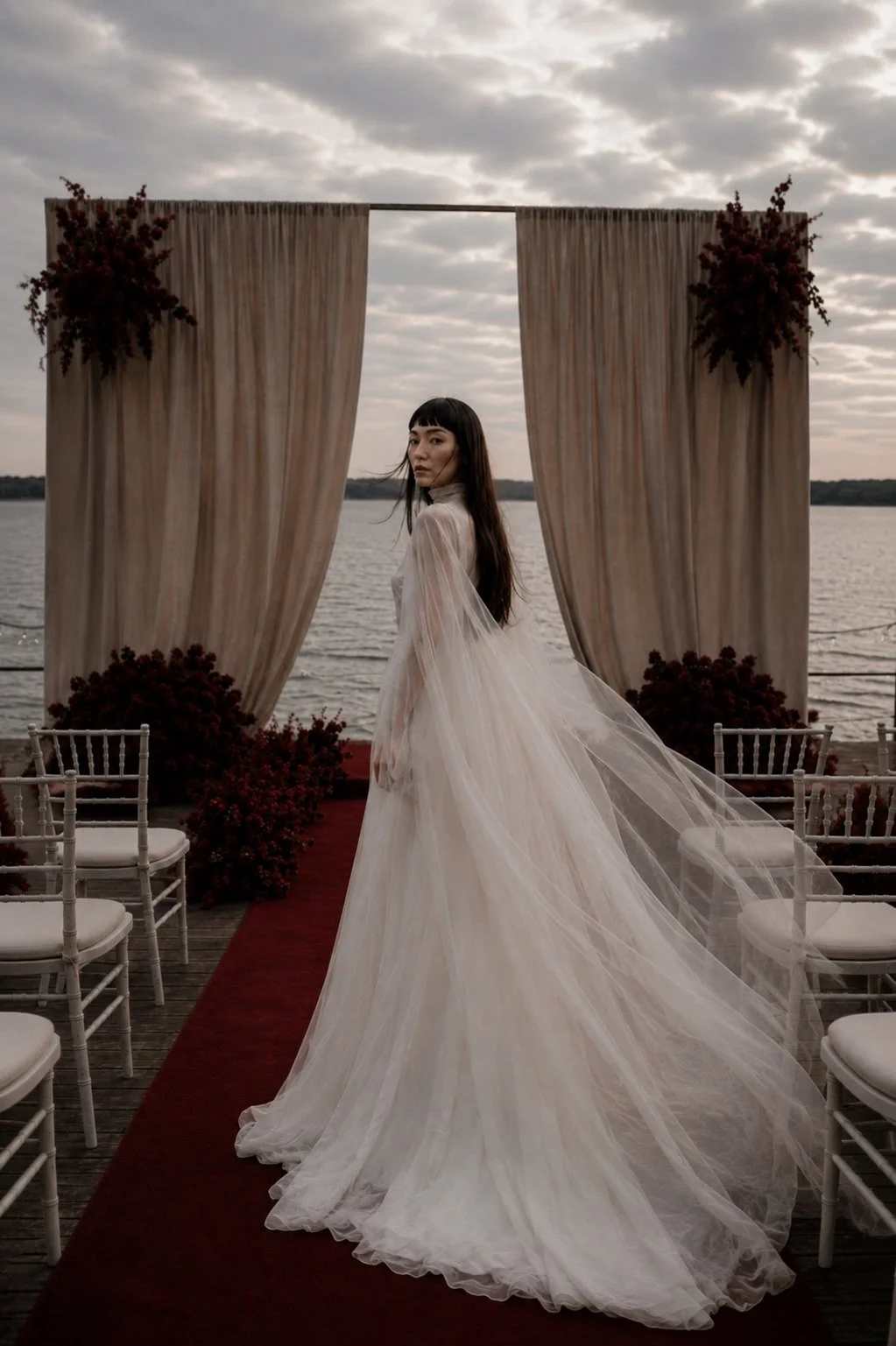
A timeless bridal portrait captured moments before a luxury destination wedding ceremony in the Camargue.
What You’re Really Paying For
There is a curious misconception surrounding luxury wedding photography.
People often assume the difference between a €2,500 photographer and a €10,000 photographer is mostly a question of talent.
It rarely is. Talent matters, of course.
But beyond a certain level, almost every established photographer understands light. They know how to compose an image. They know when to press the shutter.
The real difference lies elsewhere.
Luxury is built on countless decisions long before it becomes visible in the photographs.
The photographer who accepts forty weddings a year and the photographer who accepts twelve may both be exceptionally talented.
What differs is the way they choose to spend their time. One works at scale. The other works in depth.
Neither model is inherently right or wrong. They simply produce very different experiences.
Because the wedding day itself is only one chapter of the story.
Long before the first guest arrives, there have already been months of conversations.
Emails.
Video calls.
Timelines reviewed and revised.
Advice on the best light rather than simply the most fashionable location.
Conversations with planners.
Travel arrangements.
Equipment checks.
Back-up systems tested.
Insurance renewed.
Weather forecasts watched with perhaps slightly more attention than is entirely healthy.
And once the celebration is over, the work has only just begun.
Thousands of photographs are carefully reviewed.
Hundreds are colour graded one by one.
A narrative is constructed.
Not simply a gallery.
A story.
An album is designed.
Prints are checked.
Final details refined.
The wedding may have lasted twelve hours.
The commission often spans several weeks.
Sometimes several months.
Then comes something far more difficult to invoice.
Experience. Not experience measured in years. Experience measured in situations.
A ceremony that begins forty-five minutes late.
A veil that disappears five minutes before the bride walks down the aisle.
A summer thunderstorm that politely ignores the weather forecast.
A flower girl who refuses every form of negotiation.
A father who suddenly cannot speak during his speech.
A planner quietly solving three problems while smiling as though nothing has happened.
These things are not unusual.
They are weddings. The experienced photographer does not stop them from happening.
They simply know how to move through them without allowing the photographs to inherit the chaos.
That calm is invisible.
Until the moment it isn’t.
Luxury also buys something surprisingly rare today.
Time.
Not simply on the wedding day.
Before it.
After it.
Time to answer thoughtfully rather than quickly.
Time to notice details that others overlook.
Time to refine rather than merely deliver.
Time to discuss an album without looking at the clock.
Time, quite simply, to care.
Because care cannot be automated.
Nor outsourced.
Nor accelerated.
And perhaps most importantly, enough creative space to remain genuinely inspired.
Creativity rarely flourishes on an assembly line.
The photographers who choose to accept twelve weddings each year instead of forty are not necessarily more talented.
They have simply made a different decision.
To invest more deeply in fewer stories.
Luxury wedding photography has never really been about rushing from one wedding to the next.
It has always been about refusing to rush.
A beautifully crafted chair takes longer than a plastic one.
A bespoke suit takes longer than something bought on the high street.
An exceptional meal takes longer than fast food.
Why should wedding photography be any different?
Across today’s luxury wedding market, prices vary considerably.
They reflect reputation, artistic signature, experience, demand, geography, the complexity of the celebration and, perhaps above all, the amount of time a photographer chooses to devote to each couple.
Some photographers build businesses around volume.
Others deliberately photograph only a limited number of weddings each year, allowing themselves the freedom to invest more deeply in every commission.
Neither approach is universally better.
But they are fundamentally different business models.
Which is why asking, “How much does a wedding photographer cost?” is, in many ways, the wrong question.
A more revealing one might be:
How much time, attention, creativity and thought do I want someone to devote to preserving one of the most important days of my life?
Because, in the end, photographs are never really priced by the hour.
They are valued by everything that happened before the shutter was pressed…
…and everything that continues long after it.
Why Luxury Is Built on Scarcity
Luxury has always suffered from a public relations problem.
People tend to believe it begins with price.
It rarely does.
More often, it begins with limitation.
The world’s finest restaurants do not become exceptional because they serve the greatest number of guests.
Quite the opposite.
A Michelin-starred chef knows there is a point beyond which excellence begins to dilute.
Add too many tables, and something quietly disappears.
Precision.
Curiosity.
Attention.
The little details that nobody notices until they are no longer there.
Architecture works in much the same way.
No architect designs fifty remarkable private homes every year.
Not because they lack ambition.
Because thoughtful work has a natural capacity.
Luxury wedding photography belongs to that same family of crafts.
Not because it is rare.
Because genuine attention is.
Every couple deserves to feel as though theirs is the only wedding that matters.
That becomes surprisingly difficult if tomorrow’s celebration has already begun to occupy today’s thoughts.
This is why many photographers working at the highest level deliberately accept only a limited number of commissions each year.
Not to create artificial exclusivity.
Not to appear unattainable.
Simply because attention has limits.
And unlike camera equipment, attention cannot be upgraded every autumn.
It can only be divided.
Luxury has never really been about abundance.
It has almost always been about restraint.
The confidence to say,
“This is enough.”
Enough commissions.
Enough time.
Enough energy.
Enough care.
Enough space to do justice to each story.
There is, perhaps, one final irony.
In almost every industry, success is measured by growth.
Luxury often measures success differently.
Sometimes, the greatest privilege is not having more work.
It is having the freedom to choose your work carefully.
Because the rarest commodity in modern life is no longer money.
It is undivided attention.
And perhaps that is what couples are really investing in.
Not exclusivity.
Not prestige.
Not even photographs.
But the reassuring feeling that, for one extraordinary day, someone has chosen to give their complete attention to preserving the beginning of their family’s history.
“Luxury is not about being difficult to book.
It is about having enough time to care.”
The Only Price Nobody Talks About
There is one cost almost nobody considers while planning a wedding.
Not because it is insignificant.
Because it is impossible to calculate.
Before the wedding, every decision is judged in the present.
The flowers.
The menu.
The band.
The dress.
The photographer.
Everything is weighed against a budget, a spreadsheet or, occasionally, the opinion of a particularly vocal relative.
It is perfectly reasonable.
Weddings are expensive.
Choices have to be made.
Yet wedding photography behaves rather differently from almost everything else purchased that day.
The flowers begin fading before breakfast the following morning.
The champagne is forgotten.
Even the most extraordinary meal gradually becomes a story told over Christmas lunch.
Photographs follow another timeline entirely.
They appreciate.
Not financially.
Emotionally.
A photograph that feels beautiful a week after the wedding often feels profoundly different twenty years later.
Not because the photograph has changed.
Because life has.
Children begin asking questions.
Faces become younger every year.
Hairstyles become funnier.
Fashion somehow becomes elegant again.
People who once seemed permanently present are suddenly, unexpectedly, absent.
The photograph quietly accumulates meaning.
That is what makes it so unusual.
Very few things we buy become more valuable simply because time has passed.
Most possessions depreciate.
Cars.
Phones.
Furniture.
Even houses require constant care to preserve their value.
Photographs ask for remarkably little.
Simply to survive.
And if they do, they become something extraordinary.
Evidence.
Not merely of how a wedding looked.
But of how a family began.
Perhaps that is why, long before we care about jewellery, furniture or property, we find ourselves opening old family albums.
Trying to recognise faces.
Looking for familiar expressions.
Searching for ourselves in people we never had the chance to know.
No one asks how much those photographs cost.
The question has quietly disappeared.
The only thing that matters is that someone had the foresight to make them.
Seen from that perspective, the question changes one final time.
It is no longer: “How much does wedding photography cost?”
It becomes: “How do we want to be remembered?”
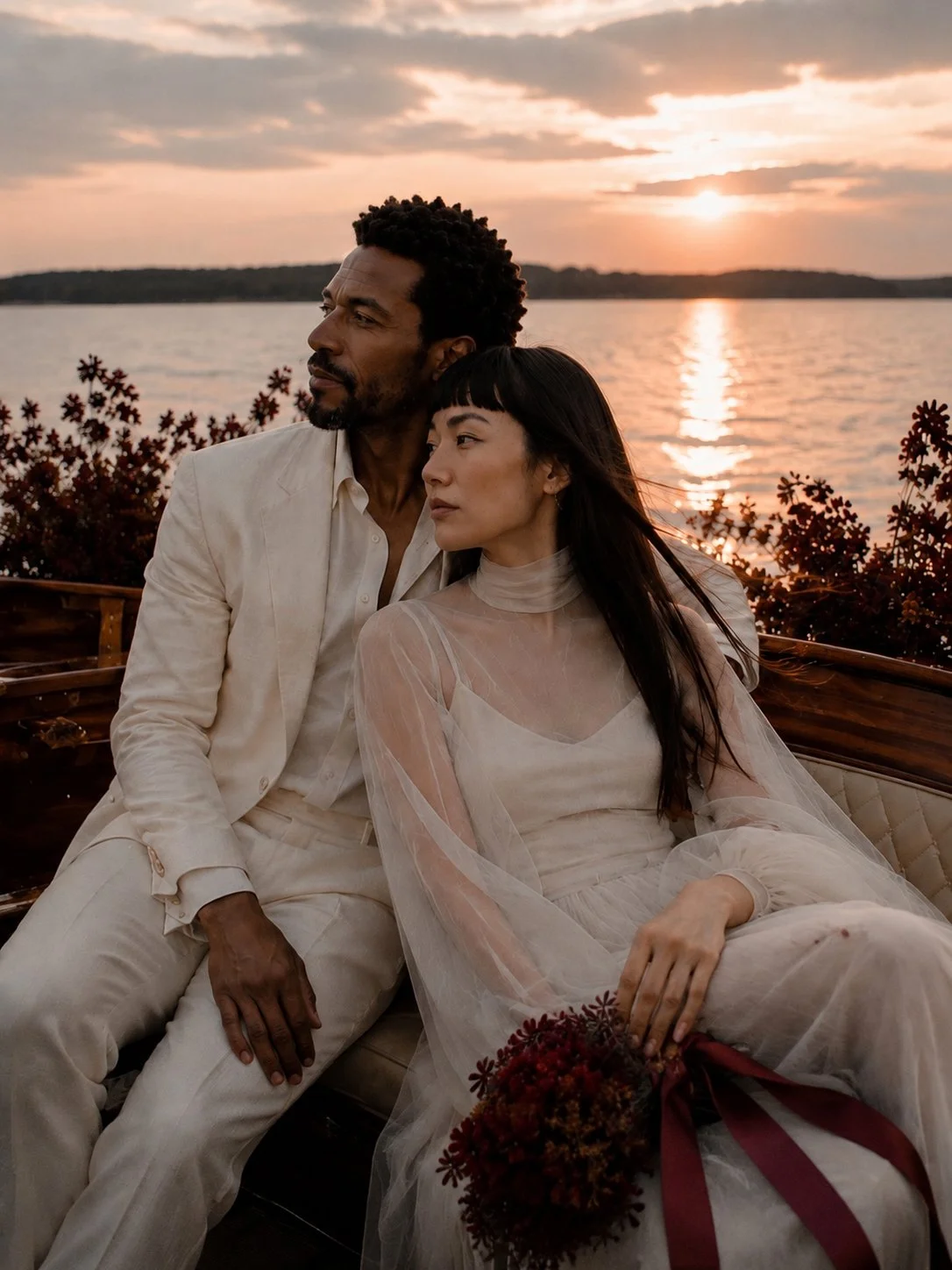
Sunset editorial portrait of a couple during a luxury destination wedding in the Camargue, France.
How to Read a Wedding Photographer’s Portfolio (and What Most Couples Miss)
There is another small trap waiting for almost every couple. It usually appears somewhere between Instagram and Pinterest.
It begins with a perfectly reasonable assumption: “If I like these photographs, I’ll probably like the photographer.”
Sometimes that’s true. Sometimes it isn’t.
Because choosing a wedding photographer based on ten beautiful images is a little like choosing a novelist after reading only the final chapter.
You know almost nothing. Every photographer has favourite images.
The extraordinary sunset.
The dramatic veil.
The perfect kiss.
The portrait that wins awards.
Those photographs absolutely deserve their place in a portfolio.
They simply don’t tell the whole story.
A wedding is not made of ten extraordinary moments.
It is made of hundreds of ordinary ones.
And photographing those ordinary moments beautifully is considerably harder.
Ask to See a Full Gallery
If there is one piece of advice I would give every couple, regardless of which photographer they eventually choose, it is this:
Ask to see at least one complete wedding. Not the highlights.
The entire story.
A complete gallery reveals things a portfolio never can.
It shows not only whether a photographer creates beautiful individual photographs, but whether they know how to tell a story.
Can they maintain the same level of quality from morning until midnight?
Do the family photographs feel natural?
Do the speeches still have atmosphere once daylight has disappeared?
Does the dance floor remain elegant without becoming chaotic?
Most importantly, does the gallery still feel coherent after eight hundred photographs?
Consistency is far more difficult than brilliance.
Brilliance happens occasionally. Consistency is a choice.
Look Beyond the Couple
Most portfolios are filled with beautiful couples.
As they should be.
But your wedding is unlikely to consist exclusively of the two of you.
Look instead at everyone else.
Parents.
Grandparents.
Children.
Friends.
How are they photographed?
Do they appear genuinely present?
Or simply decorative?
A wedding photographer is not documenting two people.
They are documenting an entire constellation of relationships.
Twenty years from now, those relationships may become the photographs you treasure most.
Pay Attention to Difficult Light
Beautiful sunshine is reassuring.
It is also remarkably cooperative.
The real test comes elsewhere.
A dark church.
A candlelit dinner.
Heavy rain.
A winter afternoon that disappears by four o’clock.
Almost every wedding eventually asks the photographer to solve a problem.
Those are the photographs worth examining.
Not because they need to be spectacular.
Because they reveal competence.
Anyone can create beautiful photographs when everything goes according to plan.
Professionals reveal themselves when nothing does.
Finally, Ask Yourself One Quiet Question
Not: “Are these beautiful photographs?”
That part is easy. Instead, ask yourself something slightly more personal.
“Can I imagine these photographs belonging to my family?”
Because photography is surprisingly intimate.
You’ll spend more time with your photographer than with almost anyone else on your wedding day.
You’ll invite them into moments that are joyful, emotional and sometimes vulnerable.
The way they observe people will quietly influence the way your memories are preserved.
Technical skill matters.
Experience matters.
Artistic style matters.
But trust matters just as much.
When those things come together, something rather wonderful happens.
You stop thinking about the photographer altogether.
And that, strangely enough, is usually when the most honest photographs begin.
When couples stop performing for the camera, they begin living the day.
That’s usually when the photographs become unforgettable.
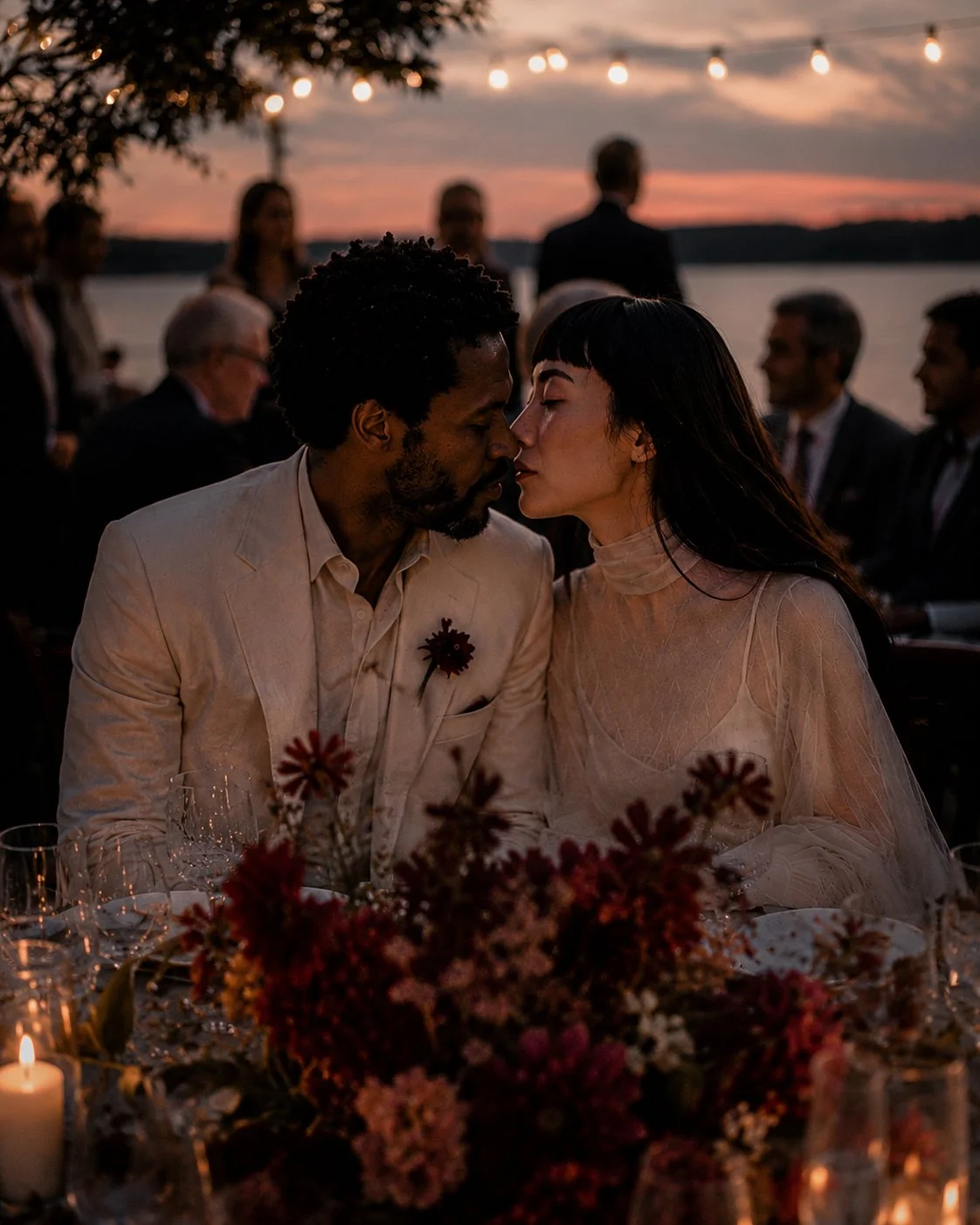
The value of a luxury wedding photographer lies in preserving intimate moments that cannot be recreated.
Frequently Asked Questions
A few practical answers for couples planning a luxury wedding in France.
-
Le texte dProfessional wedding photography in France generally ranges from around €1,500 to well over €10,000, depending on experience, reputation and the level of service provided. Most established photographers charge between €3,000 and €5,000 for full-day coverage, while luxury wedding photographers typically begin around €8,000 for highly personalised commissions, destination weddings or multi-day celebrations. Ultimately, the price reflects far more than the wedding day itself—it reflects the time, attention and expertise invested before and long after it.
-
Luxury wedding photography isn’t simply about receiving more photographs. It’s about receiving more attention. Photographers working at the highest level often accept only a limited number of weddings each year, allowing them to devote more time to preparation, communication, creative research, careful editing and a truly personalised experience. You’re investing not only in beautiful images, but also in experience, judgement, consistency and the reassurance that your memories are in trusted hands.
-
Every wedding is different, but for most celebrations, full-day coverage offers the most complete story between 10 and 12 hours. From the quiet moments of preparation to the energy of the evening celebrations, many of the most meaningful photographs happen between the events you’ve carefully planned. Rather than counting hours, it’s often more helpful to think about which memories you’ll want to revisit twenty years from now.
-
Instagram is an excellent place to discover photographers and understand their style, but it should never be the only factor in your decision. Social media naturally showcases a photographer’s strongest individual images. A complete wedding gallery reveals something much more valuable: consistency. Before making your choice, always ask to see at least one full wedding, from the morning preparations through to the evening celebration.
-
Most experienced wedding photographers begin accepting bookings 12 to 18 months in advance, particularly for popular weekends between May and September. If you’re planning a destination wedding in France or hoping to work with a photographer who accepts only a limited number of commissions each year, enquiring as early as possible will usually give you the greatest flexibility.
-
There isn’t a universal answer.
If you’ve worked with a photographer for years, or if they’re documenting several important moments in your family’s life, bringing them to France may be the right decision.
But if you’re travelling to France specifically because you fell in love with its architecture, its landscapes, its light and its atmosphere, there is another perspective worth considering.
A photographer who lives and works in France doesn’t simply know where the beautiful locations are.
They understand how French weddings unfold.
How the light moves through a Parisian apartment.
How a château feels at different times of the day.
How a Provençal village changes as evening falls.
How to work naturally with French planners, venues and suppliers.
Just as importantly, they understand something that is much harder to learn: cultural instinct.
You don’t acquire that by reading guidebooks or spending a few summers in France.
It’s built over years of living, observing and quietly absorbing the small details that make a place feel like itself.
Many international couples worry about language.
In reality, communication during a wedding is rarely about perfect grammar.
It’s about warmth.
Presence.
Empathy.
A reassuring smile.
A calm voice.
The ability to make people feel comfortable, even when they don’t share exactly the same language.
Photography has always been a remarkably visual language.
The artistic eye, emotional intelligence and the relationship you build together will almost always matter far more than speaking flawless English.
In the end, choose the photographer whose work moves you, whose presence reassures you and whose way of seeing the world feels closest to your own.
The language spoken on the day is rarely what your children and grandchildren will notice when they open the album years from now.
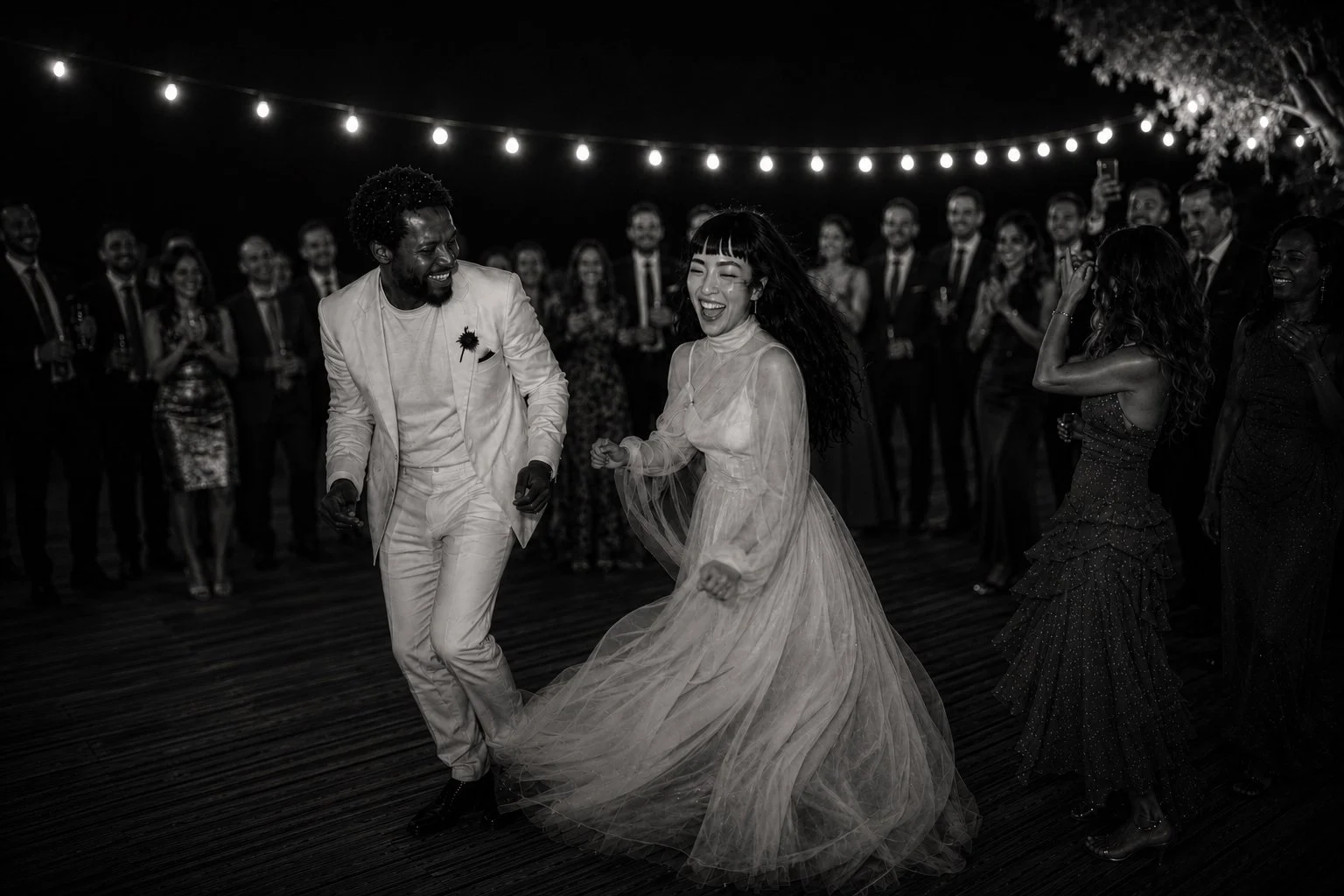
A joyful black-and-white moment during an elegant destination wedding celebration in the Camargue, France.
In the End
Perhaps we’ve been asking the wrong question all along.
Not: “How much does a wedding photographer cost?”
Nor even: “How many hours of coverage do we need?”
But something infinitely simpler. Who do we trust to remember this day for us?
Because memory is a curious thing. It edits. It softens. It exaggerates.
It quietly rearranges the past until stories become smoother than they really were.
Photographs do something rather different. They anchor memory.
They remind us not only of what happened, but of how it felt.
A glance exchanged across a crowded room.
A hand instinctively reaching for another.
The laughter that interrupted a speech.
The silence just before a ceremony began.
These moments rarely seem extraordinary while they are happening.
Life has a habit of disguising its most precious memories as ordinary afternoons.
Only time reveals what mattered.
Perhaps that is why wedding photography is so difficult to value in the present.
Its true worth belongs almost entirely to the future.
One day, many years from now, the flowers will exist only in photographs.
The music will have faded into memory.
The menu will have been forgotten.
Even the dress will spend far more time in a wardrobe than it ever did on a dance floor.
But the photographs will quietly continue doing what they have always done. They will remember.
Not simply how everything looked. But who everyone was.
And perhaps that is the greatest privilege of all. To create something that will outlive the celebration itself.
Something that will one day belong not only to you, but to the people who come after you.
The price will have long been forgotten. The photographs won’t.
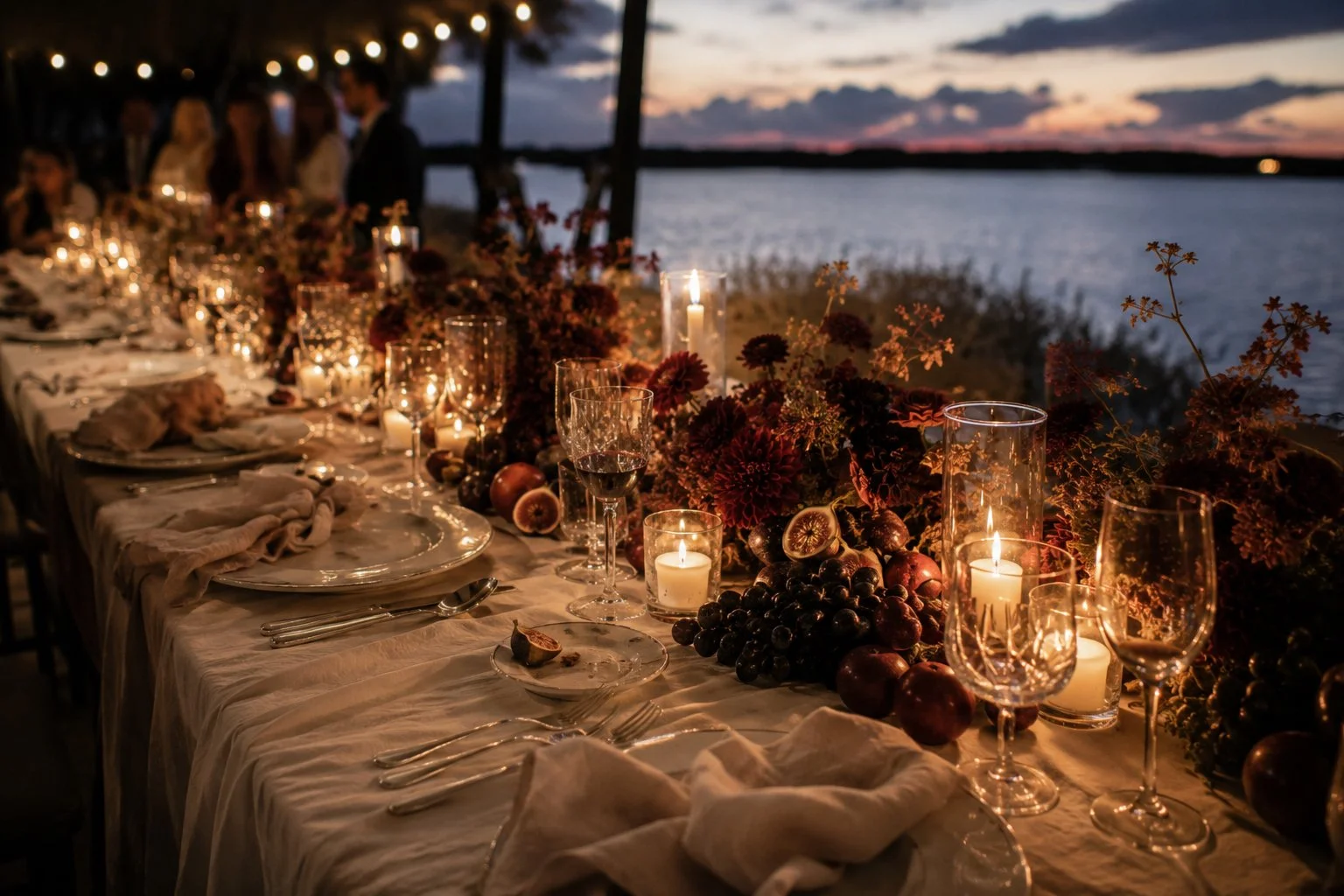
Luxury is often found in the atmosphere rather than in extravagance. A candlelit dinner by the water, where every detail quietly contributes to the memory.
If this article has helped you look at wedding photography a little differently, then it has already done what I hoped it would.
And if, somewhere along the way, you felt that my way of seeing the world resonates with yours…
Whether you’re planning an intimate celebration in Paris, a château wedding in the Loire Valley, a weekend in Provence, the French Riviera or somewhere far more unexpected, I’d be delighted to discover what you’re dreaming up together.
If it feels like the right fit, perhaps we’ll create something timeless.